Elephant Seal
Elephant seals are large, oceangoing seals in the genus Mirounga. There are two species: the Northern Elephant Seal (M. angustirostris) and the Southern Elephant Seal (M. leonina). Both were hunted to the brink of extinction by the end of the nineteenth century, but numbers have since recovered. The Northern Elephant Seal, somewhat smaller than its southern relative, ranges over the Pacific coast of the U.S., Canada and Mexico. The most northerly breeding location on the Pacific Coast is at Race Rocks, at the southern tip of Vancouver Island in the Strait of Juan de Fuca. The Southern Elephant Seal is found in the southern hemisphere on islands such as South Georgia, Macquarie Island, and on the coasts of New Zealand, South Africa, and Argentina in the Peninsula Valdés, which is the fourth largest elephant seal colony in the world.
Elephant seals take their name from the large proboscis of the adult males (bulls) which resembles an elephant's trunk. The bull's proboscis is used in producing extraordinarily loud roaring noises, especially during the mating season. More importantly, however, the nose acts as a sort of rebreather, filled with cavities designed to reabsorb moisture from the animals' exhalations. This is important during the mating season when the male seals rarely leave the beach to feed and therefore must conserve body moisture as they have no incoming source of water. Bulls of both the Northern Elephant Seal and the Southern Elephant Seal reach a length of 16 ft (5 m) and a weight of 6,000 lb (2,700 kg) and are much larger than the cows, which typically measure about 10 ft (3 m) and 1,900 lb (900 kg). The largest known bull elephant seal weighed 11,000 lb (5,000 kg) and measured 22.5 ft (6.9 m) in length. This makes the elephant seal the largest member of the order Carnivora.
Snakeheads
Snakeheads (Channidae) are a family of freshwater fish native to Africa and Asia. These predatory fish are distinguished by a long dorsal fin, large mouth and shiny teeth. They have a physiological need to breathe atmospheric air, which they do with a suprabranchial organ: a primitive form of a labyrinth organ. There are two extant genera, Channa in Asia, and Parachanna in Africa, consisting of 30-35 species.
They are considered valuable food fish. Called Ca Loc, ca Qua, or Ca Chuoi in Vietnamese, it is prized in clay pot dishes and pickled preparations. Larger species like Channa striata, Channa maculata, and Parachanna obscura are farmed in aquaculture. Snakeheads feed on plankton, aquatic insects, and molluskscarp, or frogs. In rare cases, small mammals such as rats are taken. The size of the snakehead species differs greatly. "Dwarf snakeheads" like when small. When adult, they mostly feed on other fish like Channa gachua grow to 10 inches (25 cm). Most snakeheads grow up to 2 or 3 feet (60–90 cm). Only two species (Channa marulius and Channa micropeltes) can reach a length of more than 1 meter and a weight of more than 6 kg.
It is illegal to keep snakeheads as pets in all states of the U.S. and other countries as they have become an invasive species due to individuals releasing them into the wild. In the U.S., National Geographic referred to snakeheads as "Fishzilla."
When the Snakehead eats it is a thrust predator. It will eat its prey all at once, striking and ingesting it whole.
The giant snakehead (Channa micropeltes) is native throughout Asia, and is the most aggressive Snakehead. They can grow to around 1 meter in length. Adult Snakeheads force their young to breathe air by pushing them to the surface.
From 2002 to 2003, one Los Angeles supermarket was found to have sold approximately 25,000 dollars worth of illegal live Snakeheads which caused breakouts in local ecosystems.
Amphipods
Amphipoda is an order of malacostracan crustaceans with no carapace and generally with laterally compressed bodies. The name amphipoda means "different-footed", and refers to the different forms of appendages, unlike isopods, where all the legs are alike. Of the 7,000 species, 5,500 are classified into one suborder, Gammaridea. The remainder are divided into two or three further suborders. Amphipods range in size from 1 to 340 millimetres (0.039 to 13 in) and are mostly detritivores or scavengers. They live in almost all aquatic environments; 750 species live in caves and the order also includes terrestrial animals and sandhoppers such as Talitrus saltator.
Amphipods are typically less than 10 millimetres (0.39 in) long, but the largest recorded living amphipods were 28 centimetres (11 in) long, and were photographed at a depth of 5,300 metres (17,400 ft) in the Pacific Ocean. Samples from the Atlantic Ocean with a reconstructed length of 34 centimetres (13 in) have been assigned to the same species, Alicella gigantea. The smallest known amphipods are less than 1 millimetre (0.04 in) long. The size of amphipods is limited by the availability of dissolved oxygen, such that the amphipods in Lake Titicaca at an altitude of 3,800 metres (12,500 ft) can only grow up to 22 millimetres (0.87 in), compared to lengths of 90 millimetres (3.5 in) in Lake Baikal at 455 metres (1,500 ft).
Amphipods are found in almost all aquatic environments, from fresh water to water with twice the salinity of sea water. They are almost always an important component of aquatic ecosystems. Most species in the suborder Gammaridea are epibenthic, although they are often collected in plankton samples. Members of the Hyperiidea are all planktonic and marine. Many are symbionts of gelatinous animals, including salps medusae, siphonophores, colonial radiolarians and ctenophores, and most hyperiids are associated with gelatinous animals during some part of their life cycle.
Compared to other crustacean groups, such as the Isopoda, Rhizocephala or Copepoda, relatively few amphipods are parasitic on other animals. The most notable example of parasitic amphipods are the whale lice (family Cyamidae); unlike other amphipods, these are dorso-ventrally flattened, and have large, strong claws, with which they attach themselves to baleen whales. They are the only parasitic crustaceans which cannot swim during any part of their life cycle.
Related Articles :
Pram Bug and
Sandhopper
Wels Catfish
The wels catfish (pronounced /ˈwɛls/ or /ˈvɛls/; Silurus glanis), also called sheatfish, is a large catfish found in wide areas of central, southern, and eastern Europe, and near the Baltic and Caspian Seas. It is a scaleless fresh and brackish water fish recognizable by its broad, flat head and wide mouth. Wels catfish can live for at least thirty years and have very good hearing.
The wels catfish lives on annelid worms, gastropods, insects, crustaceans, and fish; the larger ones also eat frogs, mice, rats and aquatic birds such as ducks.
The wels catfish lives in large, warm lakes and deep, slow-flowing rivers. It prefers to remain in sheltered locations such as holes in the riverbed, sunken trees, etc. It consumes its food in the open water or on the bottom, where it can be recognized by its large mouth. Wels catfish are kept in fish ponds as food fish.
Wels catfish's mouth contains lines of numerous small teeth, two long barbels on the upper jaw and four shorter barbels on the lower jaw. It has a long anal fin that extends to the caudal fin, and a small sharp dorsal fin positioned relatively far forward. It uses its sharp pectoral fins to capture prey. With these fins, it creates an eddy to disorient its victim, which it then simply engulfs in its enormous throat. It has very slippery green-brown skin. Its belly is pale yellow or white. Colour varies with environment. Clear water will give the fish a black coloration while muddy water will often tend to produce brownish specimens. Weight and length are not correlated linearly, and also depend on the season.
Algae Blooms
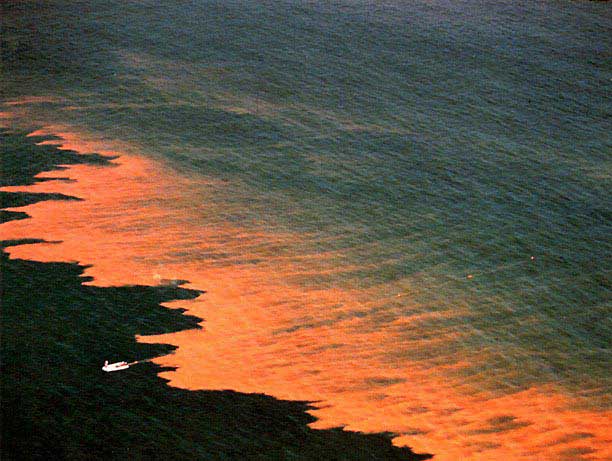
An algal bloom is a rapid increase or accumulation in the population of algae in an aquatic system. Algal blooms may occur in freshwater as well as marine environments. Typically, only one or a small number of phytoplankton species are involved, and some blooms may be recognized by discoloration of the water resulting from the high density of pigmented cells. Although there is no officially recognized threshold level, algae can be considered to be blooming at concentrations of hundreds to thousands of cells per milliliter, depending on the severity. Algal bloom concentrations may reach millions of cells per milliliter. Algal blooms are often green, but they can also be other colors such as yellow-brown or red, depending on the species of algae.
Bright green blooms are a result of blue-green algae, which are actually bacteria (cyanobacteria). Blooms may also consist of macroalgal, not phytoplankton, species. These blooms are recognizable by large blades of algae that may wash up onto the shoreline.
Of particular note are harmful algal blooms (HABs), which are algal bloom events involving toxic or otherwise harmful phytoplankton such as dinoflagellates of the genus Alexandrium and Karenia. Such blooms often take on a red or brown hue and are known colloquially as red tides.
In the marine environment, single-celled, microscopic, plant-like organisms naturally occur in the well-lit surface layer of any body of water. These organisms, referred to as phytoplankton or microalgae, form the base of the food web upon which nearly all other marine organisms depend. Of the 5000+ species of marine phytoplankton that exist worldwide, about 2% are known to be harmful or toxic. Blooms of harmful algae can have large and varied impacts on marine ecosystems, depending on the species involved, the environment where they are found, and the mechanism by which they exert negative effects.
Harmful algal blooms have been observed to cause adverse effects to varying species of marine mammals and sea turtles, with each presenting specific toxicity-induced reductions in developmental, immunological, neurological, and reproductive capacities. A mass mortality event of 107 bottlenose dolphins occurred along the Florida panhandle in the spring of 2004 due to ingestion of contaminated menhaden with high levels of brevetoxin. Manatee mortalities have also been attributed to brevetoxin but unlike dolphins, the main toxin vector was endemic seagrass species (Thalassia testudinum) in which high concentrations of brevetoxins were detected and subsequently found as a main component of the stomach contents of manatees.
Related Articles :
Dead Zones
Stellar's Sea Cow
Steller's sea cow (Hydrodamalis gigas) was a large herbivorous marine mammal. In historical times, it was the largest member of the order Sirenia, which includes its closest living relative, the dugong (Dugong dugon), and the manatees (Trichechus spp.). Formerly abundant throughout the North Pacific, its range was limited to a single, isolated population on the uninhabited Commander Islands by 1741 when it was first described by Georg Wilhelm Steller, chief naturalist on an expedition led by explorer Vitus Bering. Within 27 years of discovery by Europeans, the slow moving and easily captured Steller's sea cow was hunted to extinction.
The sea cow grew at least 8 metres (26 ft) to 9 meters or 30 feet long, much larger than the manatee or dugong. Steller's work contains two contradictory weights: 4 and 24.3 tons. The true value probably lies between these figures, around 8-10 tons. It looked somewhat like a large seal, but had two stout forelimbs and a whale-like tail and the fluke. According to Steller, "The animal never comes out on shore, but always lives in the water. Its skin is black and thick, like the bark of an old oak…, its head in proportion to the body is small…, it has no teeth, but only two flat white bones—one above, the other below". It was completely tame, according to Steller. They fed on a variety of kelp. Wherever sea cows had been feeding, heaps of stalks and roots of kelp were washed ashore. The sea cow was also a slow swimmer and apparently was unable to submerge.
The population of sea cows was small and limited in range when Steller first described them. Steller said they were numerous and found in herds, but zoologist Leonhard Hess Stejneger later estimated that at discovery there had been fewer than 1,500 remaining, and thus had been in immediate danger of extinction from overhunting by humans. They were quickly wiped out by the sailors, seal hunters, and fur traders that followed Bering's route past the islands to Alaska, who hunted them both for food and for their skins, which were used to make boats. They were also hunted for their valuable subcutaneous fat, which was not only used for food (usually as a butter substitute), but also for oil lamps because it did not give off any smoke or odor and could be kept for a long time in warm weather without spoiling. By 1768, 27 years after it had been discovered by Europeans, Steller's sea cow was extinct.
Fossils indicate that Steller's sea cow was formerly widespread along the North Pacific coast, reaching south to Japan and California. Given the rapidity with which its last population was eliminated, it is likely that aboriginal hunting caused its extinction over the rest of its original range (aboriginal peoples apparently never inhabited the Commander Islands).
Archerfish
The archerfish (Spinner Fish or Archer Fish) are a family (Toxotidae) of fish known for their habit of preying on land based insects and other small animals by literally shooting them down with water droplets from their specialized mouths. The family is small, consisting of seven species in the genus Toxotes; which typically inhabit brackish waters of estuaries and mangroves, but can also be found in the open ocean as well as far upstream in fresh water in India to the Philippines, Australia, and Polynesia.
Archerfish or Spinnerfish bodies are deep and laterally compressed, with the dorsal fin set far back, and the profile a straight line from dorsal fin to mouth. The mouth is protractile, and the lower jaw juts out. Sizes are generally small,about 5–10 cm but T. chatareus can reach 40 centimetres (16 in).
Archerfish are remarkably accurate in their shooting; adult fish almost always hit the target on the first shot. They can bring down an insect that includes grasshoppers, spiders and butterflies on a branch overhanging the water, 3 m above the water's surface. This is partially due to their good eyesight, but also their ability to compensate for the refraction of light as it passes through the air water interface when aiming for their prey. They typically spit at prey at a mean angle of about 74 degrees from the horizontal, but can still aim accurately when spitting at angles between 45 and 110 degrees.
When an archerfish selects its prey, it rotates its eye so that the image of the prey falls on a particular portion of the eye in the ventral temporal periphery of the retina and its lips just break the surface, squirting a jet of water at its victim. It does this using the narrow groove in the roof of its mouth. It presses its tongue against this groove to form a narrow channel, then contracts its gill covers to force a powerful jet of water through the channel. The resulting jet of water can be up to 2–5 m long, but their accuracy only allows them to shoot insects 1–2 m away depending on body size. The fish can alter the power of the shot for prey of different sizes. If the first shot does not knock the victim into the water, the archerfish will keep trying.
Archerfish will often leap out of the water and grab an insect in their mouth if it happens to be within reach. Individuals typically prefer to remain close to the surface of the water.