Ambergris occurs as a biliary secretion of the intestines of the sperm whale and can be found floating upon the sea, or in the sand near the coast. It is also sometimes found in the abdomens of whales. Because the beaks of giant squids have been found embedded within lumps of ambergris, scientists have theorized that the substance is produced by the whale's gastrointestinal tract to ease the passage of hard, sharp objects that the whale might have eaten.
Ambergris is found in lumps of various shapes and sizes, weighing from 15 g (½ oz) to 50 kg (100 pounds) or more. When initially expelled by or removed from the whale, the fatty precursor of ambergris is pale white in color (sometimes streaked with black), soft, with a strong fecal smell. Following months to years of photo-degradation and oxidation in the ocean, this precursor gradually hardens, developing a dark gray or black color, a crusty and waxy texture, and a peculiar odor that is at once sweet, earthy, marine, and animalic. Its smell has been generally described as a vastly richer and smoother version of isopropanol without its stinging harshness.
Ambergris has been mostly known for its use in creating perfume and fragrance much like musk. While perfumes can still be found with ambergris around the world, American perfumers usually avoid it because of legal ambiguities. It was banned from use in many countries in the 1970s, including the United States, because its precursor originates from the sperm whale, which is an endangered species. However, it has been legal since 2005 because of strict monitoring of distributors who ensure that only ambergris that has been naturally washed to shore is sold. Ancient Egyptians burned ambergris as incense, while in modern Egypt ambergris is used for scenting cigarettes. The ancient Chinese called the substance "dragon's spittle fragrance". During the Black Death in Europe, people believed that carrying a ball of ambergris could help prevent them from getting the plague. This was because the fragrance covered the smell of the air which was believed to be the cause of plague.
This substance has also been used historically as a flavouring for food, and some people consider it an aphrodisiac. During the Middle Ages, Europeans used ambergris as a medication for headaches, colds, epilepsy, and other ailments.
Source
Ommatokoita elongata
Ommatokoita elongata is a parasitic copepod, approximately 5 cm in length (almost 2 inches) with a very specific and truly cringe-worthy preference about where it attaches on to the host. The adult female copepod attaches herself to the shark's eye with an anchoring structure call the bulba, and grazes on the surface of the cornea (see photo, black arrow indicates attachment point), hanging off the eyes of the shark like a grotesque tassle.
There are two possible reasons for the copepod's attachment site. Shark skin is covered in microscopic, teeth-like structures call denticles which can make it difficult for parasites to attach themselves to skin (though some species of parasitic copepods manage). Secondly the eye is considered to be a "immunologically benign environment" for parasites, thus such an attachment is less likely to illicit an immune response.
While the parasite can cause significant damage to the cornea and result in blindness for the host, most sharks seem unaffected by the presence of the parasite and many sharks have the copepod in both eyes, strangely enough. This goes to show when considering the virulence (harmfulness of a parasite to its host) of a parasite, it is worth taking into account the perspective of the host involved - what may seem debilitating to us may not necessarily be the case for the actual organism in question.
Globster
A globster, or blob, is an unidentified organic mass that washes up on the shoreline of an ocean or other body of water. The term was coined by Ivan T. Sanderson in 1962 to describe the Tasmanian carcass of 1960, which was said to have "no visible eyes, no defined head, and no apparent bone structure". A globster is distinguished from a normal beached carcass by being hard to identify, at least by initial untrained observers, and by creating controversy as to its identity.
Globsters may present such a puzzling appearance that their nature remains controversial even after being officially identified by scientists. Some globsters lack bones or other recognisable structures, while others may have bones, tentacles, flippers, eyes or other features that can help narrow down the possible species. In the past these were often described as sea monsters, and myths and legends about such monsters may often have started with the appearance of a globster. Globsters are most frequently studied in the field of cryptozoology.
Many globsters have initially been described as gigantic octopuses, although they later turned out to be the decayed carcasses of whales or large sharks. As with the "Chilean Blob" of 2003, many are masses of whale blubber released from decaying whale corpses. Others initially thought to be dead plesiosaurs later turned out to be the decayed carcases of basking sharks. Others remain unexplained. Giant and colossal squid may also explain some globsters, particularly those tentatively identified as monster octopuses.
Some globsters have been examined only after they had decomposed too much to be used as evidence for a new species, or have been destroyed, as happened with the famous "Cadborosaurus willsi" carcass, found in 1937. However, Canadian scientists did in fact perform a DNA analysis of the Newfoundland Blob that indicated the tissue was from a sperm whale. In their resulting paper, the authors point out a number of superficial similarities between the Newfoundland Blob and other famous globsters, concluding a similar origin for those globsters is likely. Analyses of other globsters have yielded similar results.
Sea Lice
Sea louse (plural sea lice) are copepods within the order Siphonostomatoida, family Caligidae. There are 36 genera within this family which include approximately 42 Lepeophtheirus and 300 Caligus species. Sea lice are marine ectoparasites (external parasites) that feed on the mucus, epidermal tissue, and blood of host marine fish. This article focuses on the genera Lepeophtheirus and Caligus which parasitize marine fish, in particular those species that have been recorded on farmed salmon. Lepeophtheirus salmonis and various Caligus species are adapted to saltwater and are major ectoparasites of farmed and wild Atlantic salmon. Several antiparasitic drugs have been developed for control purposes. Since L. salmonis is the major sea louse of concern and has the most known about its biology and interactions with its salmon host, this review will focus on this species. Caligus rogercresseyi has become a major parasite of concern on salmon farms in Chile, and studies are under way to gain a better understanding of the parasite and the host-parasite interactions. Recent evidence is also emerging that L. salmonis in the Atlantic has sufficient genetic differences from L. salmonis from the Pacific, suggesting that Atlantic and Pacific L. salmonis may have independently co-evolved with Atlantic and Pacific salmonids, respectively.
Most of our understanding of the biology of sea lice, other than the early morphological studies, is based on laboratory studies designed to understand issues associated with sea lice infecting fish on salmon farms. Information on sea lice biology and interactions with wild fish is unfortunately sparse in most areas with a long-term history of open net-cage development, since understanding background levels of sea lice and transfer mechanisms have rarely been a condition of tenure license for farm operators.
Many sea louse species are specific with regards to host genera, for example L. salmonis which has high specificity for salmonids, including the widely farmed Atlantic salmon (Salmo salar). Lepeophtheirus salmonis can parasitize other salmonids to varying degrees, including brown trout (sea trout: Salmo trutta), arctic char (Salvelinus alpinus), and all species of Pacific salmon. In the case of Pacific salmon, coho, chum, and pink salmon (O. kisutch, O. keta, and O. gorbuscha, respectively) mount strong tissue responses to attaching L. salmonis, which lead to rejection within the first week of infection. Pacific L. salmonis can also develop, but not complete, its full life cycle on the three-spined stickleback (Gasterosteus aculeatus L.). This has not been observed with Atlantic L. salmonis.
Great Pacific Garbage Patch
The Great Pacific Garbage Patch, also described as the Pacific Trash Vortex, is a gyre of marine litter in the central North Pacific Ocean located roughly between 135° to 155°W and 35° to 42°N. The patch extends over a very wide area, with estimates ranging from an area the size of the state of Texas to one larger than the continental United States; however, the exact size is unknown. This can be attributed to the fact that there is no specific standard for determining the boundary between the “normal” and “elevated” levels of pollutants and what constitutes being part of the patch. The size is determined by a higher-than normal degree of concentration of pelagic debris in the water. Recent data collected from Pacific albatross populations suggest there may be two distinct zones of concentrated debris in the Pacific.
The Patch is characterized by exceptionally high concentrations of pelagic plastics, chemical sludge, and other debris that have been trapped by the currents of the North Pacific Gyre. Despite its size and density, the patch is not visible from satellite photography since it primarily consists of suspended particulates in the upper water column. Since plastics break down to ever smaller polymers, concentrations of submerged particles are not visible from space, nor do they appear as a continuous debris field. Instead, the patch is defined as an area in which the mass of plastic debris in the upper water column is significantly higher than average.
Like other areas of concentrated marine debris in the world's oceans, it is thought, the Great Pacific Garbage Patch formed gradually as a result of marine pollution gathered by oceanic currents. The garbage patch occupies a large and relatively stationary region of the North Pacific Ocean bound by the North Pacific Gyre (a remote area commonly referred to as the horse latitudes). The gyre's rotational pattern draws in waste material from across the North Pacific Ocean, including coastal waters off North America and Japan. As material is captured in the currents, wind-driven surface currents gradually move floating debris toward the center, trapping it in the region.
The size of the patch is unknown, as large items readily visible from a boat deck are uncommon. Most debris consists of small plastic particles suspended at or just below the surface, making it impossible to detect by aircraft or satellite. Instead, the size of the patch is determined by sampling. Estimates on size range from 700,000 square kilometres (270,000 sq mi) to more than 15,000,000 square kilometres (5,800,000 sq mi) (0.41% to 8.1% of the size of the Pacific Ocean), or, in some media reports, up to "twice the size of the continental United States." Such estimates, however, are conjectural based on the complexities of sampling and the need to assess findings against other areas.
Related Articles :
Pacific Munitions Dump
Hagfish
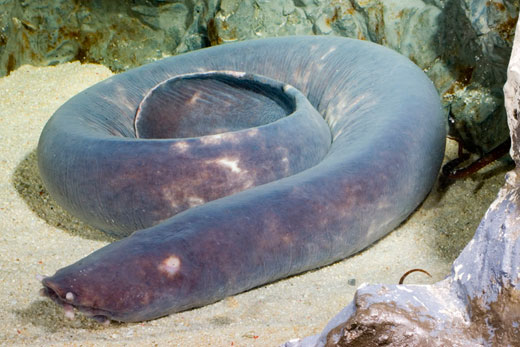
Hagfish are marine craniates of the class Agnatha or Myxini, also known as Hyperotreti. Some researchers regard Myxini as not belonging to the subphylum Vertebrata. That is, they are the only living animals that have a skull but not a vertebral column.
Despite their name, there is some debate about whether they are strictly fish (as there is for lampreys), since they belong to a much more primitive lineage than any other group that is placed in the category of fish (Chondrichthyes and Osteichthyes). The earliest fossil record dates back approximately 330 million years to the Late Carboniferous period.
Their unusual feeding habits and slime-producing capabilities have led members of the scientific and popular media to dub the hagfish as the most "disgusting" of all sea creatures. Although hagfish are sometimes called "slime eels", they are not eels at all.
Hagfish have elongated, eel-like bodies (so flexible they sometimes tie themselves in knots). They have four hearts, two brains, and a paddle-like tail. They have cartilaginous skulls (although the part surrounding the brain is composed primarily of a fibrous sheath) and tooth-like structures composed of keratin. Colors depend on the species, ranging from pink to blue-grey, and black or white spots may be present. Eyes are simple eyespots, not compound eyes that can resolve images. Hagfish have no true fins and have six or eight barbels around the mouth and a single nostril. Instead of vertically articulating jaws like Gnathostomata (vertebrates with jaws), they have a pair of horizontally moving structures with tooth-like projections for pulling off food. The mouth of the hagfish has two pairs of horny, comb-shaped teeth on a cartilaginous plate that protracts and retracts. These teeth are used to grasp food and draw it toward the pharynx.
Goose Barnacles
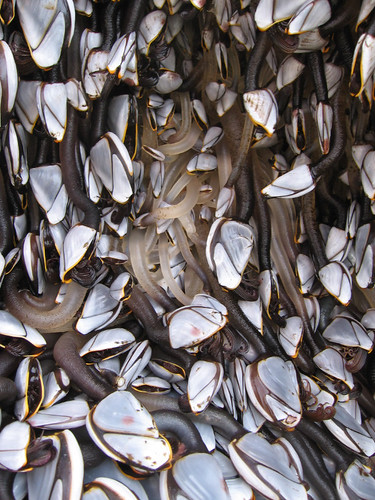
Goose barnacles (order Pedunculata), also called stalked barnacles or gooseneck barnacles, are filter-feeding crustaceans that live attached to hard surfaces of rocks and flotsam in the ocean intertidal zone.
Some species of goose barnacles are pelagic and are most frequently found on tidewrack on oceanic coasts. Unlike most other types of barnacles, intertidal goose barnacles depend on water motion rather than the movement of their cirri for feeding, and are therefore found only on exposed or moderately exposed coasts.