Showing posts with label Sea Monster. Show all posts

Saturday, October 16, 2010

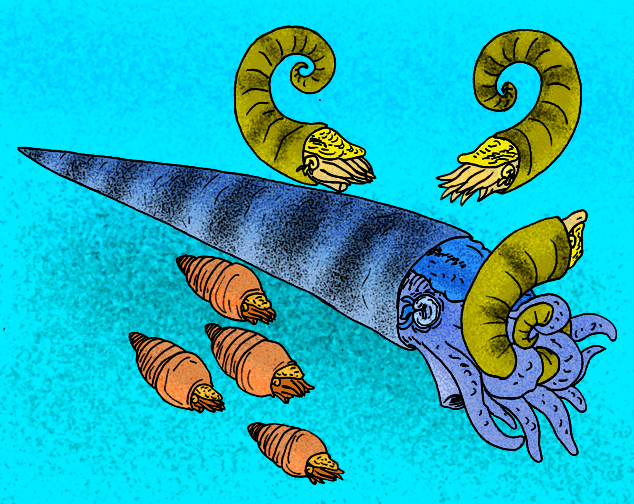
October 16, 2010 : Giant Orthocone (Extinct)


Giant Orthocone

The partial shell of one giant Cameroceras yielded a total length estimated at the time at nearly 30 feet (9 m). (This estimate has since been revised downward quite a bit.) Regardless of this estimate's degree of accuracy, this gargantuan cephalopod was one of the largest animals ever to live during the Paleozoic Era, if not the largest. Judging from its huge size, it was likely an apex predator that lived in deeper water (it would possibly have been unable to maneuver in shallow water), and probably fed on eurypterids such as Megalograptus, large trilobites, and smaller cephalopods. The program "Chased by Sea Monsters" speculatively suggests that it was largely blind, having large, yet feeble eyes like those of what may be its closest living relative, Nautilus.

"Cameroceras" has become a catch all term, or "wastebasket taxon," for any large orthoconic endocerid such as Endoceras, Vaginoceras, Meniscoceras, and even Cameroceras as a described genus. Although Cameroceras trentonense was first described by Conrad for the species in 1842 since then the generic term has had variable meaning. Hall, who named and described Endoceras in 1847 recognized Cameroceras trentonense specifically but used Endoceras for other species of large endocerids from the Trenton Limestone of western New York state.

"Cameroceras" and "Endoceras" may even apply to different stages of the same species. Although Cameroceras takes precedence where the two refer to the same species, its vague application leaves Endoceras or other well described genus the term of choice.

Friday, October 8, 2010

October 8, 2010 : Cymbospondylus (Extinct)


Cymbospondylus

Cymbospondylus ( A Greek word meaning "
Boat Spine") was a basal early ichthyosaur that lived between the middle and later years of the Triassic period (240-210 million years ago). Previously, the genus was classified as a shastasaurid, however, more recent work finds it to be more basal.

Fossils have been found in both Germany and Nevada, and the first species was named by Joseph Leidy in 1868. It was not until the early 1900s that the first complete skeletons were discovered. Fossil vertebrae from Cymbospondylus were allegedly used as plates by Nevada's silver miners; it is now the state's official fossil. 

Cymbospondylus was one of the largest ichthyosaurs, with fossils ranging from 6 to 10 metres (20 to 33 ft) long. It was also one of the least fish-like of the ichthyosaurs, lacking a dorsal fin and fluked tail. It did, however, have an elongated snout like other ichthyosaurs.

Despite its size, Cymbospondylus would not have been much of a threat to other marine reptiles, such as Nothosaurus. The one metre long head, with large jaws, contained rows of teeth which were so small that they could not have grasped and held on to large animals, let alone kill them. Instead, the teeth appear to have been adapted for catching and holding on to small and medium-sized fish, belemnites, and cephalopods such as ammonites. The long tail would have been excellent for swimming, and allowed Cymbospondylus to move at fast speeds and efficiently hunt down shoals of swimming fish.

Adult Cymbospondylus probably spent much of their time hunting in deep offshore water, only venturing into shallower water to breed or to catch seasonally available prey. Like other ichthyosaurs, Cymbospondylus probably gave birth to live young, as it had no way to lay eggs. These, on reaching adult size, probably had few, if any, predators that could harm them.
 

The eel-like tail of Cymbospondylus made up almost half the total body length, and it is possible that the tail was used as a primary swimming mechanism. Like present day sea snakes, Cymbospondylus probably swam by wriggling its body from side to side. The paddle-like limbs of Cymbospondylus would primarily have been underwater stabilizers, and for slowing down the ichthyosaur's swimming speed.

Saturday, October 2, 2010

October 2, 2010 : Charybdis (Myth)


Charybdis

In Greek mythology, Charybdis or Kharybdis (pronounced /kəˈrɪbdɨs/; in Greek, Χάρυβδις) was a sea monster, once a beautiful naiad and the daughter of Poseidon and Gaia. She takes form as a huge bladder of a creature whose face was all mouth and whose arms and legs were flippers and who swallows huge amounts of water three times a day before belching them back out again, creating whirlpools. In some variations of the tale, Charybdis is just a large whirlpool rather than a sea monster. Charybdis was very loyal to her father in his endless feud with Zeus; it was she who rode the hungry tides after Poseidon had stirred up a storm, and led them onto the beaches, gobbling up whole villages, submerging fields, drowning forests, claiming them for the sea. She won so much land for her father's kingdom that Zeus became enraged and changed her into a monster.

The myth has Charybdis lying on one side of a blue, narrow channel of water. On the other side of the strait was Scylla, another sea-monster. The two sides of the strait are within an arrow's range of each other, so close that sailors attempting to avoid Charybdis will pass too close to Scylla and vice versa. The phrase "between Scylla and Charybdis" has come to mean being in a state where one is between two dangers and moving away from one will cause you to come closer to the other. "Between Scylla and Charybdis" is the origin of the phrase "between the rock and the whirlpool" (the rock upon which Scylla dwelt and the whirlpool of Charybdis) and may also be the genesis of the phrase "between a rock and a hard place".

According to Thomas Bulfinch, based on writings of Homer, Charybdis stole the oxen of Geryon from Hermes, in whose possession they had been at the time, and was transformed into a sea monster as a punishment.

The phrase "between Scylla and Charybdis" (popularly reworded "between a rock and a hard place") has come to mean being in a state where one is between two dangers and moving away from one will cause you to be in danger from the other.

Posts during October will be of real-life sea monsters, long extinct, as well as those of myth and folklore.

Monday, August 23, 2010

August 23, 2010 : Sea Serpents (Myth)


Sea Serpents

Sightings of sea serpents have been reported for hundreds of years, and continue to be claimed today. Cryptozoologist Bruce Champagne identified more than 1,200 purported sea serpent sightings. Despite these numerous sightings, no credible physical evidence has been recorded and it is currently believed that the sightings can be best explained as misidentification of known animals such as oarfish and whales. Some cryptozoologists have suggested that the sea serpents are relict plesiosaurs, mosasaurs or other Mesozoic marine reptiles, an idea often associated with lake monsters such as the Loch Ness Monster.

Skeptics and debunkers have questioned the interpretation of sea serpent sightings, suggesting that reports of serpents are misidentifications of things such as cetaceans (whales and dolphins), sea snakes, eels, basking sharks, baleen whales, oarfish, large pinnipeds, seaweed, driftwood, flocks of birds, and giant squid.

While most cryptozoologists recognize that at least some reports are simple misidentifications, they claim that many of the creatures described by those who have seen them look nothing like the known species put forward by skeptics and claim that certain reports stick out. For their part, the skeptics remain unconvinced, pointing out that even in the absence of out-right hoaxes, imagination has a way of twisting and inflating the slightly out-of-the-ordinary until it becomes extraordinary.

Wednesday, April 21, 2010

April 21, 2010 : Oarfish


Oarfish

Oarfish is presumably in reference to either their highly compressed and elongated bodies, or to the former (but now discredited) belief that the fish "row" themselves through the water with their pelvic fins. The family name Regalecidae is derived from the Latin regalis, meaning "royal." The occasional beachings of oarfish after storms, and their habit of lingering at the surface when sick or dying, make oarfish a probable source of many sea serpent tales.

Monday, April 19, 2010

April 19, 2010 : Frilled Shark


Frilled Shark  

In 2007, a fisherman near Tokyo, Japan, told Awashiwa Marine Park officials that he’d just seen a very unusual eel-like creature with needle-sharp teeth. Staff at the park followed the fisherman, who directed them to the 5-foot-long oddity. They caught the creature, which was later identified as a frilled shark.

The frilled shark has been called everything from a “sea serpent” to a real-life “Loch Ness Monster” over the years in places where it lives, such as southeast Australia, New Zealand, Southeast Asia, West Africa, Chile and the Caribbean. A more accurate nickname is “the living fossil,” since this shark belongs to a primitive species that has changed very little over millions of years.