Longhead Dreamer Anglerfish
Looking like a creature from the Alien movies, this nightmarish "longhead dreamer" anglerfish (Chaenophryne longiceps) was until recently an alien species to Greenland waters.
The dreamer, which grows to a not-so-monstrous 6.7 inches (17 centimeters) in length, is 1 of 38 fish species found around the Arctic island for the first time, according to a recent study led by biologist Peter Møller of the Natural History Museum of Denmark in Copenhagen.
Ten of the species new to Greenland are new to science too. All 38 were discovered since the last such survey in 1992.
Rising ocean temperatures due to global warming—which could be drawing unfamiliar fishes to the region—and increased deep-sea fishing may be responsible for the spike in fresh fish faces seen off Greenland, according to the study, published in February in the journal Zootaxa. (Learn about global warming.)
Pyrosomes
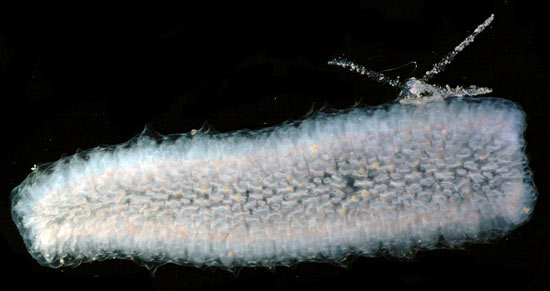
Pyrosomes, or pyrosoma, are free-floating colonial tunicates that live usually in the upper layers of the open ocean in warm seas, although some may be found to great depth. Pyrosomes are cylindrical or conical shaped colonies made up of hundreds to thousands of individuals, known as zooids. Colonies range in size from less than one centimeter to several meters in length.
Each zooid is only a few millimeters in size, but is embedded in a common gelatinous tunic that joins all of the individuals. Each zooid opens both to the inside and outside of the "tube", drawing in ocean water from the outside to its internal filtering mesh called the branchial basket, extracting the microscopic plant cells on which it feeds, and then expelling the filtered water to the inside of the cylinder of the colony. The colony is bumpy on the outside, each bump representing a single zooid, but nearly smooth, though perforated with holes for each zooid, on the inside.
Pyrosomes are planktonic, which means that their movements are largely controlled by currents, tides and waves in the oceans. On a smaller scale, however, each colony can move itself slowly by the process of jet propulsion, created by the coordinated beating of cilia in the branchial baskets of all the zooids, which also create feeding currents.
Pyrosomes are brightly bioluminescent, flashing a pale blue-green light that can be seen for many tens of meters. The name Pyrosoma comes from the Greek (pyro = "fire", soma = "body"). Pyrosomes are closely related to salps, and are sometimes called "fire salps." Sailors on the ocean are occasionally treated to calms seas containing many pyrosomes, all bioluminescencing on a dark night.