Arowana
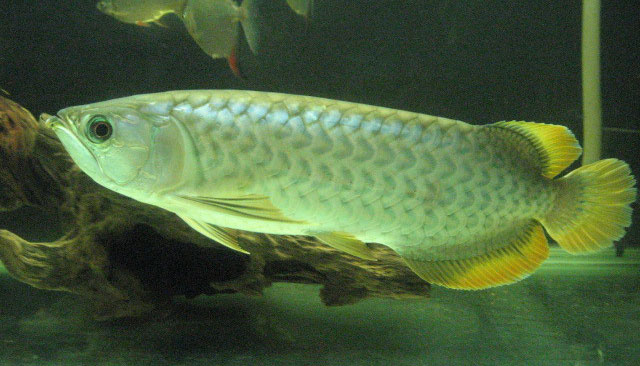
Arowanas are freshwater bony fish of the family Osteoglossidae, also known as bonytongues. In this family of fishes, the head is bony and the elongate body is covered by large, heavy scales, with a mosaic pattern of canals. The dorsal and the anal fins have soft rays and are long based, while the pectoral and ventral fins are small. The name "bonytongues" is derived from a toothed bone on the floor of the mouth, the "tongue", equipped with teeth that bite against teeth on the roof of the mouth. The fish can obtain oxygen from air by sucking it into the swim bladder, which is lined with capillaries like lung tissue. The arowana is an "obligatory air breather".
Osteoglossids are carnivorous, often being specialized surface feeders. They are excellent jumpers; it has been reported that Osteoglossum species have been seen leaping more than 6 feet (almost 2 metres) from the water surface to pick off insects and birds from overhanging branches in South America, hence the nickname "water monkeys". Arowanas have been rumored to capture prey as large as low flying bats. All species are large, and the arapaima is one of the world's largest freshwater fish, at 2.5 metres (8.2 ft) in length. Arowana species typically grow to around 3 to 4 feet in captivity.
Several species of osteoglossid exhibit extensive parental care. They build nests and protect the young after they hatch. Some species are mouthbrooders, the parents holding sometimes hundreds of eggs in their mouths. The young may make several tentative trips outside the parent's mouth to investigate the surroundings before leaving permanently.These fishes are best kept with live feed and they easily outgrow the tank within a span of 8/10 months. Always preferred in a large type aquarium.
Strait of Magellan
The Strait of Magellan (also called the Straits of Magellan or the Magellanic Strait) comprises a navigable sea route immediately south of mainland South America and north of Tierra del Fuego. The waterway is the most important natural passage between the Pacific and the Atlantic oceans, but it is considered a difficult route to navigate because of the unpredictable winds and currents and the narrowness of the passage.
Ferdinand Magellan (the original name, in Portuguese, Fernão de Magalhães), a Portuguese sailor in service to the Spanish King, became the first European to navigate the strait in 1520, during his global circumnavigation voyage. Because Magellan's ships entered it on November 1, All Saints' Day, it was originally named Estrecho de Todos los Santos (Strait of All Saints). Later the Spanish king changed the name to Estrecho de Magallanes in honor of Magellan. Since its discovery the Spanish Empire and the Kingdom of Chile saw it as its southern boundary. The first Spanish colonization attempt was led by Pedro Sarmiento de Gamboa who founded Nombre de Jesús and Rey Don Felipe on its northern shores. The cities suffered severe food shortages, and years afterwards in 1587 the English navigator Sir Thomas Cavendish landed at the site of
Rey Don Felipe and found only ruins of the settlement. He renamed the place Port Famine. Other early explorers included Francis Drake. The strait was first carefully explored and thoroughly charted by Phillip Parker King, who commanded the British survey vessel HMS Adventure, and in company with HMS Beagle, spent five years surveying the complex coasts around the strait. The result was presented at a meeting of the Royal Geographical Society in 1831.
Ophiocoma wendtii
The brittle star Ophiocoma wendtii inhabits coral reefs from Bermuda to Brazil. It is known for its advanced compound eyes.
Brittle stars have long, thin arms emanating from a small, disk-shaped body and are about the size of an outstretched human hand. They belong to the phylum of echinoderms, which includes sea urchins, sea cucumbers, and sea stars.
Its arms are covered with calcite crystals. In addition to functioning as an armor and giving structural support, the crystals make up its unique visual systems. They minimize spherical aberration and can detect the direction of incoming light. The lenses work by filtering and focusing light on an underlying photoreceptor system. Nerve bundles under each lens, presumed to be light-sensitive, transmit the optical information to the rest of the nervous system.
The only known animals to employ a similar visual system were the now-extinct trilobites. Phototropic chromatophores can change O. wendtii's color and regulate how much light will reach the photoreceptors.
Halibut
Halibut is a flatfish of the genus Hippoglossus from the family of the right-eye flounders (Pleuronectidae). Various other flatfish are also commonly called halibut. The name is derived from haly (holy) and butt (flat fish), for its alleged popularity on Catholic holy-days. Halibut live in both the North Pacific and the North Atlantic oceans and are highly-regarded food fish.
The halibut is the largest flat fish, averaging 11–13.5 kilograms (24–30 lb), but catch as large as 333 kilograms (734 lb) have been reported; the largest recently recorded was 211 kilograms (470 lb) and 2.5 metres (8.2 ft) long. They are gray-black on the top side with an off-white underbelly. At birth they have an eye on each side of the head, and swim like a salmon. After about 6 months one eye migrates to the other side, making them look more like other flounder. At the same time the stationary-eyed side darkens to match the top side, while the other side remains white. This color scheme disguises halibut from above (blending with the ocean floor) and from below (blending into the light from the sky) and is known as countershading.
Venus Flytrap Sea Anemone
The Venus flytrap sea anemone is a large sea anemone resembling a Venus Flytrap. It closes its tentacles to capture prey or to protect itself.
Ribbon Eel
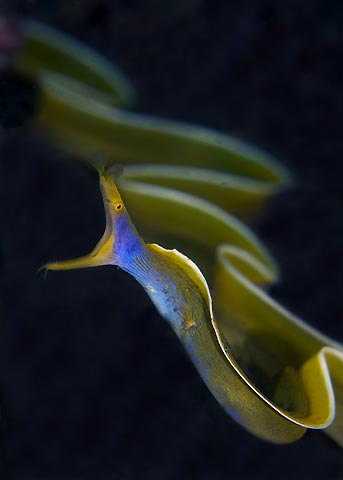
The ribbon eel, Rhinomuraena quaesita, or Bernis eel, is a species of saltwater eel, the only member of the genus Rhinomuraena of the Muraenidae (Moray eel) family of order Anguilliformes. What is now known as Rhinomuraena quaesita also includes the former Rhinomuraena amboinensis. R. quaesita was used for blue ribbon eels and R. amboinensis for black ribbon eels, but these are now recognized as the same species. The ribbon eel is native to the Indian and Pacific oceans.
The ribbon eel is an elegant creature with a long, thin body and high dorsal fins. The ribbon eel can easily be recognised by its expanded anterior nostrils. Juveniles and sub-adults are jet black with a yellow dorsal fin, while females are yellow with a black anal fin with white margins on the fins. The adult males are blue with a yellow dorsal fin.
The ribbon eel grows to an overall length of approximately 100 cm (36 in), and has a life span of up to twenty years. The ribbon eel is the only moray eel that is not gonochoristic.
Like many eels, the ribbon eel is sometimes thought to be angry or aggressive, because its mouth is often open, appearing ready to strike. In reality, the eel is simply breathing.
In the wild, the ribbon eel buries itself in sand or hides in rocks or reefs, dashing out to feed on shrimp, samin, and other fish.
Mekong Giant Catfish
The Mekong giant catfish, Pangasianodon gigas, is a species of catfish (order Siluriformes) in the shark catfish family (family Pangasiidae), native to the Mekong basin in Southeast Asia.
The Mekong giant catfish is perhaps the most interesting and most threatened species in the Mekong river. For this reason conservationists have chosen it as a sort of “flagship” species to promote conservation on the Mekong (Hogan et al. 2004, MGCCG, 2005). With recorded sizes of up to 10.5 ft (3.2 m) and 660 lb (300 kg), the Mekong’s giant catfish currently holds the Guinness Book of World Record’s position for the world’s largest freshwater fish (Mydans et al. 2005, Hogan et al. 2004, Hogan et al. 2007). Although research projects are currently on going, relatively little is known about this species.
Historically the fish has a natural range that reaches from the lower Mekong in Vietnam (above the tidally influenced brackish water of the river’s delta) all the way to the northern reaches of the river in the Yunnan province of China, spanning almost the entire 4,800 km length of the river (Lopez et al. 2007, Hogan et al. 2007). Due to threats which will be discussed below, this species no longer inhabits the majority of its original habitat, now believed to only exist are small, isolated populations in the middle Mekong region (Hogan et al. 2004). Fish congregate during the beginning of the rainy season and migrate up-stream to spawn (Hogan et al. 2004). They live primarily in the main channel of the river where the water depth is over 10 m (Mattson et al. 2002) while researchers, fishermen and officials have found this species in the Tonle Sap river and lake in Cambodia (also a UNESCO Biosphere reserve). In the past fishermen have reported the fish in a number of the Mekong’s tributaries, however today essentially no sightings are reported outside of the main Mekong river channel and the Tonle Sap region.
In infancy, this species feeds on zooplankton in the river and is known to be cannibalistic (Pholprasith, 1983 as cited in Mattson et al. 2002). After approximately one year, the fish becomes herbivorous, feeding on filamentous algae probably ingesting larvae and periphyton accidentally (Pookaswan, 1989 and Jensen, 1997 as cited in Mattson et al. 2002). The fish likely obtain their food from algae growing on submerged rocky surfaces, as they do not have any sort of dentition (Pholprasith, 1983 as cited in Mattson et al. 2002).