Scaly-foot Gastropod
Crysomallon squamiferum, common name the scaly-foot gastropod, is a species of deep sea hydrothermal vent snail, a marine gastropod mollusk in the family Peltospiridae.
This species was discovered in 2001 on the bases of black smokers at the Kairei hydrothermal vent field, on the Central Indian Ridge, just north of the Rodrigues Triple Point and about 2,420 metres (7,940 ft) below the surface.
The snail's foot is armored with iron-mineral scales. It is protected by scale-shaped sclerites composed of the iron sulfides greigite and pyrite. No other animal is known to use iron sulfides in this way.
The snail's shell is unusual in that its structure is composed of three layers. The outer layer is made of the aforementioned iron sulfides, containing greigite Fe3S4 about 30 μm thick. This makes this gastropod the only metazoan, known so far, to employ this material in its skeleton. The middle layer is organic, and is also the thickest of the three (about 150 μm). It is comparable to the periostracum, a thin protein coating found on other snail shells. The innermost layer is made of aragonite, a calcium mineral that is found in the shells of mollusks and various corals.
Each layer contributes to the effectiveness of the snail's shell in different ways. The middle organic layer appears to absorb the mechanical strain and energy generated by a squeezing attack (as by the claws of a crab), making the shell much tougher. The organic layer also acts to dissipate heat.
The United States military is currently funding research on the armor of the snail in hopes of developing insights into new military armor designs.
Mako Shark
The shortfin mako shark, Isurus oxyrinchus ("sharp nose"), is a large mackerel shark. Along with the closely related longfin mako (Isurus paucus) it is commonly referred to as a "mako shark".
In 1809, Constantine Rafinesque first described shortfin mako and coined the name Isurus oxyrinchus (IsurusMāori language, meaning either the shark or a shark tooth. It may have originated in a dialectal variation as it is similar to the common words for shark in a number of Polynesian languages— means "the same tail", oxyrinchus means "pointy snout"). "Mako" comes from the makō in the Kāi Tahu Māori dialect, mangō in other Māori dialects, "mago" in Samoan, ma'o in Tahitian, and mano in Hawaiian. The first written usage is in LeeKendall's & Grammar and vocabulary of the language of New Zealand (1820), which simply states "Máko; A certain fish". Richard Taylor's A leaf from the natural history of New Zealand (1848) is more elaborate: "Mako, the shark which has the tooth so highly prized by the Maoris".
The shortfin mako inhabits offshore temperate and tropical seas worldwide. The closely related longfin mako shark, Isurus paucus, is found in the Gulf Stream or warmer offshore waters.
It is a pelagic species that can be found from the surface down to depths of 150 meters (492 ft), normally far from land though occasionally closer to shore, around islands or inlets. One of only four known endothermic sharks, it is seldom found in waters colder than 16 °C (60.8 °F).
In the western Atlantic it can be found from Argentina and the Gulf of Mexico to Browns Bank off of Nova Scotia. In Canadian waters these sharks are neither abundant nor rare. Swordfish are a good indication of shortfin makos as the former is a source of food and prefers similar environmental conditions.
Shortfin makos travel long distances to seek prey or mates. In December 1998, a female tagged off California was captured in the central Pacific by a Japanese research vessel, meaning this fish traveled over 1,725 miles (2,776 km). Another swam 1,322 miles (2,128 km) in 37 days, averaging 36 miles (58 km) a day.
The shortfin mako's speed has been recorded at 50 kilometers per hour (31 mph) with bursts of up to 74 kilometers per hour (46 mph). They can leap approximate 9 meters (30 ft) high or higher in the air. Some scientists suggest that the biochemistry of shortfin mako can swim up to 100 kilometers per hour (62 mph). Scientists are in debate exactly how fast the shortfin mako shark can swim, as well as which particular species are actually the champion ocean swimmers. This high-leaping fish is sought as game worldwide. There are cases when an angry mako jumped into a boat after having been hooked.
Opalescent Squid
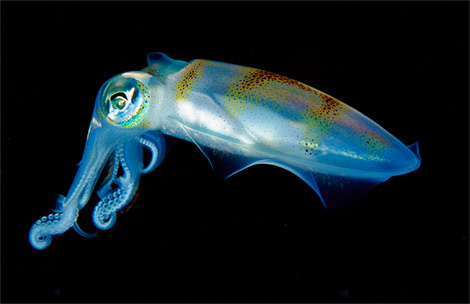
The Opalescent Inshore Squid (Loligo opalescens) is a small squid (mantle length (ML) up to 190 mm) in the family Loliginidae. It is a myopsid squid, which is the near shore group and that means that they have corneas over their eyes. The species lives in the Eastern Pacific Ocean from Mexico's Baja California peninsula to Alaska, USA, within 200 miles (320 kilometers) off shore.
Adult Loligo opalescens can reach a total size of 28 cm. Males are typically larger with a mantle length of 13-19 cm, while females are 12-18 cm in mantle length. The mantle of L. opalescens is not fused to the head and its body is 4 to 5 times longer than it is wide, with fins equal in both length and width. This squid has 8 arms with 2 longer tentacles ending in tentacular clubs equipped with suckers at their ends. The tentacular clubs are narrow with 4 rows of suckers and 2 large rows in the center of the tentacular club bordered by outer rows of smaller suckers. The 8 arms have only 2 rows of alternating suckers running down their length. In male L. opalescens, the left ventral arm is specialized or “hectocotylized” for spermatophore transfer during mating. The eyes of L. opalescens are covered with a non-perforated membrane known as a cornea which is a signature of myopsid squid. The color of L. opalescens can range from white to brown, with the animals able to change their color shades using chromatophores depending on mood and for camouflage. They are normally a bluish-white to mottled brown and gold, and they change to dark red or brown when excited, frightened or feeding.
L. opalescens is a cannibalistic predator that feeds on smaller prey species such as fish, crabs and shrimp, mollusks, and other juvenile squid. It uses its two longer tentacles with tentacular clubs on the end to snare and catch its prey. L. opalescens itself is an important food source for many predators like larger fish, sharks, marine mammals, sea birds, and also humans. Its predators include the Common Seal, California Sea Lion, Blue shark, Chinook salmon, Black-throated Diver, and Brandt's Cormorant.
Breaching
A breach or a lunge is a leap out of the water also known as cresting. The distinction between the two is fairly arbitrary: cetacean researcher Hal Whitehead chooses to define a breach as any leap in which at least 40% of the animal's body clears the water, and a lunge as a leap with less than 40% clearance. Qualitatively, a breach is a genuine jump with an intent to clear the water, whereas a lunge is the result of a fast upward sloping swim, perhaps as a result of feeding, that has caused the whale to clear the surface of the water unintentionally.
Whales such as Sperm Whales perform a breach by travelling vertically upwards from depth, and heading straight out of the water. Others, such as the Humpback Whale, travel close to the surface and parallel to it, and then jerk upwards at full speed to perform a breach. In a typical breach, as performed by a Humpback or Right Whale, the whale clears the water at an angle of about 30° to the horizontal. Around 90% of the body clears the water before the whale turns to land on its back or side. "Belly flops" also occur but are less common. In order to achieve 90% clearance, a Humpback needs to leave the water at a speed of eight metres per second or 29 km/h. For a 36 ton animal this results in a momentum of 288 thousand newton-seconds.
Breaches are often carried out in series. The longest recorded sustained series was by a Humpback near the West Indies - totaling 130 leaps in less than 90 minutes. Repeated breaches tire the animal, so that less of the body clears the water each time.
The Right, Humpback and Sperm whales are the most prodigious jumpers. However the other baleen whales such as Fin, Blue, Minke and Sei whales also breach. Oceanic dolphins, including the Orca, are very common breachers and are in fact capable of lifting themselves completely out of the water very easily.
Many reasons have been suggested for breaching. Whales are more likely to breach when they are in groups, suggesting social reasons, such as an assertion of dominance, courting or warning of danger. Scientists have called this theory "honest signalling". The immense cloud of bubbles and underwater disturbance following a breach cannot be faked; neighbours then know a breach has taken place. A single breach costs a whale only about 0.075% of its total daily energy intake, but a long series of breaches may add up to a significant energy expenditure.
It is also possible that the loud "smack" upon re-entering is useful for stunning or scaring prey. Noisemaking is believed to be the reason for lobtailing. Others suggest that a breach allows the whale to breathe in air that is not close to the surface, which may aid breathing in rough seas. Another widely accepted possible reason is to dislodge parasites from the skin. While other whale experts think some of the behavior might simply be playful in nature.
Breaching has also been observed in the following sharks and rays: the great white shark, thresher shark, shortfin mako, longfin mako, spinner shark, blacktip reef shark, salmon shark, porbeagle shark, copper shark and basking shark as well as the manta ray.
Bearded Fireworm
The bearded fireworm, Hermodice carunculata, is a type of marine bristleworm.
Bearded fireworms are usually between 5–10 centimetres (1.9–3.9 in) in length, but can reach up to 35 centimetres (13.8 in). They are endowed with a group of poisonous white bristles on each side, which are flared out when the worm is disturbed. It is considered by marine biologists as a particularly beautiful and colourful species, though swimmers wisely tend to avoid them due to their appearance.
The bearded fireworm is usually found on reefs, under stones in rocky areas of the sea, and on some mud bottoms. Sometimes, they can be found to be hidden on moss-covered rocks.
It is encountered throughout the tropical western Atlantic and at Ascension Island in mid-Atlantic. It can be found near ocean reefs and at depths of up to 150m. These worms are also common in the mediterranean sea, in the coastal waters surrounding Cyprus and the Maltese archipelago.
The bearded fireworm is a slow creature, and is not considered a threat to humans unless touched by a careless swimmer. The bristles, when flared, can penetrate human skin, injecting a powerful neurotoxin and producing intense irritation and a painful burning sensation around the area of contact. The sting can also lead to nausea and dizziness. This sensation lasts up to a few hours, but a painful tingling can continue to be felt around the area of contact. In a case of accidental contact, application and removal of adhesive tape will help remove the spines; applying alcohol to the area will also help alleviate the pain.
Humpback Whale
The humpback whale (Megaptera novaeangliae) is a species of baleen whale. One of the larger rorqual species, adults range in length from 12–16 metres (39–52 ft) and weigh approximately 36,000 kilograms (79,000 lb). The humpback has a distinctive body shape, with unusually long pectoral fins and a knobbly head. It is an acrobatic animal, often breaching and slapping the water. Males produce a complex whale song, which lasts for 10 to 20 minutes and is repeated for hours at a time. The purpose of the song is not yet clear, although it appears to have a role in mating.
Found in oceans and seas around the world, humpback whales typically migrate up to 25,000 kilometres (16,000 mi) each year. Humpbacks feed only in summer, in polar waters, and migrate to tropical or sub-tropical waters to breed and give birth in the winter. During the winter, humpbacks fast and live off their fat reserves. The species' diet consists mostly of krill and small fish. Humpbacks have a diverse repertoire of feeding methods, including the bubble net feeding technique.
Like other large whales, the humpback was and is a target for the whaling industry. Due to over-hunting, its population fell by an estimated 90% before a whaling moratorium was introduced in 1966. Stocks have since partially recovered; however, entanglement in fishing gear, collisions with ships, and noise pollution also remain concerns. There are at least 80,000 humpback whales worldwide. Once hunted to the brink of extinction, humpbacks are now sought by whale-watchers, particularly off parts of Australia, New Zealand, South America, Canada, and the United States.
Humpback whales are rorquals (family Balaenopteridae), a family that includes the blue whale, the fin whale, the Bryde's whale, the sei whale and the minke whale. The rorquals are believed to have diverged from the other families of the suborder Mysticeti as long ago as the middle Miocene. However, it is not known when the members of these families diverged from each other.
Though clearly related to the giant whales of the genus Balaenoptera, the humpback has been the sole member of its genus since Gray's work in 1846. More recently though, DNA sequencing analysis has indicated the Humpback is more closely related to the gray whale (Eschrichtius robustus) and to certain rorquals, such as the fin whale (Balaenoptera physalus) than it is to other rorquals such as the minke whales. If further research confirms these relationships, it will be necessary to reclassify the rorquals.
Fata Morgana
A Fata Morgana is an unusual and very complex form of mirage, a form of superior mirage, which, like many other kinds of superior mirages, is seen in a narrow band right above the horizon. It is an Italian phrase derived from the vulgar Latin for "fairy" and the Arthurian sorcerer Morgan le Fay, from a belief that the mirage, often seen in the Strait of Messina, were fairy castles in the air or false land designed to lure sailors to their death created by her witchcraft. Although the term Fata Morgana is sometimes incorrectly applied to other, more common kinds of mirages, the true Fata Morgana is not the same as an ordinary superior mirage, and is certainly not the same as an inferior mirage.
Fata Morgana mirages tremendously distort the object or objects which they are based on, such that the object often appears to be very unusual, and may even be transformed in such a way that it is completely unrecognizable. A Fata Morgana can be seen on land or at sea, in polar regions or in deserts. This kind of mirage can involve almost any kind of distant object, including such things as boats, islands, and coastline, as shown in the photographs which accompany this article.
A Fata Morgana is not only complex, but also rapidly changing. The mirage comprises several inverted (upside down) and erect (right side up) images that are stacked on top of one another. Fata Morgana mirages also show alternating compressed and stretched zones.
This optical phenomenon occurs because rays of light are strongly bent when they pass through air layers of different temperatures in a steep thermal inversion where an atmospheric duct has formed. (A thermal inversion is an atmospheric condition where warmer air exists in a well-defined layer above a layer of significantly cooler air. This temperature inversion is the opposite of what is normally the case; air is usually warmer close to the surface, and cooler higher up.)
In calm weather, a layer of significantly warmer air can rest over colder dense air, forming an atmospheric duct which acts like a refracting lens, producing a series of both inverted and erect images. A Fata Morgana requires a duct to be present; thermal inversion alone is not enough to produce this kind of mirage. While a thermal inversion often takes place without there being an atmospheric duct, an atmospheric duct cannot exist without there first being a thermal inversion.
Arctic Circle
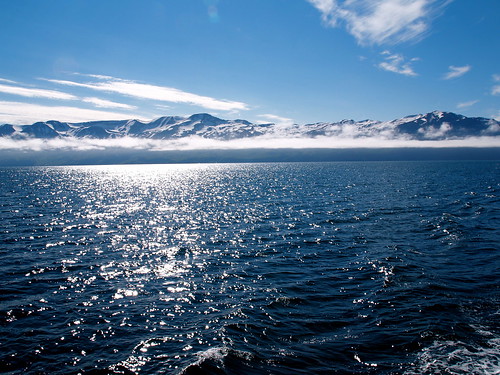
The Arctic Circle is one of the five major circles of latitude that mark maps of the Earth. For Epoch 2011, it is the parallel of latitude that runs 66° 33′ 44″ (or 66.5622°) north of the Equator.
The region north of this circle is known as the Arctic, and the zone just to the south is called the Northern Temperate Zone. The equivalent polar circle in the Southern Hemisphere is called the Antarctic Circle.
The Arctic Circle marks the southern extremity of the polar day (24-hour sunlit day, often referred to as the "midnight sun") and polar night (24-hour sunless night). North of the Arctic Circle, the sun is above the horizon for 24 continuous hours at least once per year and below the horizon for 24 continuous hours at least once per year. On the Arctic Circle those events occur, in principle, exactly once per year, at the June and December solstices, respectively.
In fact, because of atmospheric refraction and because the sun appears as a disk and not a point, part of the midnight sun may be seen on the night of the northern summer solstice up to about 50′ (90 km (56 mi)) south of the Arctic Circle; similarly, on the day of the northern winter solstice, part of the sun may be seen up to about 50′ north of the Arctic Circle. That is true at sea level; those limits increase with elevation above sea level although in mountainous regions, there is often no direct view of the horizon.
The position of the Arctic Circle is not fixed, but directly depends on the Earth's axial tilt, which fluctuates within a margin of 2° over a 40,000 year period, notably due to tidal forces resulting from the orbit of the Moon. The Arctic Circle is currently drifting northwards at a speed of about 15 m (49 ft) per year.
Relatively few people live north of the Arctic Circle due to the Arctic climate. The three largest communities above the Arctic Circle are situated in Russia: Murmansk (population 325,100), Norilsk (135,000), and Vorkuta (85,000). Tromsø (in Norway) has about 62,000 inhabitants. In contrast, the largest North American community north of the circle, Barrow, Alaska, has approximately 4,000 inhabitants. Rovaniemi (in Finland), which lies slightly south of the line, has a population of approximately 58,000, and is the largest settlement in the immediate vicinity of the Arctic Circle.
Bluespotted Ribbontail Ray
The bluespotted ribbontail ray (Taeniura lymma) is a species of stingray in the family Dasyatidae. Found from the intertidal zone to a depth of 30 m (100 ft), this species is common throughout the tropical Indian and western Pacific Oceans in nearshore, coral reef-associated habitats. It is a fairly small ray, not exceeding 35 cm (14 in) in width, with a mostly smooth, oval pectoral fin disc, large protruding eyes, and a relatively short and thick tail with a deep fin fold underneath. It can be easily identified by its striking color pattern of many electric blue spots on a yellowish background, with a pair of blue stripes on the tail.
At night, small groups of bluespotted ribbontail rays follow the rising tide onto sandy flats to root for small benthic invertebrates and bony fishes in the sediment. When the tide recedes, the rays separate and withdraw to shelters on the reef. Reproduction is aplacental viviparous, with females giving birth to litters of up to seven young. This ray is capable of injuring humans with its venomous tail spines, though it prefers to flee if threatened. Because of its beauty and size, the bluespotted ribbontail ray is popular with private aquarists despite being poorly suited to captivity. The International Union for Conservation of Nature (IUCN) has listed this species as Near Threatened, as it faces widespread habitat degradation and intensive fishing pressure throughout its range.
The bluespotted ribbontail ray was originally described as Raja lymma by Swedish naturalist Peter Forsskål, in his 1775 Descriptiones Animalium quae in itinere ad maris australis terras per annos 1772, 1773, et 1774 suscepto collegit, observavit, et delineavit Joannes Reinlioldus Forster, etc., curante Henrico Lichtenstein. The specific epithet lymma means "dirt". Forsskål did not designate a type specimen. In 1837, German biologists Johannes Peter Müller and Friedrich Gustav Jakob Henle created the genus Taeniura for Trygon ornatus, now known to be a junior synonym of this species.
Other common names used for this species include bluespotted ray, bluespotted fantail ray, bluespotted lagoon ray, bluespotted stingray, fantail ray, lesser fantail ray, lagoon ray, reef ray, ribbon-tailed stingray, and ribbontail stingray. Morphological examination has suggested that the bluespotted ribbontail ray is more closely related to the amphi-American Himantura (H. pacifica and H. schmardae) and the river stingrays (Potamotrygonidae) than to the congeneric blotched fantail ray (T. meyeni), which is closer to Dasyatis and Indo-Pacific Himantura.
Widespread in the nearshore waters of the tropical Indo-Pacific region, the bluespotted ribbontail ray has a range that extends around the periphery of the Indian Ocean from South Africa to the Arabian Peninsula to Southeast Asia, including Madagascar, Mauritius, Zanzibar, the Seychelles, Sri Lanka, and the Maldives. It is rare in the Persian Gulf and Gulf of Oman. In the Pacific Ocean, this species is found from the Philippines to northern Australia, as well as around numerous Melanesian and Polynesian islands as far east as the Solomon Islands. Rarely found deeper than 30 m (100 ft), the bluespotted ribbontail ray is a bottom-dwelling species that frequents coral reefs and adjacent sandy flats. It is also commonly encountered in the intertidal zone and tidal pools, and has been sighted near seagrass beds. Every summer, considerable numbers of bluespotted ribbontail rays arrive off South Africa.
Mandarinfish
The Mandarinfish or Mandarin dragonet (Synchiropus splendidus), is a small, brightly-colored member of the dragonet family, which is popular in the saltwater aquarium trade. The mandarinfish is native to the Pacific, ranging approximately from the Ryukyu Islands south to Australia.
The Mandarinfish was first described as Callionymus splendidus in 1927 by Albert William Herre, an American ichthyologist working in the Philippines. It was later placed in genus Synchiropus. The generic name Synchiropus is from Ancient Greek syn-, meaning "with", and -chiropus meaning "hand-foot". The specific epithet splendidus is from Latin for splendid. The common name of the Mandarinfish comes from its extremely vivid colouration, evoking the robes of an Imperial Chinese mandarin. Other common names include Mandarin goby, Green mandarin, Striped mandarinfish, Striped dragonet, Green dragonet and sometimes Psychedelic mandarinfish. The similarly named mandarin fish (Siniperca chuatsi), properly known as the Chinese perch, is only distantly related.
The Mandarinfish belongs to the perciform family Callionymidae, the dragonets, which counts 10 genera and more than 182 species. Genus Synchiropus counts 51 species, divided into 10 subgenera. The Mandarinfish is in subgenus Synchiropus (Pterosynchiropus) along with the Australian LSD-fish (S. occidentalis) and the LSD- or psychedelic fish (S. picturatus).
To date, S. splendidus is one of only two animal species known to have blue colouring because of cellular pigment, the other being the closely related LSD-fish (S. picturatus). The name "cyanophore" was proposed for the blue chromatophores, or pigment-containing and light-reflecting cells. In all other known cases, the colour blue comes from thin-film interference from piles of flat, thin and reflecting purine crystals.
Bay of Fundy
The Bay of Fundy (French: Baie de Fundy) is a bay on the Atlantic coast of North America, on the northeast end of the Gulf of Maine between the Canadian provinces of New Brunswick and Nova Scotia, with a small portion touching the U.S. state of Maine. Some sources believe the name "Fundy" is a corruption of the French word "Fendu", meaning "split", while others believe it comes from the Portuguese fondo, meaning "funnel". The bay was also named Baie Française (French Bay) by explorer/cartographer Samuel de Champlain during a 1604 expedition led by Pierre Dugua, Sieur de Monts which resulted in a failed settlement attempt on St. Croix Island.
The Bay of Fundy is known for its high tidal range. Rivaled by Ungava Bay in northern Quebec and the Severn Estuary in the UK, it has one of the highest vertical tidal ranges in the world.
Portions of the Bay of Fundy, Shepody Bay and Minas Basin, form one of six Canadian sites in the Western Hemisphere Shorebird Reserve Network, and is classified as a Hemispheric site. It is owned by the provinces of New Brunswick and Nova Scotia, and the Canadian Wildlife Service, and is managed in conjunction with Ducks Unlimited Canada and the Nature Conservancy of Canada.
In July 2009, the Bay of Fundy was named as a finalist for the New 7 Wonders of Nature contest that ends in November of 2011.
The Bay of Fundy is known for its high tidal range. The quest for world tidal dominance has led to a rivalry between the Minas Basin in the Bay of Fundy and the Leaf Basin in Ungava Bay, over which body of water lays claim to the highest tides in the world, with supporters in each region claiming the record.
Folklore in the Mi'kmaq First Nation claims that the tides in the Bay of Fundy are caused by a giant whale splashing in the water. Oceanographers attribute it to tidal resonance resulting from a coincidence of timing: the time it takes a large wave to go from the mouth of the bay to the inner shore and back is practically the same as the time from one high tide to the next. During the 12.4 hour tidal period, 115 billion tonnes of water flow in and out of the bay.
The tides in the Bay of Fundy are semidiurnal. Semidiurnal tides are tides that have two highs and two lows each day. The height that the water rises and falls to each day during these tides are approximately equal. There are approximately six hours and thirteen minutes between each high and low tide.
Tidal Bore
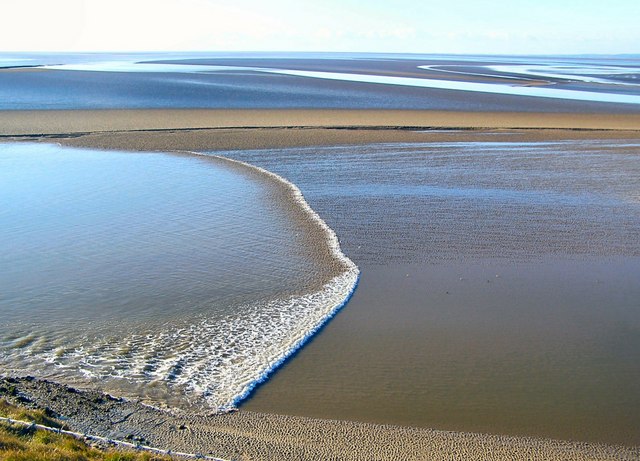
A tidal bore (or simply bore in context, or also aegir, eagre, or eygre) is a tidal phenomenon in which the leading edge of the incoming tide forms a wave (or waves) of water that travel up a river or narrow bay against the direction of the river or bay's current. As such, it is a true tidal wave and not to be confused with a tsunami, which is a large ocean wave traveling primarily on the open ocean.
Bores occur in relatively few locations worldwide, usually in areas with a large tidal range (typically more than 6 metres (20 ft) between high and low water), and where incoming tides are funneled into a shallow, narrowing river or lake via a broad bay. The funnel-like shape not only increases the tidal range, but it can also decrease the duration of the flood tide, down to a point where the flood appears as a sudden increase in the water level. Note the tidal bore takes place during the flood tide and never during the ebb tide.
A tidal bore may take on various forms, ranging from a single breaking wavefront with a roller — somewhat like a hydraulic jump — to ‘undular bores’, comprising a smooth wavefront followed by a train of secondary waves (whelps). Large bores can be particularly very unsafe for shipping,but also present opportunities for river surfing.
Two key features of a tidal bore are the intense turbulence and turbulent mixing generated during the bore propagation, as well as its rumbling noise. The visual observations of tidal bores highlight the turbulent nature of the surging waters. The tidal bore induces a strong turbulent mixing in the estuarine zone, and the effects may be felt along considerable distances. The velocity observations indicate a rapid deceleration of the flow associated with the passage of the bore as well as large velocity fluctuations. A tidal bore creates a powerful roar that combines the sounds caused by the turbulence in the bore front and whelps, entrained air bubbles in the bore roller, sediment erosion beneath the bore front and of the banks, scouring of shoals and bars, and impacts on obstacles. The bore rumble is heard far away because its low frequencies can travel over long distances. The low-frequency sound is a characteristic feature of the advancing roller in which the air bubbles entrapped in the large-scale eddies are acoustically active and play the dominant role in the rumble sound generation.
The word bore derives through Old English from the Old Norse word bára, meaning a wave or swel
Electric Flame Scallop
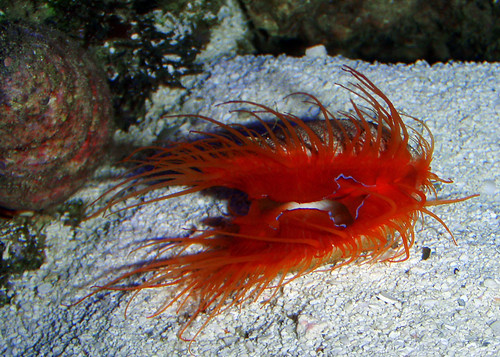
The Electric Flame Scallop, also called the Red Electric Flame Scallop or scientifically known as Lima Sp, belongs to the mollusk family known as Limidae which comprises of only bivalve mollusks which are made up of scallops, clams, oysters and mussels that have a shell consisting of two rounded plates called valves joined at one edge by a flexible ligament or hinge.
The Electric Flame Scallop, inhabits the waters of the Indo-Pacific, ranges in size from 1 inch to 3 inches when reaching maturity and is instantly recognizable by its soft parts being a flame red color, with several bright red tentacles protruding from the open valves (shell). What makes this creature even more fascinating is that it seems to create bluish white electricity which can be seen shooting across the mantel like lightning bolts quite visibly in the dark.
While the purpose of the electricity generated by this creature is unknown, it makes a remarkable spectacle for any night dive where even in the darkness; you can see the flicker of bluish electricity bolts flowing through the scallop’s filaments. For underwater photography an electric flame scallop is truly a delight to photograph. During the day, the bio-luminescence isn’t very apparent, which is why electric scallop sightings are more spectacular at night.
The electricity (which is actually a form of bioluminescence) is not known to be harmful to divers or other creatures, and especially since the electric flame scallop is a filter feeder and feeds off on microscopic phytoplankton and bacterioplankton (omnivorous) it is curious why it possesses such a brilliant ability. Marine Biologists suggest that the light generated by the electric scallop attracts plankton to its filament like tentacles helping it feed from a fixed location.
Often the Electric Flame Scallop is confused with its parent species the Flame Scallop or Lima Scabra which is also similar in appearance, with a red fleshy mantle covered with tentacles, except for the absence of the strip of bio-luminescent tissue on its mantle that sends a flash of color back and forth over the mantle. Interestingly enough the Flame Scallop, and it’s sub-species the Electric Flame Scallop are not truly scallops but a form of file-clam.
Pororoca
The pororoca (Portuguese pronunciation: [poɾoˈɾɔkɐ]) is a tidal bore, with waves up to 4 meters high that travel as much as 13 kilometers inland upstream on the Amazon River and adjacent rivers. Its name comes from the indigenous Tupi language, where it translates into "great destructive noise". It occurs at the mouth of the river where river water meets the Atlantic Ocean. The phenomenon is best seen in February and March.
The wave has become popular with surfers. Since 1999, an annual championship has been held in São Domingos do Capim (on the adjacent Guamá River). However, surfing the Pororoca is especially dangerous, as the water contains a significant amount of debris from the shores of the river (often entire trees), in addition to dangerous fauna. In 2003 the Brazilian Picuruta Salazar won the event with a record ride of 12.5 kilometers during 37 minutes. The longest time captured on tape riding the wave is also by Picuruta and it is on 43 minutes.
Along the branches or "caños" in the Orinoco Delta, pororoca is known as macareo, which is also the name of one of these branches.
Tiger Shark
The tiger shark, Galeocerdo cuvier, is a species of requiem shark and the only member of the genus Galeocerdo. Tiger sharks are relatively large macropredators, capable of attaining a length of over 5 m (16 ft). This shark typically reaches maturity at lengths of 2 to 3 m (6.6 to 9.8 ft). It is found in many tropical and temperate oceans, and is especially common around central Pacific islands. Its name derives from the dark stripes down its body, which resemble a tiger's pattern and fade as the shark matures.
The tiger shark is a solitary, mostly night-time hunter. Its diet involves a wide range of prey, including crustaceans, fish, seals, birds, smaller sharks, squid, turtles, sea snakes, and dolphins.
While the tiger shark is considered to be one of the sharks most dangerous to humans, the attack rate is surprisingly low according to researchers. The tiger is second on the list of number of recorded attacks on humans, with the great white shark being first. They often visit shallow reefs, harbours and canals, creating the potential for encounter with humans.
Tiger sharks are considered a near threatened species due to excessive finning and fishing by humans.
The tiger shark is often found close to the coast, in mainly tropical and sub-tropical waters worldwide, though they can reside in temperate waters. Along with the Great White shark, Pacific sleeper shark, Greenland shark and sixgill shark, tiger sharks are among the largest extant sharks. The shark's behavior is primarily nomadic, but is guided by warmer currents, and it stays closer to the equator throughout the colder months. The shark tends to stay in deep waters that line reefs but does move into channels to pursue prey in shallower waters. In the western Pacific Ocean, the shark has been found as far north as Japan and as far south as New Zealand.
Celestial Eye Goldfish
Celestial eye goldfish or Choten gan is a double-tailed breed of fancy goldfish that has a breed-defining pair of telescope eyes which are turned upwards, pupils gazing skyward. When the fry hatch, the eyes of young Celestials are normal but gradually protrude sideways, as in the Telescope eye goldfish, and then turn upwards within a period of six months.
The Celestial is a relatively small variety of goldfish that has a torpedo-shaped body similar to the Bubble Eye. Like the Bubble Eye, the Celestial does not have a dorsal fin. Their paired fins are of the Fantail or Ryukin type. The caudal may be half as long, to as long, as the body. They are most commonly seen with metallic scales colored various shades of orange (called 'red' by fanciers), white, or red and white. Celestials with nacreous scales are known but rarely seen. Despite their limited vision and their lack of a dorsal fin, they are active and agile swimmers. They do require some special attention since, apart from sporting easily damaged upward-oriented eyes, and having limited vision, they are also sensitive to cold water temperatures. They are unable to compete with more vigorous goldfish for food. Sharp ornaments and objects in the aquarium are contraindicated. They are best kept with other limited-vision breeds (i.e the Bubble Eye) or in a tank of their own.
Sperm Whale
The sperm whale, Physeter macrocephalus, is a marine mammal species, order Cetacea, a toothed whale (odontocete) having the largest brain of any animal. The name comes from the milky-white waxy substance, spermaceti, found in the animal's head. The sperm whale is the only living member of genus Physeter. The synonym Physeter catodon refers to the same species. It is one of three extant species in the sperm whale superfamily, along with the pygmy sperm whale and dwarf sperm whale.
A bull can grow to 20.5 metres (67 ft) long. It is the largest living toothed animal. The head can take up to one-third of the animal's length. It has a cosmopolitan distribution across the oceans. The species feeds on squid and fish, diving as deep as 3 kilometres (9,800 ft), which makes it the deepest diving mammal. Its diet includes giant squid and colossal squid. The sperm whale's clicking vocalization is the loudest sound produced by any animal, but its functions are uncertain. These whales live in groups called pods. Pods of females and their young live separately from older males. The females cooperate to protect and nurse their young. Females give birth every three to six years, and care for the calves for more than a decade.
Historically, the sperm whale was also known as the common cachalot; "cachalot" is derived from an archaic French word for "tooth". Over most of the period from the early 18th century until the late 20th century, the sperm whale was hunted to obtain spermaceti and other products, such as sperm oil and ambergris. Spermaceti found many important uses, such as candles, soap, cosmetics and machine oil. Due to its size, the sperm whale could sometimes defend itself effectively against whalers. In the most famous example, a sperm whale attacked and sank the American whaleship Essex in 1820. As a result of whaling, the sperm whale is currently listed as vulnerable by the IUCN. The sperm whale has few natural predators, since few are strong enough to successfully attack a healthy adult; orcas attack pods and kill calves. The sperm whale can live for more than 70 years.
The name sperm whale is an apocopation of spermaceti whale. Spermaceti is the semi-liquid, waxy substance found in the spermaceti organ or case in front of and above the skull bone and also in the junk, the area below the spermaceti organ and just above the upper jaw. The case consists of a soft white, waxy substance saturated with spermaceti oil. The junk is composed of cavities filled with the same wax and spermaceti oil and intervening connective tissue. The sperm whale is also known as the "cachalot", which is thought to derive from the archaic French for "tooth" or "big teeth", as preserved for example in cachau in the Gascon dialect (a word of either Romance or Basque origin). The etymological dictionary of Corominas says the origin is uncertain, but it suggests that it comes from the vulgar Latin cappula, plural of cappulum, sword hilt. According to Encarta Dictionary, the word cachalot came to English "via French from Spanish or Portuguese cachalote, perhaps from [Portuguese] cachola, 'big head'".
Ghost Crabs
Ghost crabs, also called sand crabs, are crabs of the genus Ocypode, common shore crabs in many countries. Characteristics of the genus include one claw being larger than the other, but this difference is not as marked as in male fiddler crabs.
Ghost crabs dominate sandy shores in tropical and subtropical areas, replacing the sandhoppers that predominate in cooler areas. They breathe through gills, which they periodically wet with seawater. They must also return to the ocean to release their eggs, which develop into marine larvae.
Adult ghost crabs dig deep burrows, comprising a log shaft with a chamber at the end, occasionally with a second entrace shaft. They remain in the burrow during the hottest part of the day, and throughout the coldest part of the winter. They emerge mostly at night, to feed on mole crabs and coquina clams, although they will also eat a wide range of items, including carrion, debris and turtle hatchlings.
The name "ghost crab" derives from the animals' nocturnality and their pale colouration; only O. gaudichaudii The scientific name is brightly coloured.
Ocypode is derived from the Greek roots ocy- ("fast") and ποδός (
podos, "foot"), in reference to the animal's speed.

"Glamour" Squid
A large new species of deep red, glowing squid has been discovered living near undersea mountains in the southern Indian Ocean, scientists announced Monday.
At about 28 inches (70 centimeters) long, the as yet unnamed species is relatively big—though other squid can reach as long as 65 feet (20 meters), some species are barely three quarters of an inch (1.5 centimeters).
The new species belongs to Chiroteuthidae, a group of slender squid in which light-producing organs run in the family.
"It's thought that this particular group of squid actually uses bioluminescence to lure in prey," which are thought to include small fish and crustaceans, said Alex Rogers, a conservation biologist at the University of Oxford in the UK.
The new squid is just one of more than 70 squid species observed during a six-week research cruise that began in September 2009 but whose results are only now beginning to be released.
"In a single expedition, we sampled about a fifth of all the world's squid species that are known to date," Rogers said. "That's really a staggering diversity of squid to sample in a single trip."
Most of the squid observed were already known to science, but, in addition to the blinking beast above, a few are thought to be completely new species.
"We think we have more than one new species of squid," Rogers said. "This just happens to be the biggest and most glamorous one."
Ghost Knifefish
The ghost knifefishes are a family, Apteronotidae, of ray-finned fishes in the order Gymnotiformes. These fish can be found in the freshwater of Panama and South America.
They are distinguished from other gymnotiform fishes by the presence of a caudal fin (all other families lack a caudal fin) as well as a fleshy dorsal organ represented by a longitudinal strip along the dorsal midline. The longest Apteronotid is Apteronotus magdalenensis, reaching 1.3 metres. These nocturnal fish have small eyes. Also, sexual dimorphism exists in some genera in snout shape and jaws.
Apteronotids use a high frequency tone-type (also called wave-type) electric organ discharge (EOD) to communicate.
Many Apteronotids are aggressive predators of small aquatic insect larvae and fishes, though there are also piscivorous and planktivorous species. Magosternarchus spp. are very unusual, preying on the tails of other electric fishes. Other species, such as Sternarchorhynchus and Sternarchorhamphus, have tubular snouts and forage on the beds of aquatic insect larvae and other small animals which burrow into the river bottom. At least one species (Sternarchogiton nattereri) eats freshwater sponges which grow on submerged trees, stumps, and other woody debris. The genus Apteronotus is artificial and many of the species do not actually belong in it.
The black ghost knifefish (Apteronotus albifrons) and brown ghost knifefish (Apteronotus leptorhynchus) are readily available as aquarium fish. Others, are known to appear in the trade, but are quite rare.