Swinhoe's Softshell Turtle
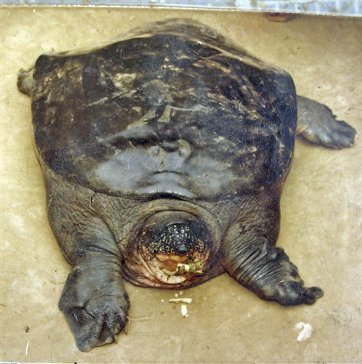
Rafetus swinhoei, commonly known as the Red river giant softshell turtle, Shanghai softshell turtle, Yangtze giant softshell turtle (Chinese: 斑鱉; Pinyin: Bān Bīe; literally "specked softshell turtle"), or Swinhoe's softshell turtle, is a species of softshell turtle. Rafetus leloii is considered a junior synonym of Rafetus swinhoei, a related and much bigger softshell turtle which lives more than 2000 km further south in Vietnam. It is listed as critically endangered in the IUCN Red List 2006, and is one of the rarest turtles in the world. There are only four known to survive in Vietnam and China: one each at Hoan Kiem Lake, Hanoi and Dong Anh, Hanoi, Vietnam, an 80-year-old female in Changsha Zoo and a 100-year-old male in Suzhou Zoo.
Rafetus swinhoei have been known to inhabit the Yangtze River and Lake Taihu, situated on the border of Jiangsu and Zhejiang provinces, in eastern China; Gejiu, Yuanyang, Jianshui and Honghe in Yunnan province in southern China; . The last known specimen caught in the wild in China was in 1998 in the Red River between Yuanyang and Jianshui ; that turtle was then released. There are only four known living specimens in Vietnam and China, one each at Hoan Kiem Lake, Hanoi, Dong Anh Hanoi, Vietnam and Suzhou, Changsha Zoos, China.
A specimen at the Beijing Zoo died in 2005, and another one at the Shanghai Zoo died in 2006; both of them were caught at Gejiu in the 1970s.
Coordinated by the Wildlife Conservation Society and the Turtle Survival Alliance, the still reproductive, more than 80-year-old female living in the Changsha Zoo was introduced to the only known male in China, a more than 100-year-old individual living more than 600 miles away at the Suzhou Zoo, on May 5, 2008. The female has arrived safely and settled in well into her new habitat at the Suzhou Zoo, and biologists were optimistic for breeding success.
Rafetus swinhoei is on the brink of extinction due to habitat loss, hunting for subsistence and local consumption, and the use of the carapace and bones in medicine. Skulls are often kept as trophies. A recent plan to build hydropower cascade of 12 dams on the Red River in China may flood all of its habitat and change the ecosystem of lower Vietnam.
In 1999, 2000, and 2005 turtles have reemerged from Hoan Kiem Lake on special occasions, when it was seen by a large audience and caught on film. It is believed that there is only a single turtle left in the lake. In April 2011, it was captured because it had open sores that needed to be treated.
False Catshark
The false catshark (Pseudotriakis microdon) is a species of ground shark in the family Pseudotriakidae, and the sole member of its genus. It has been reported from a number of locations worldwide, usually at depths of 200-1,500 meters (660-4,900 ft) on the continental slopes. A large, slow-moving shark, it feeds mostly on bony fishes but also takes elasmobranchs and cephalopods, and scavenges off the sea floor. It is one of the few non-lamnoid sharks known to exhibit intrauterine oophagy, in which the developing embryos feed on eggs ovulated by the mother. This species is of minimal interest to fisheries.
The Pacific populations of the false catshark were formerly regarded as a separate species, Pseudotriakis acrales; Leonard Compagno synonymized the two species in 1984 based on a lack of distinguishing characteristics. The closest living relative of the false catshark is the slender smooth-hound (Gollum attenuatus), and some authors place that species in the Pseudotriakidae.
The false catshark is known from scattered locations worldwide, including New York, New Jersey, Cuba, Brazil, Iceland, France, Portugal, Madeira, the Azores, Senegal, Cape Verde, the Aldabra Islands, Japan, Taiwan, Australia, New Zealand, and Hawaii. It is found near the bottom on continental and insular slopes from 173 to 1,890 meters (570-6,100 ft), but occasionally wanders over the continental shelf into shallower water.
Knifefish
The family Notopteridae contains eight species of osteoglossiform (bony-tongued) fishes, commonly known as featherbacks and knifefishes. They are small fishes living in freshwater or brackish environments in Africa and Southeast Asia.
With the denotation of "knifefish", the Notopterids should not be confused with Gymnotiforms, the electric knifefishes. Although their manner of swimming is similar, the two groups are not closely related.
A few of the larger species, especially Chitala chitala, are food fish and occasionally aquarium pets. The name is from Greek noton meaning "back" and pteron meaning "fin".
Featherbacks have slender, elongated, bodies, giving them a knife-like appearance. The caudal fin is small and fused with the anal fin, which runs most of the length of the body. Where present, the dorsal fin is small and narrow, giving rise to the common name of "featherback". The fish swims by holding its body rigid and rippling the anal fin to propel itself forward or backwards.
Notopterids have specialized swim bladders. The organ extends throughout the body and even into the fins in some cases. Although the swim bladder is not highly vascularised, it can absorb oxygen from air and also functions to produce sound by squeezing air through a narrow passage into the pharynx.
At least some species prepare nests and guard the eggs until they hatch.
Slipper Lobster
Slipper lobsters are a family of decapod crustaceans found in all warm oceans and seas. Despite their name, they are not true lobsters, but are more closely related to spiny lobsters and furry lobsters. Slipper lobsters are instantly recognisable by their enlarged antennae, which project forward from the head as wide plates. All the species are edible, and some, such as the Moreton Bay bug and the "Balmain bug" (Ibacus peronii) are of commercial importance.
Slipper lobsters have six segments in their heads and eight segments in the thorax, which are collectively covered in a thick carapace. The six segments of the abdomen each bear a pair of pleopods, while the thoracic appendages are either walking legs or maxillipeds. The head segments bear various mouthparts and two pairs of antennae. The first antennae, or antennules, are held on a long flexible stalk, and are used for sensing the environment. The second antennae are the slipper lobsters' most conspicuous feature, as they are expanded and flattened into large plates that extend horizontally forward from the animal's head.
There is considerable variation in size among species of slipper lobsters. The Mediterranean species Scyllarus pygmaeus is the smallest, growing to a maximum total length of 55 millimetres (2.2 in), and rarely more than 40 mm (1.6 in). The largest species, Scyllarides haanii, may reach 50 centimetres (20 in) long.
Slipper lobsters are typically bottom dwellers of the continental shelves, found at depths of up to 500 metres (1,600 ft). Slipper lobsters eat a variety of molluscs, including limpets, mussels and oysters, as well as crustaceans, polychaetes and echinoderms. They grow slowly and live to a considerable age. They lack the giant neurones which allow other decapod crustaceans to perform tailflips, and must rely on other means to escape predator attack, such as burial in a substrate and reliance on the heavily armoured exoskeleton.
Shingle Urchin
The shingle urchin (Colobocentrotus atratus) is a species of sea urchin from the family Echinometridae. It is sometimes commonly referred to as the shingle sea urchin. It is found on wave-swept intertidal shores in the Indo-West Pacific, particularly on the shores of Hawaii. It is usually found on substrata fully exposed to waves and their associated abrasion. They get as big as a soft ball but are rarely found this size. They are usually found in groups. They feed on periwinkle urchins and corralline algae.
Celestial Eye Goldfish
Celestial eye goldfish or Choten gan is a double-tailed breed of fancy goldfish that has a breed-defining pair of telescope eyes which are turned upwards, pupils gazing skyward. When the fry hatch, the eyes of young Celestials are normal but gradually protrude sideways, as in the Telescope eye goldfish, and then turn upwards within a period of six months.
The Celestial is a relatively small variety of goldfish that has a torpedo-shaped body similar to the Bubble Eye. Like the Bubble Eye, the Celestial does not have a dorsal fin. Their paired fins are of the Fantail or Ryukin type. The caudal may be half as long, to as long, as the body. They are most commonly seen with metallic scales colored various shades of orange (called 'red' by fanciers), white, or red and white. Celestials with nacreous scales are known but rarely seen. Despite their limited vision and their lack of a dorsal fin, they are active and agile swimmers. They do require some special attention since, apart from sporting easily damaged upward-oriented eyes, and having limited vision, they are also sensitive to cold water temperatures. They are unable to compete with more vigorous goldfish for food. Sharp ornaments and objects in the aquarium are contraindicated. They are best kept with other limited-vision breeds (i.e the Bubble Eye) or in a tank of their own.
Tiger Catfish
Pseudoplatystoma is a genus of several South American catfish species of family Pimelodidae. The three species are known by a number of different common names. They inhabit the major rivers of north-eastern Argentina, Paraguay, Peru, Bolivia, Uruguay and Brazil. They prefer the main channels and tend to stay at maximum depth. They have robust bodies, and are important food fish.
In their native waters, these fish may be called Surubí in guaraní. This name is also used in some Spanish speaker countries. In Peruvian Spanish is called Doncella or Zúngaro. P. corruscans may be called molequepintado. They often are referred to in the vernacular as or
Bagre rayado or Pintadillo (tiger catfish or tiger–shovelnose). P. corruscans, P. fasciatum, and P. tigrinum are also known as Spotted Sorubim, Barred Sorubim, and Tiger Sorubim, respectively. This genus contains the fish commonly known as the tiger shovelnose catfish in the aquarium hobby, though the species in this genus are relatively easy to confuse.
Pseudoplatystoma species live in a diverse range of habitats such as great rivers, lakes, side channels, floating meadows, and flooded forests. P. fasciatum is found in river beds and sometimes in flooded forests. Though it is biologically similar to P. tigrinum, this fish seems to favor shadier streams. P. tigrinum occurs in estuarine zones, mainly upstream of the first rapids up to the basin's headwaters. They live in the main bed of slow or fast zones, and the juveniles particularly live in flooded forests.
Pseudoplatystoma species are all large, boldly striped or spotted catfishes. They are familiar due to their distinctively marked color patterns. They are also recognized due to a depressed head, an occipital process extending backward to contact the pre dorsal plate, and a very long fontanel.
Oreo Fish
The warty oreo, Allocyttus verrucosus, is an oreo of the genus Neocyttus, found in all southern oceans at depths of between 300 and 1,600 m. Its length is up to 42 cm.
The warty oreo resembles the spiky oreo. However, there are differences: the body, which has a shape much like a diamond, has a lower corner not as pointed, a dorsal which is not as tall as that of the spiky oreo, and there are spines along the warty oreo's anal fin. In addition, there are two rows of scales, which are relatively large and warty, bedecking the sides of the warty oreo between the fish's pelvic fin and its anal fin. The warty oreo has a dark gray colour and is black-finned.
Warty oreos live in the waters of continental slopes, and they form in large schools over rough terrain. Young warty oreos are pelagic and reside in shallow waters of the oceans - less than a kilometer in depth. They eat other fish, as well as cephalopods and shrimp. The eggs and larvae of warty oreos live on or near the surface of the sea.
They are very long living creatures, the oldest living to be 140 years old.
Bluntnose Sixgill Shark
The bluntnose sixgill shark, Hexanchus griseus, often simply called the cow shark, is the largest hexanchoidshark, growing to more than 5.4 m (18 ft) in length.
The bluntnose sixgill shark is a member of the Hexanchidae family. Many of its relatives are extinct. The living species that are closest genetically include the dogfish, the Greenland shark, as well as other six- and sevengilled sharks. There are more closely related relatives in the fossil record than living species. Some of the shark's relatives date back to 200 million years ago. This shark is a notable species due to both its primitive and current physical characteristics.
This species typically inhabits depths greater than 90 m (300 ft), and has been recorded as deep as 1,875 m (6,150 ft). Like many deep-sea creatures, the bluntnose sixgill shark is known to undertake nightly vertical migrations (travelling surfaceward at night, returning to the depths before dawn).
The bluntnose sixgill shark can be seen at depths of 30 m (100 ft) and shallower during parts of the year in some specific places e.g. Flora Islet, near Hornby Island, Sightings during shallow evening dives in Whytecliff Park West Vancouver in British Columbia, in Puget Sound, Monterey Canyon off Monterey, California and in fjords in Norway. The sharks are deepsea sharks, but like most fish that prefer the deep, they come to the shallower depths to feed.
Elephant Seal
Elephant seals are large, oceangoing seals in the genus Mirounga. There are two species: the Northern Elephant Seal (M. angustirostris) and the Southern Elephant Seal (M. leonina). Both were hunted to the brink of extinction by the end of the nineteenth century, but numbers have since recovered. The Northern Elephant Seal, somewhat smaller than its southern relative, ranges over the Pacific coast of the U.S., Canada and Mexico. The most northerly breeding location on the Pacific Coast is at Race Rocks, at the southern tip of Vancouver Island in the Strait of Juan de Fuca. The Southern Elephant Seal is found in the southern hemisphere on islands such as South Georgia, Macquarie Island, and on the coasts of New Zealand, South Africa, and Argentina in the Peninsula Valdés, which is the fourth largest elephant seal colony in the world.
Elephant seals take their name from the large proboscis of the adult males (bulls) which resembles an elephant's trunk. The bull's proboscis is used in producing extraordinarily loud roaring noises, especially during the mating season. More importantly, however, the nose acts as a sort of rebreather, filled with cavities designed to reabsorb moisture from the animals' exhalations. This is important during the mating season when the male seals rarely leave the beach to feed and therefore must conserve body moisture as they have no incoming source of water. Bulls of both the Northern Elephant Seal and the Southern Elephant Seal reach a length of 16 ft (5 m) and a weight of 6,000 lb (2,700 kg) and are much larger than the cows, which typically measure about 10 ft (3 m) and 1,900 lb (900 kg). The largest known bull elephant seal weighed 11,000 lb (5,000 kg) and measured 22.5 ft (6.9 m) in length. This makes the elephant seal the largest member of the order Carnivora.
Swimming Sea Cucumber
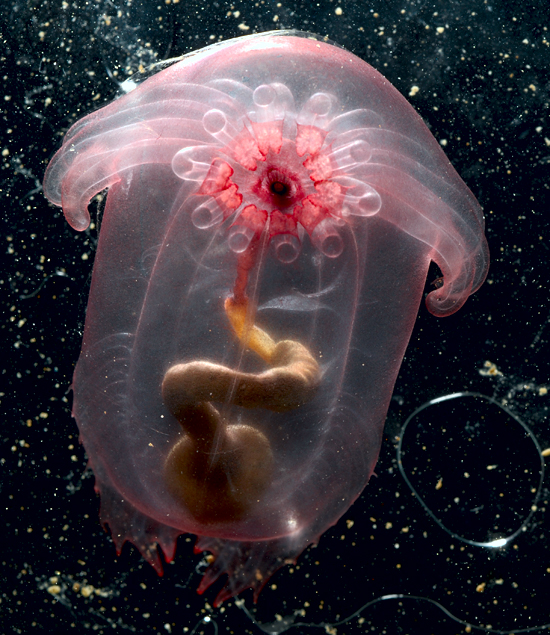
Sea cucumbers resemble large, leathery slugs that typically amble across the seabed. Unusually, Enypniastes has developed webbed swimming structures at the front and back of the body, and can swim long distances of up to 1,000m (3,280 ft) up into the water column.
They are brilliant red in colour, with a soft, delicate, transparent body, through which their intestine and other internal organs are visible.
Their mouths are surrounded by tentacles which are used to gather sediment from the sea floor.
Sea cucumbers are capable of swimming up from the bottom by undulating the cape-like structure around the top of the animal. They are graceful, slow swimmers.
When attacked by predators, they produce bioluminescence across their entire body surface, before shedding the sticky glowing skin as a distraction ploy.
Humphead Parrotfish
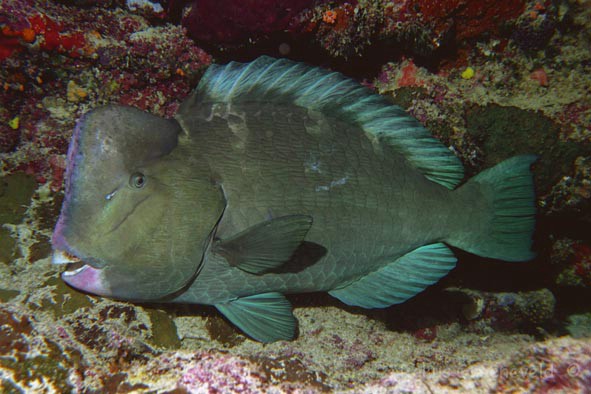
The green humphead parrotfish, Bolbometopon muricatum, is the largest species of parrotfish growing to lengths of 1.3 metres (4.3 ft) and weighing up to 46 kilograms (100 lb). It is found on reefs in the Indian and Pacific Oceans, from the Red Sea in the west to Samoa in the east, and from the Yaeyama Islands in the north to the Great Barrier Reef, Australia in the south.
Other common names include bumphead parrotfish, humphead parrotfish, double-headed parrotfish, buffalo parrotfish and giant parrotfish.
Unlike wrasses, it has a vertical head profile, and unlike other parrotfishes, it is uniformly covered with scales except for the leading edge of the head which is often light green to pink. Primary phase colouration is a dull gray with scattered white spots, gradually becoming uniformly dark green. This species does not display sex-associated patterns of color change. Adults develop a bulbous forehead and their teeth plates are exposed (only partly covered by lips). The species is slow growing and long-lived (up to 40 years), with delayed reproduction and low replenishment rates. This species is gregarious and usually occurs in small aggregations, but group size can be quite large (> 75) on seaward and clear outer lagoon reefs.
Barramundi
The Barramundi (Lates calcarifer), also known as Asian Seabass, is a species of catadromous fish in familyLatidae of order Perciformes. The native species is widely distributed in the Indo-West Pacific region from the Persian Gulf, through Southeast Asia to Papua New Guinea and Northern Australia. Known in Thai language as Pla Krapong (Thai: ปลากระพง), it is very popular in Thai cuisine. It is known as pandugappa in the Telugu language in India.
Barramundi is a loanword from an Australian Aboriginal language of the Rockhampton area in Queensland Originally, the name barramundi referred to saratoga and Gulf saratoga. meaning "large-scaled river fish". However, the name was appropriated for marketing reasons during the 1980s, a decision which has aided in raising the profile of this fish significantly.L. calcarifer is broadly referred to as Asian seabass by the international scientific community, but is also known as giant perch, giant seaperch, Australian seabass, and by a variety of names in other local languages, such as Ikan Siakap or Ikan Kakap Putih in Indonesian and also known as selunsung in local sabahan. 'Barra Mundi' when pronounced as two words, is clearly of Indian origin meaning 'big head'.
Bowhead Whale
The bowhead whale (Balaena mysticetus) is a baleen whale of the right whale family Balaenidae in suborderMysticeti. A stocky dark-colored whale without a dorsal fin, it can grow to 20 meters (66 ft) in length. Estimated maximum weight of this thick-bodied species is 136 tonnes (134 LT; 150 ST), second only to the blue whale, although the bowhead's maximum length is less than several other whales. It lives entirely in fertile Arctic and sub-Arctic waters, unlike other whales that migrate to feed or reproduce. It is also known as Greenland right whale or Arctic whale. The bowhead is perhaps the longest-living mammal, and has the largest mouth of any animal.
The bowhead was an early whaling target. Its population was severely reduced before a 1966 moratorium. The population is estimated to be over 24,900 worldwide, down from an estimated 50,000 before whaling.
The bowhead whale has a robust, dark-colored body, no dorsal fin and a strongly bowed lower jaw and narrow upper jaw. Its baleen, the longest of any whale at 3 meters (10 ft), strains tiny prey from the water. The whale has a massive bony skull which it uses to break through the Arctic ice to breathe. Inuit hunters have reported them surfacing through 60 cm (24 in) of ice. The bowhead may reach up to 20 m (66 ft). The largest yet reported was 21.2 m (70 ft) m for an unweighed giant caught off Spitsbergen, Norway. Females are larger than males. Its blubber is the thickest of any animal, averaging 43–50 cm (17–20 in).
Kitefin Shark
The kitefin shark or seal shark (Dalatias licha) is a species of dogfish shark in the family Dalatiidae, and the only species in its genus. It is found sporadically around the world, usually close to the sea floor at depths of 200–600 m (660–2,000 ft). With a sizable oil-filled liver to maintain neutral buoyancy, this shark is able to cruise slowly through the water while expending little energy. The kitefin shark has a slender body with a very short, blunt snout, large eyes, and thick lips. Its teeth are highly differentiated between the upper and lower jaws, with the upper teeth small and narrow and the lower teeth large, triangular, and serrated. Its typical length is 1.0–1.4 m (3.3–4.6 ft).
Armed with large teeth and a strong bite, the kitefin shark is a powerful, solitary predator that takes many different types of prey, ranging from bony fishes, sharks and rays, to cephalopods, crustaceans, polychaete worms, siphonophores, and possibly carrion. It also takes bites out of animals larger than itself, similar to its smaller relative, the cookiecutter shark (Isistius brasiliensis). This shark is aplacental viviparous and gives birth to 10–14 young. The kitefin shark is fished commercially for its meat, skin, and liver oil, primarily by Portugal and Japan. A fishery targeting this species existed off the Azores from the 1970s to the 1990s, but collapsed due to overfishing and falling liver oil prices; the rapid depletion of the Azores stock is often cited as an example of the susceptibility of deep-sea sharks to human exploitation. The low reproductive rate of this species renders it susceptible to overfishing and, coupled with known population declines, has led it to be assessed as Near Threatened by the International Union for Conservation of Nature (IUCN).
Bristlemouth
Gonostomatidae is a family of deep-water marine fish, commonly named bristlemouths, lightfishes or anglemouths. It is a relatively small family, containing only eight known genera and 32 species. However, bristlemouths make up for their lack of diversity with numbers: Cyclothone, with 12 species, is thought to be (along with Vinciguerria), the most abundant vertebrate genus in the world.
The fossil record of this family dates back to the Miocene epoch, and was discovered by L. S. Berg in 1958. The fish are mostly found in the Atlantic Ocean, Indian Ocean and Pacific Ocean, although the species Cyclothone microdon may be found in Arctic waters. They have elongated bodies from 2 centimetres (0.79 in) to 30 centimetres (12 in) in length. They have a number of green or red light-producing photophores aligned along the undersides of their heads or bodies. Their chief common name, bristlemouth, comes from their odd equally-sized and bristle-like teeth. Due to the depth in which they live, where very little light penetrates, the fish is typically colored black so as to hide from prey.
Tube-eye Fish
The tube-eye or thread-tail, Stylephorus chordatus, is a deep-sea Stylephoriformes fish, the only fish in the genus Stylephorus and family Stylephoridae.
It is found in deep subtropical and tropical waters around the world, living at depths during the day and making nightly vertical migrations to feed on plankton. It is an extremely elongated fish: although its body grows only to 28 centimetres (11 in) long, it has a pair of tail fin rays that triple its length to about 90 centimetres (35 in). Its eyes are tubular in shape, resembling a pair of binoculars.
It has a tubular mouth through which it sucks seawater by enlarging its oral cavity to about forty times its original size. It then expels the water through the gills, leaving behind the copepods on which it feeds.
The tube-eye was previously thought to be related to Lampridiformes, a group of other bizzarre fishes. However it has now been placed in a new order, named Stylephoriformes.
Squidworm
In October 2007, US and Filipino scientists travelled to the Celebes Sea in south-east Asia, searching for new species living in its deep water. When they discovered this extraordinary worm - which they named "squidworm" - they knew they had something completely different.
Harpagofututor
Harpagofututor is an extinct genus of cartilaginous fish from the Mississippian of North America.
It was an eel-shaped fish with almost no scales. About eight inches long, it swam with some help from its fins, but also relied on whole-body locomotion to move. The fish also had teeth sufficient for eating shellfish.
Harpagofututor is thought to be related to the cochliodonts, chimaeroids, and Chondrenchelys problematica.
The fish was discovered in the 1980s in Montana's Bear Gulch area by Adelphi University palaeontologist Richard Lund, who has been exploring the limestone formations of the region since 1969. The area was thought to be the location of a shallow bay. Fish remains are found throughout the area. Further examinations of the soft tissue pigments of these fossilized remains led to more information about the fish and information about its internal organs, including its reproductive system.