Mass Strandings
The term "mass stranding" refers to events in which groups of distressed cetaceans (whales, dolphins, porpoises) come ashore alive. They can involve anywhere from a few to several hundred animals. Mass strandings regularly occur in several parts of the world (primarily Australia, New Zealand and Cape Cod), yet so far we have no universally accepted, comprehensive explanation for this syndrome.
In many cases, the animals show no obvious signs of health problems other than those resulting from coming ashore. Once a cetacean comes ashore, a cascade of physiological changes occurs, often resulting in shock and death. Because the species typically involved are extremely social, the bonds that hold groups together are perhaps strong enough to supercede the survival instincts of individual animals. Although we don't know what specifically might set off a mass stranding event, we know that once animals start coming ashore, it's extremely difficult to stop the process from continuing and escalating. Affected animals will relentlessly follow one another ashore, as if crippled by widespread panic, even when there is clear access to open water. Gregarious offshore species such as Atlantic white-sided dolphins (Lagenorhynchus acutus) and long-finned pilot whales (Globicephala melaena) are particularly known to mass strand in New England, mainly on Cape Cod.
A staggering 97 dolphins died during a stranding event in January and February of 1998. Carcasses were recovered over a four-week period from over 25 miles of shoreline between Dennis and Wellfleet, on Cape Cod, Massachusetts. Eighty of these were Atlantic white-sided dolphins (Lagenorhynchus acutus) and 16 were common dolphins (Delphinus delphis). Unfortunately, none were healthy enough to be relocated or saved for rehabilitation. A team of biologists, technicians and veterinarians, including many volunteers, responded to the event, providing supportive care, collecting blood samples, and later conducting necropsies and preparing tissue samples.While the exact cause of this stranding is unknown, and may never be known, we believe that a combination of factors, including the new moon (producing unusually extreme tides), and a powerful coastal storm may all have contributed to the event. Another noteworthy aspect of this mass stranding was that it involved two species of dolphins rather than just one. About a year later, in March of 1999, a similar stranding event occurred, again during stormy weather with high winds and unusually extreme tides. This time a total of 54 white-sided dolphins stranded on the Cape Cod coast, from Wellfleet to Eastham. Fortunately, three of these animals were found to be in good physical condition and were transported to a beach in Provincetown, where they were released into open water.
Although mass strandings typically occur during winter months and at times of severe weather, they can occur at any time of year and under any conditions. During the summer of 2000, we responded to a mass stranding of 11 pilot whales on Nantucket Island, on July 4. The weather was clear and calm and the animals showed no obvious underlying health problems.This was the first pilot whale mass stranding to occur in this region since 1992.
Vaquita
The vaquita (Phocoena sinus) is a rare species of porpoise. It is endemic to the northern part of the Gulf of California. Estimates of the number of individuals alive range from 100 to 300. The word "vaquita" is Spanish for little cow.
Other names include Cochito, Gulf of California Harbor Porpoise, Gulf of California Porpoise, Gulf Porpoise, Hafenschweinswal, and Marsouin du Golfe de Californie.
The Vaquita has a classic porpoise shape (stocky and curved into a star shape when viewed from the side). It is the smallest of the porpoises. Individuals may grow up to 150 centimetres (4.92 ft) in length and weigh up to 50 kilograms (110.2 lb). They have large black eye rings and lip patches. The upper side of the body is medium to dark grey. The underside is off-white to light grey but the demarcation between the sides is indistinct. The flippers are proportionately larger than in other phocoenids and the fin is taller and more falcate. The skull is smaller and the rostrum is shorter and broader than in other members of the genus.
The Vaquita is one of the top 100 EDGE Species, meaning "Evolutionarily Distinct, Globally Endangered". Evolutionarily distinct animals have no close relatives and represent proportionally more of the tree of life than other species, meaning they are top priority for conservation campaigns.
On October 28, 2008 Canada, Mexico, and the United States, under the jurisdiction of the NAFTA environmental organization, the Commission for Environmental Cooperation, launched the North American Conservation Action Plan (NACAP) for the Vaquita. The NACAP is a strategy to support Mexico’s efforts to recover the Vaquita, which is considered the world’s most-endangered marine mammal. The U.S. government has listed the vaquita as endangered under the Endangered Species Act.
Stellar's Sea Cow
Steller's sea cow (Hydrodamalis gigas) was a large herbivorous marine mammal. In historical times, it was the largest member of the order Sirenia, which includes its closest living relative, the dugong (Dugong dugon), and the manatees (Trichechus spp.). Formerly abundant throughout the North Pacific, its range was limited to a single, isolated population on the uninhabited Commander Islands by 1741 when it was first described by Georg Wilhelm Steller, chief naturalist on an expedition led by explorer Vitus Bering. Within 27 years of discovery by Europeans, the slow moving and easily captured Steller's sea cow was hunted to extinction.
The sea cow grew at least 8 metres (26 ft) to 9 meters or 30 feet long, much larger than the manatee or dugong. Steller's work contains two contradictory weights: 4 and 24.3 tons. The true value probably lies between these figures, around 8-10 tons. It looked somewhat like a large seal, but had two stout forelimbs and a whale-like tail and the fluke. According to Steller, "The animal never comes out on shore, but always lives in the water. Its skin is black and thick, like the bark of an old oak…, its head in proportion to the body is small…, it has no teeth, but only two flat white bones—one above, the other below". It was completely tame, according to Steller. They fed on a variety of kelp. Wherever sea cows had been feeding, heaps of stalks and roots of kelp were washed ashore. The sea cow was also a slow swimmer and apparently was unable to submerge.
The population of sea cows was small and limited in range when Steller first described them. Steller said they were numerous and found in herds, but zoologist Leonhard Hess Stejneger later estimated that at discovery there had been fewer than 1,500 remaining, and thus had been in immediate danger of extinction from overhunting by humans. They were quickly wiped out by the sailors, seal hunters, and fur traders that followed Bering's route past the islands to Alaska, who hunted them both for food and for their skins, which were used to make boats. They were also hunted for their valuable subcutaneous fat, which was not only used for food (usually as a butter substitute), but also for oil lamps because it did not give off any smoke or odor and could be kept for a long time in warm weather without spoiling. By 1768, 27 years after it had been discovered by Europeans, Steller's sea cow was extinct.
Fossils indicate that Steller's sea cow was formerly widespread along the North Pacific coast, reaching south to Japan and California. Given the rapidity with which its last population was eliminated, it is likely that aboriginal hunting caused its extinction over the rest of its original range (aboriginal peoples apparently never inhabited the Commander Islands).
Bowhead Whale
The bowhead whale (Balaena mysticetus) is a baleen whale of the right whale family Balaenidae in suborderMysticeti. A stocky dark-colored whale without a dorsal fin, it can grow to 20 meters (66 ft) in length. Estimated maximum weight of this thick-bodied species is 136 tonnes (134 LT; 150 ST), second only to the blue whale, although the bowhead's maximum length is less than several other whales. It lives entirely in fertile Arctic and sub-Arctic waters, unlike other whales that migrate to feed or reproduce. It is also known as Greenland right whale or Arctic whale. The bowhead is perhaps the longest-living mammal, and has the largest mouth of any animal.
The bowhead was an early whaling target. Its population was severely reduced before a 1966 moratorium. The population is estimated to be over 24,900 worldwide, down from an estimated 50,000 before whaling.
The bowhead whale has a robust, dark-colored body, no dorsal fin and a strongly bowed lower jaw and narrow upper jaw. Its baleen, the longest of any whale at 3 meters (10 ft), strains tiny prey from the water. The whale has a massive bony skull which it uses to break through the Arctic ice to breathe. Inuit hunters have reported them surfacing through 60 cm (24 in) of ice. The bowhead may reach up to 20 m (66 ft). The largest yet reported was 21.2 m (70 ft) m for an unweighed giant caught off Spitsbergen, Norway. Females are larger than males. Its blubber is the thickest of any animal, averaging 43–50 cm (17–20 in).
Fish Kill
The term fish kill is applied to a localized die-off of fish populations which may also be associated with more generalized mortality of aquatic life. It may result from a variety of causes, most frequently ecological hypoxia (oxygen depletion). The hypoxic event may be brought on by factors including high and temperatures, weather, drought, thermal pollution and algae blooms. Fish kills may also occur due to the presence of disease, agricultural sewage runoff, oil or chemical spill, hazardous waste spills, sea-quakes, inappropriate re-stocking of fish, underwater explosions, and other catastrophic events that upset a normally stable aquatic population.
Fish kills are often the first visible signs of ecological hypoxia and are usually investigated as a matter of urgency by environmental agencies to determine the cause of the hypoxic event and whether or not the cause was man made, due to pollution, or naturally occurring.
Related Articles :
Dead Zones
Sawfish
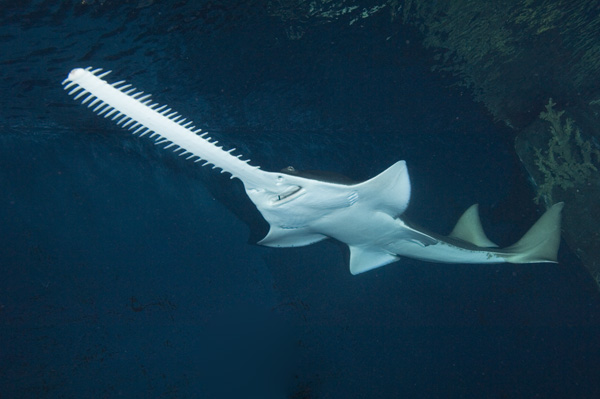
Sawfishes are a family of rays, characterized by a long, toothy snout. Several species can attain sizes up to approximately 7 metres or 23 ft, but the family as a whole is largely unknown and little studied. They are members of the sole living family Pristidae within the order Pristiformes, from the Ancient Greek pristēs (πρίστης) meaning "a sawyer" or "a saw".
They are not to be confused with sawsharks (order Pristiophoriformes), which have a similar appearance.
All species of sawfishes are considered Critically Endangered by the IUCN, and the only legal international trade involves live Pristis microdon to appropriate aquaria for primarily conservation purposes.
The most distinctive feature of a sawfish is the saw-like rostrum. The rostrum is covered with motion- and electro-sensitive pores that allow sawfish to detect movement and even heartbeats of buried prey in the ocean floor as the sawfish hovers over the bottom. It is also used as a digging tool to unearth buried crustaceans. When a suitable prey swims by, the normally lethargic sawfish will spring from the bottom and slash at it with its saw. This generally stuns or injures the prey sufficiently for the sawfish to devour it without much resistance. Sawfish have also been known to defend themselves with their rostrum, against predators such as sharks, and against intruding divers. The "teeth" protruding from the rostrum are not real teeth, but modified tooth-like structures called denticles.
River Dolphins
River dolphins are four living species of dolphin which reside in freshwater rivers and estuaries. River dolphins inhabit areas of Asia and South America. They are classed in the Platanistoidea superfamily of cetaceans. Three species live in fresh water rivers. The fourth species, the La Plata Dolphin, lives in salt-water estuaries and near-shore marine environments. However, it is scientifically classed in the river dolphin group rather than the oceanic dolphin family.
River dolphins are in danger of extinction due to habitat loss, hunting by humans, and naturally low numbers.
The largest river dolphins usually grow up to 2.4 meters (8 feet) long, but most of the animals are smaller. River dolphins may be white, pink, yellow, brown, gray, or black.
The four families of river dolphins are classified by Rice, 1998 as belonging to Platanistoidea. Formerly Platanistidae was listed as the only extant family of the Platanistoidea superfamily. The previously accepted classification treated all four families as belonging to this family and treated the Ganges and Indus River Dolphins as separate species. Five lineages of dolphin have evolved to live in big, muddy rivers. River dolphins are thought to have relictual distributions. Their ancestors originally occupied marine habitats, but were then displaced from these habitats by modern dolphin lineages. Many of the morphological similarities and adaptations to freshwater habitats arose due to convergent evolution. A December 2006 survey found no members of Lipotidae (commonly known as the Yangtze River dolphin) and declared the species functionally extinct.