Ambergris occurs as a biliary secretion of the intestines of the sperm whale and can be found floating upon the sea, or in the sand near the coast. It is also sometimes found in the abdomens of whales. Because the beaks of giant squids have been found embedded within lumps of ambergris, scientists have theorized that the substance is produced by the whale's gastrointestinal tract to ease the passage of hard, sharp objects that the whale might have eaten.
Ambergris is found in lumps of various shapes and sizes, weighing from 15 g (½ oz) to 50 kg (100 pounds) or more. When initially expelled by or removed from the whale, the fatty precursor of ambergris is pale white in color (sometimes streaked with black), soft, with a strong fecal smell. Following months to years of photo-degradation and oxidation in the ocean, this precursor gradually hardens, developing a dark gray or black color, a crusty and waxy texture, and a peculiar odor that is at once sweet, earthy, marine, and animalic. Its smell has been generally described as a vastly richer and smoother version of isopropanol without its stinging harshness.
Ambergris has been mostly known for its use in creating perfume and fragrance much like musk. While perfumes can still be found with ambergris around the world, American perfumers usually avoid it because of legal ambiguities. It was banned from use in many countries in the 1970s, including the United States, because its precursor originates from the sperm whale, which is an endangered species. However, it has been legal since 2005 because of strict monitoring of distributors who ensure that only ambergris that has been naturally washed to shore is sold. Ancient Egyptians burned ambergris as incense, while in modern Egypt ambergris is used for scenting cigarettes. The ancient Chinese called the substance "dragon's spittle fragrance". During the Black Death in Europe, people believed that carrying a ball of ambergris could help prevent them from getting the plague. This was because the fragrance covered the smell of the air which was believed to be the cause of plague.
This substance has also been used historically as a flavouring for food, and some people consider it an aphrodisiac. During the Middle Ages, Europeans used ambergris as a medication for headaches, colds, epilepsy, and other ailments.
Source
Vaquita
The vaquita (Phocoena sinus) is a rare species of porpoise. It is endemic to the northern part of the Gulf of California. Estimates of the number of individuals alive range from 100 to 300. The word "vaquita" is Spanish for little cow.
Other names include Cochito, Gulf of California Harbor Porpoise, Gulf of California Porpoise, Gulf Porpoise, Hafenschweinswal, and Marsouin du Golfe de Californie.
The Vaquita has a classic porpoise shape (stocky and curved into a star shape when viewed from the side). It is the smallest of the porpoises. Individuals may grow up to 150 centimetres (4.92 ft) in length and weigh up to 50 kilograms (110.2 lb). They have large black eye rings and lip patches. The upper side of the body is medium to dark grey. The underside is off-white to light grey but the demarcation between the sides is indistinct. The flippers are proportionately larger than in other phocoenids and the fin is taller and more falcate. The skull is smaller and the rostrum is shorter and broader than in other members of the genus.
The Vaquita is one of the top 100 EDGE Species, meaning "Evolutionarily Distinct, Globally Endangered". Evolutionarily distinct animals have no close relatives and represent proportionally more of the tree of life than other species, meaning they are top priority for conservation campaigns.
On October 28, 2008 Canada, Mexico, and the United States, under the jurisdiction of the NAFTA environmental organization, the Commission for Environmental Cooperation, launched the North American Conservation Action Plan (NACAP) for the Vaquita. The NACAP is a strategy to support Mexico’s efforts to recover the Vaquita, which is considered the world’s most-endangered marine mammal. The U.S. government has listed the vaquita as endangered under the Endangered Species Act.
Triggerfish
Triggerfishes are about 40 species of often brightly colored fishes of the family Balistidae. Often marked by lines and spots, they inhabit tropical and subtropical oceans throughout the world, with the greatest species richness in the Indo-Pacific. Most are found in relatively shallow, coastal habitats, especially at coral reefs, but a few, such as the aptly named oceanic triggerfish (Canthidermis maculata), are pelagic. While several species from this family are popular in the marine aquarium trade, they are often notoriously ill-tempered.
The largest member of the family, the stone triggerfish (Pseudobalistes naufragium) reaches 1 metre (3.3 ft), but most species have a maximum length between 20 and 50 centimetres (7.9 and 20 in).
The rather bizarre anatomy of the triggerfishes reflects their typical diet of slow-moving, bottom dwelling crustaceans, mollusks, sea urchins and other echinoderms, generally creatures with protective shells and spines. Many will also take small fishes and some, notably the members of the genus Melichthys, feed on algae. A few, for example the redtoothed triggerfish (Odonus niger), mainly feed on plankton. They are known to exhibit a level of intelligence that is unusual among fishes, and have the ability to learn from previous experiences.
Some triggerfish species can be quite aggressive when guarding their eggs. Both the picasso (Rhinecanthus aculeatus) and titan triggerfish (Balistoides viridescens) viciously defend their nests against intruders, including scuba divers and snorkelers. Their territory extends in a cone from the nest toward the surface, so swimming upwards can put a diver further into the fishes' territory; a horizontal swim away from the nest site is best when confronted by an angry triggerfish. Unlike the relatively small picasso triggerfish, the titan triggerfish poses a serious threat to inattentive divers due to its large size and powerful teeth.
Triggerfish are notorious bait stealers; rather than swallowing a bait whole, they nibble off small bites of it, making a small, stout hook essential to success in hooking them. Accordingly, the best baits are tough strips of fish skin, squid mantle etc.
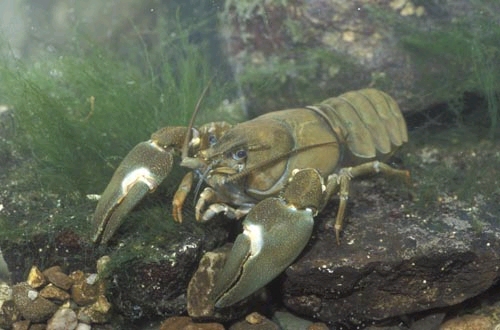
Signal Crayfish
The signal crayfish, Pacifastacus leniusculus, is a North American species of crayfish. It was introduced to Europe in the 1960s to supplement the Scandinavian Astacus astacus fisheries, which were being damaged by crayfish plague, but the imports turned out to be a carrier of that disease. The signal crayfish is now an invasive species, ousting native species across Europe and Japan.
From 1907, crayfish plague, an infectious disease caused by the water mould Aphanomyces astaci, damaged stocks of the native European crayfish Astacus astacus. Since the signal crayfish occupied a similar ecological niche in its native range, it was imported in the 1960s to Sweden and Finland to allow recreational and commercial crayfish capture. It was not realised at the time that the signal crayfish was a carrier of the crayfish plague. All American species carry the infection, but it is only lethal to individuals that are already stressed; to European species, the infection is rapidly fatal.
The signal crayfish is now the most widespread alien crayfish in Europe, occurring in 25 countries, from Finland to Great Britain and from Spain to Greece. It was first introduced to Great Britain in 1976, and is now widespread across the island as far north as the Moray Firth. It has also been observed on the Isle of Man, but has not yet been introduced to Ireland.
Comb Jelly
The Ctenophora (pronounced /tɨˈnɒfərə/, singular ctenophore, pronounced /ˈtɛnəfɔər/ or /ˈtiːnəfɔər/), (from the Greek ctena/χτένα (comb), phero/φέρω (carry) commonly known as comb jellies, are a phylum of animals that live in marine waters worldwide. Their most distinctive feature is the "combs", groups of cilia that they use for swimming, and they are the largest animals that swim by means of cilia — adults of various species range from a few millimeters to 1.5 meters (59 in) in size. Like cnidarians, their bodies consist of a mass of jelly with one layer of cells on the outside and another lining the internal cavity. In ctenophores these layers are two cells deep while those in cnidarians are only one cell deep. Ctenophores also resemble cnidarians in having a decentralized nerve net rather than a brain. Some authors combined ctenophores and cnidarians in one phylum, Coelenterata, as both groups rely on water flow through the body cavity for both digestion and respiration. Increasing awareness of the differences persuaded more recent authors to classify them in separate phyla.
Almost all ctenophores are predators, taking prey ranging from microscopic larvae and rotifers to the adults of small crustaceans; the exceptions are juveniles of two species, which live as parasites on the salps on which adults of their species feed. In favorable circumstances ctenophores can eat ten times their own weight in a day. There are only 100–150 valid species and possibly another 25 that have not been fully described and named. The textbook examples are cydippids with egg-shaped bodies and a pair of retractable tentacles fringed with tentilla ("little tentacles") that are covered with colloblasts, sticky cells that capture prey. The phylum has a wide range of body forms, including the flattened deep-sea platyctenids, in which the adults of most species lack combs, and the coastal beroids, which lack tentacles and prey on other ctenophores by using huge mouths armed with groups of large, stiffened cilia that act as teeth. These variations enable different species to build huge populations in the same area, because they specialize in different types of prey, which they capture by as wide a range of methods as spiders use.
Despite their soft, gelatinous bodies, fossils thought to represent ctenophores, apparently with no tentacles but many more comb-rows than modern forms, have been found in lagerstätten as far back as the early Cambrian, about 525 million years ago. The position of the ctenophores in the evolutionary family tree of animals has long been debated, and the majority view at present, based on molecular phylogenetics, is that cnidarians and bilaterians are more closely related to each other than either is to ctenophores. A recent molecular phylogenetics analysis concluded that the common ancestor of all modern ctenophores was cydippid-like, and that all the modern groups appeared relatively recently, probably after the Cretaceous-Tertiary extinction 65.5 million years ago. Evidence accumulating since the 1980s indicates that the "cydippids" are not monophyletic, in other words do not include all and only the descendants of a single common ancestor, because all the other traditional ctenophore groups are descendants of various cydippids.