Showing posts with label It's Cute. Show all posts

Sunday, August 14, 2011

August 14, 2011 : Bobtail Squid


Bobtail squid (order Sepiolida) are a group of cephalopods closely related to cuttlefish. Bobtail squid tend to have a rounder mantle than cuttlefish and have no cuttlebone. They have eight suckered arms and two tentacles and are generally quite small (typical male mantle length being between 1 and 8 cm). Sepiolids live in shallow coastal waters of the Pacific Ocean and some parts of the Indian Ocean as well as in shallow waters on the west coast of the Cape Peninsula off South Africa. Like cuttlefish, they can swim by either using the fins on their mantle or by jet propulsion. They are also known as dumpling squid (owing to their rounded mantle) or stubby squid.

Bobtail squid have a symbiotic relationship with bioluminescent bacteria (
Vibrio fischeri), which inhabit a special light organ in the squid's mantle. The bacteria are fed a sugar and amino acid solution by the squid and in return hide the squid's silhouette when viewed from below by matching the amount of light hitting the top of the mantle. The organ contains filters which may alter the wavelength of luminescence closer to that of downwelling moonlight and starlight; a lens with biochemical similarities to the squid's eye to diffuse the bacterial luminescence; and a reflector which directs the light ventrally.

Source

Friday, March 11, 2011

March 11, 2011 : Harbour Porpoise


Harbour Porpoise

The Harbour Porpoise (Phocoena phocoena) is one of six species of porpoise. It is one of the smallest marine mammals. As its name implies, it stays close to coastal areas or river estuaries and as such is the most familiar porpoise to whale watchers. This porpoise often ventures up rivers and has been seen hundreds of miles from the sea. The Harbour porpoise may be polytypic, with geographically distinct populations representing distinct races: P. p. phocoena in the North Atlantic and West Africa, P. p. relicta in the Black Sea and Sea of Azov, an unnamed population in the Northwest Pacific and P. p. vomerina in the Northeast Pacific.

The Harbour Porpoise is a little smaller than the other porpoises. It is about 67–85 cm (26–33 in) long at birth, weighing 6.4-10 kg. Both sexes grow up to be 1.4 m to 1.9 m (4.6-6.2 ft). The females are heavier, with a maximum weight of around 76 kg (167 pounds) compared with the males' 61 kg (134 pounds). The body is robust and the animal is at its maximum girth just in front of its triangular dorsal fin. The beak is poorly demarcated. The flippers, dorsal fin, tail fin and back are a dark grey. The sides are a slightly speckled lighter grey. The underside is much whiter, though there are usually grey stripes running along the throat from the underside of their body.

Harbour Porpoises are limited to northern or and subarctic waters. They are often found in fjords, bays, estuaries and harbors, hence the name. Harbour Porpoises feed mostly on small pelagic schooling fish, particularly herring, capelin, and sprat. They will, however, also eat squid and crustaceans in some areas. The porpoises mostly forage near the sea bottom in waters less than 200m deep. They will also forage near the surface when feeding on sprat. When in deeper waters, porpoises may forage for mid-water fish like pearlsides. Harbour porpoises tend to be independent foragers, but groups have been observed to collaborate to keep schools of fish closely together and herd them to the surface. Young porpoises need to consume about 7% to 8% of their body weight each day in order to survive, which is approximately 14 pounds or 7 kilograms of fish a day. Significant predators of harbour porpoises include white sharks and orcas. Researchers at the University of Aberdeen in Scotland have also discovered that the local bottlenose dolphins attack and kill harbour porpoises without eating them due to competition for a decreasing food supply.

Saturday, March 5, 2011

March 5, 2011 : Ghost Crabs


Ghost Crabs

Ghost crabs, also called
sand crabs, are crabs of the genus Ocypode, common shore crabs in many countries. Characteristics of the genus include one claw being larger than the other, but this difference is not as marked as in male fiddler crabs.

Ghost crabs dominate sandy shores in tropical and subtropical areas, replacing the sandhoppers that predominate in cooler areas. They breathe through gills, which they periodically wet with seawater. They must also return to the ocean to release their eggs, which develop into marine larvae.


Adult ghost crabs dig deep burrows, comprising a log shaft with a chamber at the end, occasionally with a second entrace shaft. They remain in the burrow during the hottest part of the day, and throughout the coldest part of the winter. They emerge mostly at night, to feed on mole crabs and
coquina clams, although they will also eat a wide range of items, including carrion, debris and turtle hatchlings.

The name "ghost crab" derives from the animals' nocturnality and their pale colouration; only
O. gaudichaudii The scientific name is brightly coloured.Ocypode is derived from the Greek roots ocy- ("fast") and ποδός (podos, "foot"), in reference to the animal's speed.

Monday, February 14, 2011

February 14, 2011 : "Pastel" Octopus


"Pastel" Octopus

An unidentified purple octopus (pictured) is one of 11 potentially new species found this month during a deep-sea expedition off Canada's Atlantic coast, scientists say.


Still at sea, a team of Canadian and Spanish researchers is using a remotely operated vehicle called ROPOS for dives off Newfoundland with a maximum depth of about 9,800 feet (3,000 meters).

The 20-day expedition aims to uncover relationships between cold-water coral and other bottom-dwelling creatures in a pristine yet "alien" environment, according to the researchers' blog.


"It's been really spectacular," Ellen Kenchington, research scientist with the Fisheries Department of Canada—one of the organizations involved in the project—told Canada's CTV News website.


"It's really changing our perception of the diversity that's out there. ... We're seeing new species in deeper waters."

Thursday, January 20, 2011

January 20, 2011 : Manatee


Manatee

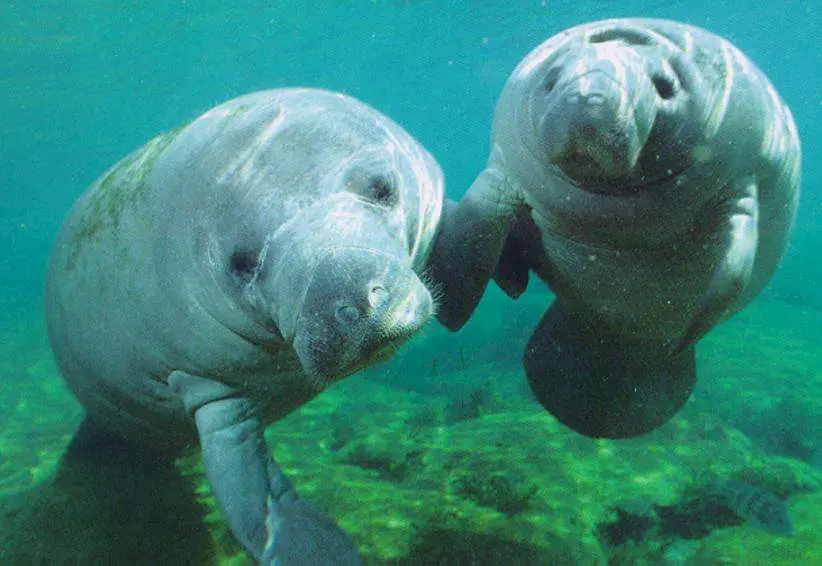
Manatees (family Trichechidae, genus Trichechus) are large, fully aquatic, mostly herbivorous marine mammals sometimes known as sea cows. There are three accepted living species of Trichechidae, representing three of the four living species in the order Sirenia: the Amazonian manatee (
Trichechus inunguis), the West Indian manatee (Trichechus manatus), and the West African manatee (Trichechus senegalensis). They measure up to 3.6 metres (12 ft)), and have paddle-like flippers. The name manatí comes from the Taíno, a pre-Columbian people of the Caribbean, meaning "breast".

Half a manatee's day is spent sleeping in the water, surfacing for air regularly at intervals no greater than 20 minutes. Manatees spend most of the rest of the time grazing in shallow waters at depths of 1–2 metres (3.3–6.6 ft). The Florida subspecies (T. m. latirostris) has been known to live up to 60 years.

Manatees inhabit the shallow, marshy coastal areas and rivers of the Caribbean Sea and the Gulf of Mexico (T. manatus, West Indian Manatee), the Amazon Basin (T. inunguis, Amazonian Manatee), and West Africa (T. senegalensis, West African Manatee). A fourth species, the Dwarf Manatee (T. "pygmaeus"), was recently proposed for a population found in the Brazilian Amazon, although some believe it to be an immature Amazon Manatee.

They enjoy warmer waters and are known to congregate in shallow waters, and frequently migrate through brackish water estuaries to freshwater springs. Manatees cannot survive below 15°C (288 K; 60°F). Their natural source for warmth during winter is warm-spring fed rivers.

Thursday, December 30, 2010

December 30, 2010 : Beluga Whale


Beluga Whale

The beluga or white whale, Delphinapterus leucas, is an Arctic and sub-Arctic species of cetacean. It is one of two members of the family Monodontidae, along with the narwhal. This marine mammal is commonly referred to simply as the beluga or sea canary due to its high-pitched twitter. It is up to 5 meters (16 ft) in length and an unmistakable all-white color with a distinctive protuberance on the head. From a conservation perspective, the beluga is considered "near threatened" by the International Union for Conservation of Nature; however the subpopulation from the Cook Inlet in Alaska is considered critically endangered and is under the protection of the United States' Endangered Species Act. Of seven Canadian beluga populations, two are listed as endangered, inhabiting eastern Hudson Bay, and Ungava Bay.

Belugas are highly sociable. Groups of males may number in the hundreds, while mothers with calves generally mix in slightly smaller groups. When pods aggregate in estuaries, they may number in the thousands. This can represent a significant proportion of the entire population and is when they are most vulnerable to hunting.

Pods tend to be unstable, meaning that they tend to move from pod to pod. Radio tracking has shown that belugas can start out in a pod and within a few days be hundreds of miles away from that pod. Mothers and calves form the beluga's closest social relationship. Nursing times of two years have been observed and lactational anestrus may not occur. Calves often return to the same estuary as their mother in the summer, meeting her sometimes even after becoming fully mature.

Belugas can be playful—they may spit at humans or other whales. It is not unusual for an aquarium handler to be drenched by one of his charges. Some researchers believe that spitting originated with blowing sand away from crustaceans at the sea bottom.

Unlike most whales, it is capable of swimming backwards.

Thursday, December 23, 2010

December 23, 2010 : Pipefish


Pipefish

Pipefishes or pipe-fishes (Syngnathinae) are a subfamily of small fishes, which, together with the seahorses, form the family Syngnathidae.


Pipefish look like straight-bodied seahorses with tiny mouths. The name is derived from the peculiar form of their snout, which is like a long tube, ending in a narrow and small mouth which opens upwards and is toothless. The body and tail are long, thin, and snake-like. They have a highly modified skeleton formed into armored plating. This dermal skeleton has several longitudinal ridges, so that a vertical section through the body looks angular, not round or oval as in the majority of other fishes.

A dorsal fin is always present, and is the principal (in some species, the only) organ of locomotion. The ventral fins are constantly absent, and the other fins may or may not be developed. The gill openings are extremely small and placed near the upper posterior angle of the gill cover.

Many are very weak swimmers in open water, moving slowly by means of rapid movements of the dorsal fin. Some species of pipefish have tails that are prehensile, as in seahorses. The majority of pipefishes have some form of a caudal fin (unlike seahorses), which can be used for locomotion. See fish anatomy for fin descriptions. There are species of pipefish with more developed caudal fins, such as the group collectively known as flagtail pipefish, which are quite strong swimmers.

Pipefishes, like their seahorse relatives, leave most of the parenting duties to the male. Courtship tends to be elaborately choreographed displays between the males and females. Pair bonding varies wildly between different species of pipefish. While some are monogamous or seasonally monogamous, others are not.

Saturday, December 11, 2010

December 11, 2010 : Albino Dolphin


Albino Dolphin

A rare pink bottlenose dolphin has been spotted in a Louisiana lake. The albino dolphin has been making a splash with locals and visitors to the area since it was first spotted last year.

The animal has been photographed by local charter boat Captain Erik Rue, 42, who has been studying the dolphin since it first surfaced in Lake Calcasieu, an inland saltwater estuary, north of the Gulf of Mexico in south-west Louisiana. Rue originally saw the rare albino dolphin, which also has reddish eyes, swimming with a pod of four other dolphins.

"I just happened to see a little pod of dolphins, and I noticed one that was a little lighter ... I had never seen anything like it. It's the same colour throughout the whole body," said Rue.

"The dolphin appears to be healthy and normal other than its coloration, which is quite beautiful and stunningly pink," Rue said he had seen the dolphin 40 to 50 times.

"As time has passed the young mammal has grown and sometimes ventures away from its mother to feed and play but always remains in the vicinity of the pod," he said.

Regina Asmutis-Silvia, a senior biologist with the Whale and Dolphin Conservation Society, said: "I have never seen a dolphin coloured in this way in all my career."

"It is a truly beautiful dolphin but people should be careful, as with any dolphins, to respect it - observe from a distance, limit their time watching, don't chase or harass it."

"While this animal looks pink, it is an albino which you can notice in the pink eyes. Albinism is a genetic trait and it unclear as to the type of albinism this animal inherited."

A different dolphin species, the endangered Amazon river boto (Inia geoffrenis), which lives in South America , is sometimes called the pink river dolphin because of its appearance.

Friday, December 3, 2010

December 3, 2010 : Axolotl


Axolotl


The axolotl (pronounced /ˈæksəlɒtəl/), Ambystoma mexicanum, is the best known of the Mexican neotenicmole salamanders belonging to the Tiger Salamander complex. Larvae of this species fail to undergo metamorphosis, so the adults remain aquatic and gilled. The species originates from the lake underlying Mexico City and is also called ajolote (which is also the common name for the Mexican Mole Lizard). Axolotls are used extensively in scientific research due to their ability to regenerate most body parts, ease of breeding, and large embryos. They are commonly kept as pets in the United States, Great Britain, Australia, Japan (sold under the name wooper looper (ウーパールーパー Ūpā Rūpā)) and other countries.

Axolotls should not be confused with waterdogs, the larval stage of the closely related Tiger Salamanders (Ambystoma tigrinum and Ambystoma mavortium), which are widespread in much of North America and also occasionally become neotenic, nor with mudpuppies (Necturus spp.), fully-aquatic salamanders which are not closely related to the axolotl but bear a superficial resemblance.

As of 2010, wild axolotls are near extinction due to urbanization in Mexico City and polluted waters. Nonnative fish such as African tilapia and Asian carp have also recently been introduced to the waters. These new fish have been eating the axolotls' young, as well as its primary source of food. The axolotl is currently on the International Union for Conservation of Nature's annual Red List of threatened species.

Thursday, October 28, 2010

October 28, 2010 : Nectocaris (Extinct)


Nectocaris

Nectocaris is a genus containing one species (
N. pteryx) of early cephalopod known from the Middle Cambrian Burgess Shale. Walcott, the discoverer of the shale, had photographed the one specimen he had collected in the 1910s, but never had time to investigate it further. It was not until 1976 that it was formally described, by Simon Conway Morris. The head had two stalked eyes, one pair of tentacles, and a flexible siphon underneath its body. Fleshy fins supported by internal spines ran along the sides of the flattened, kite-shaped body.

Because the genus was only known from a single specimen, Conway Morris was unable to deduce its affinity. It had some features which were reminiscent of the arthropods, but these could well have been convergently derived. Its fins were very unlike the arthropods. Working from photographs, the Italian palaeontologist Alberto Simonetta believed he could classify
Nectocaris within the chordates. He focussed mainly on the tail and fin morphology, interpreting Conway Morris's 'gut' as a notochord - a distinctive chordate feature. However, his case was unconvincing, and its classification remained uncertain until 2010, when Martin Smith and Jean-Bernard Caron described 91 additional specimens, many better preserved than the type. These allowed them to reinterpret Nectocaris as a primitive cephalopod, with two tentacles instead of the 8 or 10 of modern cephalopods. The structure previous researchers had identified as an oval carapace or shield behind the eyes was shown to actually be a soft funnel, similar to the ones used for propulsion by modern cephalopods. The interpretation would push back the origin of cephalopods by at least 30 million years, much closer to the first appearance of complex animals, in the Cambrian explosion.

Nectocaris was a free-swimming, predatory or scavenging organism, possibly occupying a niche similar to the arrow worms. This lifestyle is honoured in its binomial name:
Nectocaris means "swimming crab" (Latin pteryx means "fin").

Tuesday, August 10, 2010

August 10, 2010 : Piglet Squid


Piglet Squid

The animal, named because of its tuft of bristle-like arms and tentacles and rotund shape, is normally found more than 320 feet (100m) below the surface of the ocean.

Because of its deep water habit, little is known of the behaviour of the squid, although not surprisingly, judging by its body shape, it is known to be a sluggish swimmer.

The squids' bodies are almost completely clear except for some pigment-containing cells, or chromatophores, which give this specimen its distinctive appearance.

Properly called Helicocranchia pfefferi, the animals are also noted for the light producing organs known as photophores located beneath each of their large eyes.

This specimen, about the size of an orange, was collected by the Cabrillo Marine Aquarium where director Mike Schaat managed to capture it on film.

Monday, July 12, 2010

July 12, 2010 : Horn Shark


Horn Shark 

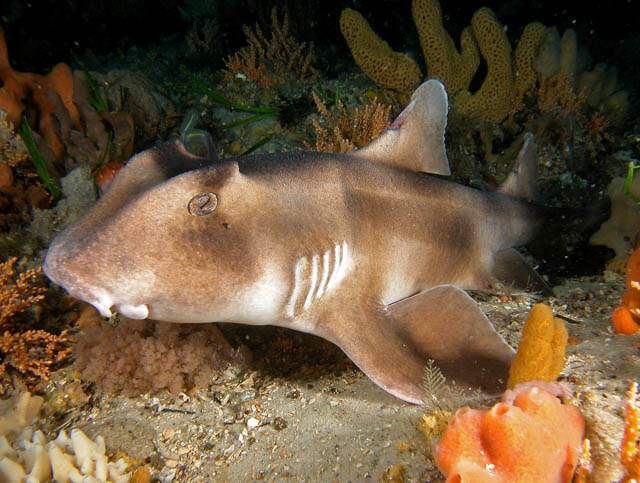
The horn shark (Heterodontus francisci) is a species of bullhead shark, family Heterodontidae. It is endemic to the coastal waters off the western coast of North America, from California to the Gulf of California. Young sharks are segregated spatially from the adults, with the former preferring deeper sandy flats and the latter preferring shallower rocky reefs or algal beds. A small species typically measuring 1 m (3.3 ft) in length, the horn shark can be recognized by a short, blunt head with ridges over its eyes, two high dorsal fins with large venomous spines, and a brown or gray coloration with many small dark spots.

Slow-moving, generally solitary predators, horn sharks hunt at night inside small home ranges and retreat to a favored shelter during the day. Their daily activity cycles are controlled by environmental light levels. Adult sharks prey mainly on hard-shelled molluscs, echinoderms, and crustaceans, which they crush between powerful jaws and molar-like teeth, while also feeding opportunistically on a wide variety of other invertebrates and small bony fishes. Juveniles prefer softer-bodied prey such as polychaete worms and sea anemones. The shark extracts its prey from the substrate using suction and, if necessary, levering motions with its body. Reproduction is oviparous, with females laying up to 24 eggs from February to April. After laying, the female picks up the auger-shaped egg cases and wedges them into crevices to protect them from predators.

Friday, July 9, 2010

July 9, 2010 : Squirrelfish


Squirrelfish
 

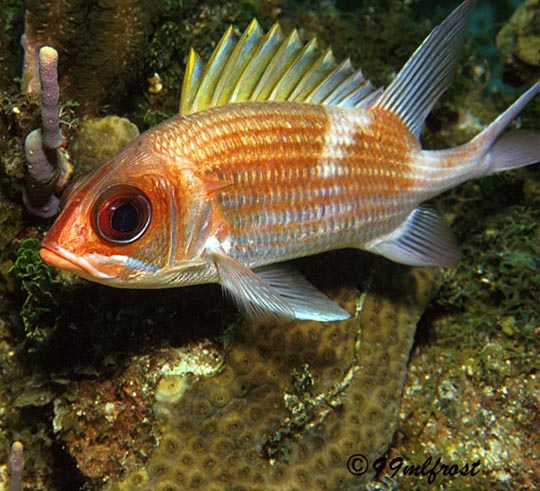
The Holocentridae is a family of ray-finned fish, belonging to the order Beryciformes with the members of the subfamily Holocentrinae typically known as squirrelfish, while the members of Myripristinae typically are known as soldierfish. In Hawaii they are known as menpachi.

They are found in tropical parts of the Indian, Pacific and Atlantic Oceans, with the greatest species diversity near reefs in the Indo-Pacific. Most are found at depths from the shoreline to 100 m (330 ft), but some, notably the members of the genus Ostichthys, are generally found far deeper. Being largely or entirely nocturnal, they have relatively large eyes. During the day they typically remain hidden in crevices, caves, or under ledges. Red and silvery colours dominate. The preopercle spines (near the gill-opening) of the members of the subfamily Holocentrinae are venomous, and can give painful wounds. Most have a maximum length of 15-35 cm (6-14 in), but Sargocentron iota barely reaches 8 cm (3 in), and S. spiniferum and Holocentrus adscensionis can reach more than 50 cm (20 in). The squirrelfishes mainly feed on small fishes and benthic invertebrates, while the soldierfishes typically feed on zooplankton. The larvae are pelagic, unlike the adults, and can be found far out to sea.

Sunday, July 4, 2010

July 4, 2010 : Dumbo Octopus


Dumbo Octopus

The octopuses of the genus Grimpoteuthis are also known as "Dumbo octopuses" from the ear-like fins protruding from the top of their head-like bodies, resembling the ears of Walt Disney's flying elephant. They are bathyal creatures, living at extreme depths: 3000-4000 meters, and are some of the rarest of the Octopoda species. They can flush the transparent layer of their skin at will, and are pelagic animals, as with all other cirrate octopuses.

They hover above the sea floor, searching for worms, bivalves, pelagic copepods, and other crustaceans. They move by pulsing their arms, shooting water through their funnel, or by waving their ear-like fins. They can use each of these techniques separately or all simultaneously. The males and females are different in their size and sucker patterns. The females lay eggs consistently, with no distinct breeding season.

Friday, June 4, 2010

June 4, 2010 : Cuttlefish


Cuttlefish

Cuttlefish are marine animals of the order Sepiida belonging to the class Cephalopoda (which also includes squid, octopuses, and nautiluses). Despite their common name, cuttlefish are not fish but molluscs. Recent studies indicate that cuttlefish are among the most intelligent invertebrates. Additionally, it is noted that cuttlefish have one of the largest brain-to-body size ratios of all invertebrates.
 

The origin of the word cuttlefish can be found in the old English term cudele, itself derived in the 1400s from the Norwegian koddi (cushion, testicle) and the Middle German kudel (pouch), a literal description of the cephalopod's shape. The Greco-Roman world valued the cephalopod as a source of the unique brown pigment released from its siphon when alarmed. Hence, the word for it in Greek and Latin is sepia (later seppia in Italian).

Cuttlefish have an internal shell (the cuttlebone), large W-shaped pupils, and eight arms and two tentaclesprey. They generally range in size from 15 cm (5.9 in) to 25 cm (9.8 in), with the largest species, Sepia apama, reaching 50 cm (20 in) in mantle furnished with denticulated suckers, with which they secure their length and over 10.5 kg (23 lb) in weight.