Opalescent Squid
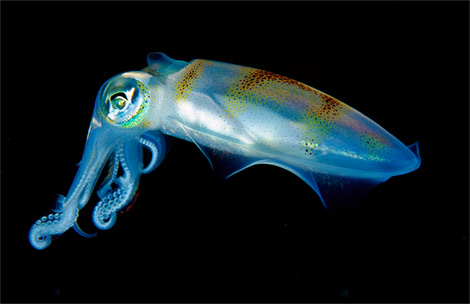
The Opalescent Inshore Squid (Loligo opalescens) is a small squid (mantle length (ML) up to 190 mm) in the family Loliginidae. It is a myopsid squid, which is the near shore group and that means that they have corneas over their eyes. The species lives in the Eastern Pacific Ocean from Mexico's Baja California peninsula to Alaska, USA, within 200 miles (320 kilometers) off shore.
Adult Loligo opalescens can reach a total size of 28 cm. Males are typically larger with a mantle length of 13-19 cm, while females are 12-18 cm in mantle length. The mantle of L. opalescens is not fused to the head and its body is 4 to 5 times longer than it is wide, with fins equal in both length and width. This squid has 8 arms with 2 longer tentacles ending in tentacular clubs equipped with suckers at their ends. The tentacular clubs are narrow with 4 rows of suckers and 2 large rows in the center of the tentacular club bordered by outer rows of smaller suckers. The 8 arms have only 2 rows of alternating suckers running down their length. In male L. opalescens, the left ventral arm is specialized or “hectocotylized” for spermatophore transfer during mating. The eyes of L. opalescens are covered with a non-perforated membrane known as a cornea which is a signature of myopsid squid. The color of L. opalescens can range from white to brown, with the animals able to change their color shades using chromatophores depending on mood and for camouflage. They are normally a bluish-white to mottled brown and gold, and they change to dark red or brown when excited, frightened or feeding.
L. opalescens is a cannibalistic predator that feeds on smaller prey species such as fish, crabs and shrimp, mollusks, and other juvenile squid. It uses its two longer tentacles with tentacular clubs on the end to snare and catch its prey. L. opalescens itself is an important food source for many predators like larger fish, sharks, marine mammals, sea birds, and also humans. Its predators include the Common Seal, California Sea Lion, Blue shark, Chinook salmon, Black-throated Diver, and Brandt's Cormorant.
Aba
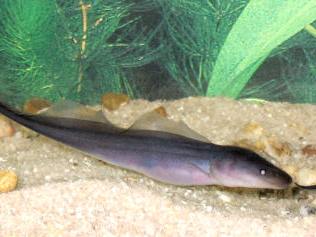
Gymnarchus niloticus, commonly known as the aba, aba aba, frankfish, or African knifefish, is the only species in the family Gymnarchidae within the order Osteoglossiformes. It is found exclusively in swamps and vegetated river edges along the rivers Nile, Niger, Volta, Chad, and Gambia.
The aba has a long and slender body, with no caudal, pelvic, or anal fins. The dorsal fin is elongated, running along the back of the fish towards the blunt, finless, tail, and is the main source of propulsion. It grows up to 1.6 metres (5.2 ft) in length and 19 kilograms (42 lb) in weight.
The aba is nocturnal and has poor vision. Instead, it navigates and hunts smaller fish using a weak electric field similar to that of the related elephantfish. Also like the elephantfishes, it possesses an unusually large brain, which is believed to help it interpret the electrical signals.
Abas lay their eggs in floating nests up to a metre across. The adults continue to guard the young after hatching.
The Gymnarchus niloticus fish can make its tail negatively charged with respect to its head. This produces a symmetrical electric field around its body. Nearby objects distort this field, and the aba can sense the distortion on its skin.
Mudskipper
Mudskippers are members of the subfamily Oxudercinae (tribe Periophthalmini), within the family Gobiidae (Gobies). They are completely amphibious fish, fish that can use their pectoral fins to walk on land. Being amphibious, they are uniquely adapted to intertidal habitats, unlike most fish in such habitats which survive the retreat of the tide by hiding under wet seaweed or in tidal pools. Mudskippers are quite active when out of water, feeding and interacting with one another, for example to defend their territories.
They are found in tropical, subtropical and temperate regions, including the Indo-Pacific and the Atlantic coast of Africa.
The genus Periophthalmus is by far the most diverse and widespread genus of mudskipper. Eighteen species have been described. Periophthalmus argentilineatus is one of the most widespread and well known species. It can be found in mangrove ecosystems and mudflats of East Africa and Madagascar east through the Sundarbans of Bengal, South East Asia to Northern Australia, southeast China and southern Japan, up to Samoa and Tonga Islands. It grows to a length of about 9.5 cm and is a carnivorous opportunist feeder. It feeds on small prey such as small crabs and other arthropods. Another species, Periophthalmus barbarus, is the only oxudercine goby that inhabits the coastal areas of western Africa.
Leafy Sea Dragon
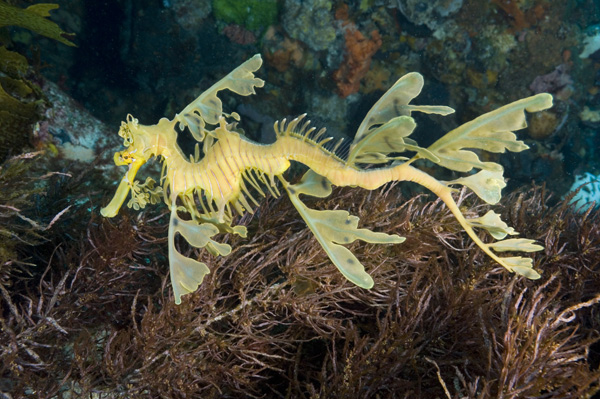
The leafy sea dragon or Glauerts Seadragon, Phycodurus eques, is a marine fish in the family Syngnathidae, which also includes the seahorses. It is the only member of the genus Phycodurus. It is found along the southern and western coasts of Australia. The name is derived from the appearance, with long leaf-like protrusions coming from all over the body. These protrusions are not used for propulsion; they serve only as camouflage. The leafy sea dragon propels itself by means of a pectoral fin on the ridge of its neck and a dorsal fin on its back closer to the tail end. These small fins are almost completely transparent and difficult to see as they undulate minutely to move the creature sedately through the water, completing the illusion of floating seaweed.
Much like the seahorse, the leafy sea dragon's name is derived from its resemblance to another creature (in this case, the mythical dragon). While not large, they are slightly larger than most sea horses, growing to about 20–24 cm (8–10 in). They feed on plankton and small crustaceans.
The lobes of skin that grow on the leafy sea dragon provide camouflage, giving it the appearance of seaweed. It is able to maintain the illusion when swimming, appearing to move through the water like a piece of floating seaweed. It can also change colour to blend in, but this ability depends on the sea dragon's diet, age, location, and stress level.
The leafy sea dragon is found only in the waters of Australia from Kangaroo Island on the Southern shoreline to Jurien Bay on the Western shoreline. It was once thought to be very limited in its range; however, further research has discovered that the sea dragon will actually travel several hundred metres from its habitat, returning to the same spot using a strong sense of direction. They are mostly found around clumps of sand in waters up to 50 metres (164 feet) deep, hiding among rocks and sea grass. They are commonly sighted by scuba divers near Adelaide.
Aurelia aurita
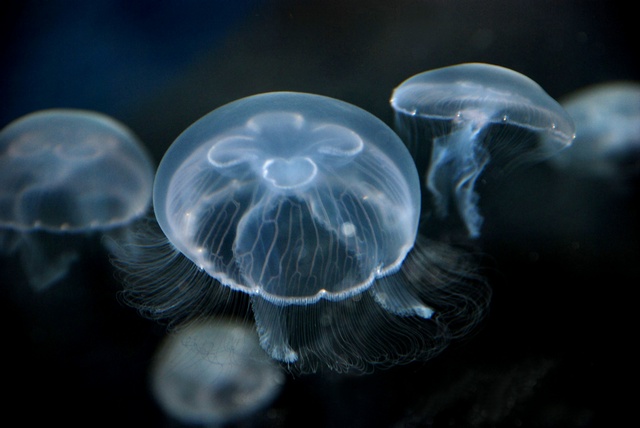
Aurelia aurita (moon jelly, moon jellyfish, common jellyfish, saucer jelly) is one of a group of more than ten morphologically nearly identical jellyfish species in the genus Aurelia. In general, it is nearly impossible to identify Aurelia medusae without genetic sampling, so most of what follows about Aurelia aurita, could equally be applied to any species of the genus. The medusa is translucent, usually about 25–40 cm in diameter, and can be recognized by its four horseshoe-shaped gonads that are easily seen through the top of the bell. It feeds by collecting medusae, plankton and mollusks with its mucusy bell nematocyst-laden tentacles and bringing the prey into its body for digestion, but is capable of only limited motion; like other jellies it primarily drifts with the current, even when it is swimming.
The cosmopolitan genus Aurelia is found throughout most of the world's oceans, from the tropics to as far north as 70° latitude and as far south as 40°. The species Aurelia aurita, whose distribution has been confirmed by Michael Dawson using genetic analysis, is found along the eastern Atlantic coast of Northern Europe and the western Atlantic coast of North America in New England and Eastern Canada. In general, Aurelia is an inshore genus that can be found in estuaries and harbors. It lives in ocean water temperatures ranging from 6 °C to 31 °C; with optimum temperatures of 9 °C to 19 °C. A. aurita prefers temperate seas with consistent currents. It has been found in waters with salinity as low as 6 parts per thousand.
Aurelia aurita is known to be eaten by a wide variety of predators including the Ocean Sunfish (Mola mola), the Leatherback Sea Turtle (Dermochelys coriacea), the scyphomedusa Phacellophora camtschatica, and a very large hydromedusa (Aequorea victoria). Moon jellies are also fed upon by sea birds, which may be more interested in the amphipods and other small arthropods that frequent the bells of Aurelia, but in any case, birds do some substantial amount of damage to these jellyfish that often are found just at the surface of bays.
Aurelia jellyfish naturally die after living and reproducing for several months. It is probably rare for these moon jellies to live more than about six months in the wild, although specimens cared for in public aquarium exhibits typically live several to many years. In the wild, the warm water at the end of summer combines with exhaustive daily reproduction and lower natural levels of food for tissue repair, leaving these jellyfish more susceptible to bacterial and other disease problems that likely lead to the demise of most individuals. Such problems are responsible for the demise of many smaller species of jellyfish. In 1997, Arai summarized that seasonal reproduction leaves the gonads open to infection and degradation.
Some metazoan parasites attack Aurelia aurita, as well as most other species of jellyfish.
Cuvier's Beaked Whale
Cuvier's beaked whale (Ziphius cavirostris) is the most widely distributed of all the beaked whales. It is the only member of the genus Ziphius. Another common name for the species is goose-beaked whale on account of the fact that its head is said to be shaped like the beak of a goose. Georges Cuvier first described it in 1823 from part of a skull found in France in 1804.
Cuvier's beaked whale has a short beak in comparison with other species in its family, with a slightly bulbous melon. The melon is white or creamy in color and a white strip runs back to the dorsal fin about two-thirds of the way along the back. The rest of the body color varies by individual: some are dark grey; others a reddish-brown. Individuals commonly have white scars and patches caused by cookiecutter sharks. The dorsal fin varies in shape from triangular to highly falcate. The fluke of the whale is about one-quarter the body length. The whale grows up to about 7 meters (23 ft) in length and weighs 2–3 tonnes (2.0–3.0 LT; 2.2–3.3 ST). They live for forty years.
The Cuvier's beaked whale is difficult to distinguish from many of the mesoplodont whales at sea.
Their range is known mainly from strandings. It is widespread across the Atlantic, Pacific and Indian Oceans. Individuals have been found as far north as the Shetland Islands and as far south as Tierra del Fuego. Deep waters are preferred in anything from cool to tropical habitats.
Because of identification difficulties, the global population is unknown.
Beaked whales may also be sensitive to noise. A higher incidence of strandings has been recorded in noisy seas such as the Mediterranean. Multiple mass strandings (beachings) have occurred following operations by the Spanish Navy.
Albino Dolphin
A rare pink bottlenose dolphin has been spotted in a Louisiana lake. The albino dolphin has been making a splash with locals and visitors to the area since it was first spotted last year.
The animal has been photographed by local charter boat Captain Erik Rue, 42, who has been studying the dolphin since it first surfaced in Lake Calcasieu, an inland saltwater estuary, north of the Gulf of Mexico in south-west Louisiana. Rue originally saw the rare albino dolphin, which also has reddish eyes, swimming with a pod of four other dolphins.
"I just happened to see a little pod of dolphins, and I noticed one that was a little lighter ... I had never seen anything like it. It's the same colour throughout the whole body," said Rue.
"The dolphin appears to be healthy and normal other than its coloration, which is quite beautiful and stunningly pink," Rue said he had seen the dolphin 40 to 50 times.
"As time has passed the young mammal has grown and sometimes ventures away from its mother to feed and play but always remains in the vicinity of the pod," he said.
Regina Asmutis-Silvia, a senior biologist with the Whale and Dolphin Conservation Society, said: "I have never seen a dolphin coloured in this way in all my career."
"It is a truly beautiful dolphin but people should be careful, as with any dolphins, to respect it - observe from a distance, limit their time watching, don't chase or harass it."
"While this animal looks pink, it is an albino which you can notice in the pink eyes. Albinism is a genetic trait and it unclear as to the type of albinism this animal inherited."
A different dolphin species, the endangered Amazon river boto (Inia geoffrenis), which lives in South America , is sometimes called the pink river dolphin because of its appearance.
Copepods
Copepods (pronounced /ˈkoʊpɪpɒd/) are a group of small crustaceans found in the sea and nearly every freshwater habitat. Many species are planktonic (drifting in sea waters), but more are benthic (living on the ocean floor), and some continental species may live in limno-terrestrial habitats and other wet terrestrial places, such as swamps, under leaf fall in wet forests, bogs, springs, ephemeral ponds and puddles, damp moss, or water-filled recesses (phytotelmata) of plants such as bromeliads and pitcher plants. Many live underground in marine and freshwater caves, sinkholes, or stream beds. Copepods are sometimes used as bioindicators.
Planktonic copepods are important to global ecology and the carbon cycle. They are usually the dominant members of the zooplankton, and are major food organisms for small fish, whales, seabirds and other crustaceans such as krill in the ocean and in fresh water. Some scientists say they form the largest animal biomass on earth. They compete for this title with Antarctic krill (Euphausia superba). Because of their smaller size and relatively faster growth rates, however, and because they are more evenly distributed throughout more of the world's oceans, copepods almost certainly contribute far more to the secondary productivity of the world's oceans, and to the global ocean carbon sink than krill, and perhaps more than all other groups of organisms together. The surface layers of the oceans are currently believed to be the world's largest carbon sink, absorbing about 2 billion tons of carbon a year, the equivalent to perhaps a third of human carbon emissions, thus reducing their impact. Many planktonic copepods feed near the surface at night, then sink into deeper water during the day to avoid visual predators. Their moulted exoskeletons, faecal pellets and respiration at depth all bring carbon to the deep sea.
About half of the estimated 13,000 described species of copepods are parasitic and have strongly modified bodies. They attach themselves to fish, sharks, marine mammals, and many kinds of invertebrates such as molluscs, tunicates, or corals. They live as endo- or ectoparasites on fish or invertebrates in fresh water as well as in marine environments.
Sandhopper
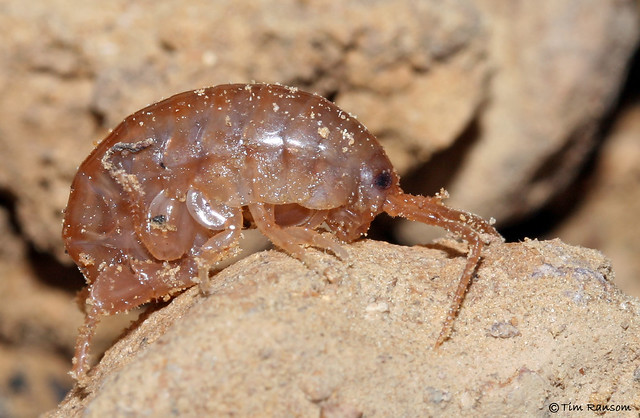
Talitrus saltator, a species of sand hopper, is a common amphipod crustacean of sandy coasts around Europe. The animal's typical "hopping" movement gives the animal its common name, and is produced by a flexion of the abdomen. In order to do this, it must stand on its legs (amphipods usually rest on their sides) and suddenly extend its abdomen out from under its body. It can thus leap several inches into the air, although without any control over its direction. A great deal of scientific research has been carried out on the animal, to determine the environmental cues it uses to control its behaviour.
Talitrus saltator reaches lengths between 8.2 mm (0.32 in) and 16.5 mm (0.65 in), with males being slightly larger than females. The body is greyish-brown or greyish-green in colour, with a single pair of black eyes. It has a distinct pair of antennae, with one antenna more robust than the other.
Talitrus saltator is found around the coasts of the North Sea and north-east Atlantic Ocean from southern Norway to the Mediterranean Sea. In most of its range, its daily cycle is strongly linked to the tides, with daily migrations of up to 100 m (328 ft), but where there are no significant tides (as in parts of the Mediterranean), visual cues are used instead.
Related Articles :
Pram Bug and
Amphipods
Arrow Worm
Chaetognatha, meaning hair-jaws, and commonly known as arrow worms, are a phylum of predatory marine worms that are a major component of plankton worldwide. About 20% of the known species are benthic, that is belonging to the lowest zone of the ocean, or benthic zone, and can attach to algae and rocks. They are found in all marine waters, from surface tropical waters and shallow tide pools to the deep sea and polar regions. Most chaetognaths are transparent and are torpedo shaped, but some deep-sea species are orange. They range in size from 2 to 120 millimetres (0.079 to 4.7 in).
There are more than 120 modern species assigned to over 20 genera. Despite the limited diversity of species, the number of individuals is large.
Chaetognaths are transparent or translucent dart-shaped animals covered by a cuticle. The body is divided into a distinct head, trunk, and tail. There are between four and fourteen hooked, grasping spines on each side of their head, flanking a hollow vestibule containing the mouth. The spines are used in hunting, and covered with a flexible hood arising from the neck region when the animal is swimming. All chaetognaths are carnivorous, preying on other planktonic animals.
Whale Fall
Whale fall is the term used for a whale carcass that has fallen to the ocean floor. Whale falls were first observed in the 1980s, with the advent of deep-sea robotic exploration.
When a whale dies in shallow water, its carcass is typically devoured by scavengers over a relatively short period of time—within several months. However, in deeper water (depths of 2,000 m/6,600 ft or greater), fewer scavenger species exist, and the carcass can provide sustenance for a complex localized ecosystem Some of the organisms that have been observed at whale falls are squat lobsters, bristleworms, prawns, shrimp, lobsters, hagfish, over periods of decades.
Osedax (bone-eating worms), crabs, sea cucumbers, octopuses, clams, and even deep-sea sleeper sharks. Whale falls are often inhabited by large colonies of tubeworms. Over 30 previously unknown species have been discovered at whale falls.
A whale fall was first observed by marine biologists led by University of Hawaii oceanographer Craig Smith in 1987, discovered accidentally by the submersible Alvin using scanning sonar at 1,240 m (4,068 ft) in Santa Catalina, California Basin. Whale falls have since been found by other scientists, and by military submarines. They can be found by using side-scan sonar to examine the ocean floor for large aggregations of matter.
The first sign that whale carcasses could host specialized animal communities came in 1854 when a new mussel species was extracted from a piece of floating whale blubber. Beginning in the 1960s, deep sea trawlers unintentionally recovered other new mollusk species including limpets (named Osteopelta) attached to whale bones.
Pteraspis
Pteraspis (meaning wing shield) is an extinct genus of primitive jawless fish that lived in the Devonian period of what is now Britain and Belgium.
Like other heterostracan fishes, Pteraspis had a protective armored plating covering the front of its body. Though lacking fins other than its lobed tail, it is thought to have been a good swimmer thanks to stiff, wing-like protrusions derived from the armoured plates over its gills. This, along with the horn-like rostrum, made Pteraspis very streamlined in shape; a perfect quality for a good swimmer. Pteraspis also had some stiff spikes on its back, possibly an additional form of protection against predators. It is thought to have fed from shoals of plankton just under the ocean surface.
Pteraspis grew to a length of 8 inches (20 centimeters).
Jamoytius kerwoodi
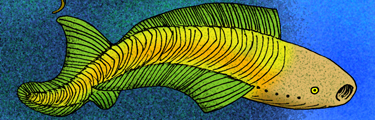
Jamoytius kerwoodi was a species of primitive, eel-like jawless fish that lived in the Silurian period.
J. kerwoodi is the earliest known anaspid.. It had long, paired fins running along its body - making it a good swimmer. J. kerwoodi resembled a lamprey, especially with its rounded mouth and elongated body. However, as it had no teeth or teeth-like structures in its mouth, it was not carnivorous like its distant modern-day relative, the lamprey. It was more likely to have been a filter-feeder or a detrius-feeder, possibly in the manner of larval lampreys.
The fish had a cartilaginous skeleton, and a branchial basket resembling the cyclostomes - used to suggest that it was a near-ancestor to that clade. It is also the earliest known vertebrate with camera-type eyes. It also possessed weakly mineralised scales.
Jormungand
In Norse mythology, Jörmungandr (pronounced [ˈjœrmuŋɡandr]), mostly known as Jormungand, or Jörmungand(Old Norse: Jǫrmungandr), or Midgard Serpent (Old Norse: Midgarðsormr), or World Serpent, is a sea serpent, and the middle child of the giantess Angrboða and the god Loki. According to the Prose Edda, Odin took Loki's three children, Fenrisúlfr, Hel and Jörmungandr, and tossed Jörmungandr into the great ocean that encircles Midgard. The serpent grew so large that he was able to surround the Earth and grasp his own tail. When he lets go the world will end. As a result he earned the alternate name of the Midgard Serpent or World Serpent. Jörmungandr's arch enemy is the god Thor.
The major sources for myths about Jörmungandr are the Prose Edda, Húsdrápa, Hymiskviða, and Völuspá. Less important sources include kennings in skaldic poetry. For example in Þórsdrápa, faðir lögseims, "father of the sea-thread", is used as a kenning for Loki. There are also image stones from ancient times depicting the fishing encounter.
Sacabambaspis
Sacabambaspis is an extinct genus of jawless fish that lived in the Ordovician period. It is related to Astraspis.
Sacabambaspis had a head shield made from a large upper (dorsal) plate that rose to a slight ridge in the midline, and a deep curved lower (ventral) plate. Also it had narrow branchial plates which link these two along the sides, and cover the gill area. The rest of body was covered by long, strap-like scales behind the head shield. The eyes were far forward and between them are possibly two small nostrils, and the mouth was armed with very thin plates (oral plates).
The fossils of Sacabambaspis and Astraspis show clear evidence of a sensory structure (lateral line system). The arrangement of these organs in regular lines allows the fish to detect the direction and distance from which a disturbance in the water is coming.
Scylla
In Greek mythology, Scylla (pronounced /ˈsɪlə/, sil-uh; Greek: Σκύλλα, Skulla) was a monster that lived on one side of a narrow channel of water, opposite its counterpart Charybdis. The two sides of the strait were within an arrow's range of each other—so close that sailors attempting to avoid Charybdis would pass too close to Scylla and vice versa.
Scylla was a horrible sea monster with six long necks equipped with grisly heads, each of which contained three rows of sharp teeth. Her body consisted of twelve tentacle-like legs and a cat's tail and with four to six dog-heads ringing her waist. She was one of the children of Phorcys and either Hecate, Crataeis, Lamia or Ceto (all of whom may be various names for the same goddess. Some sources, including Stesichorus, cite her parents as Triton and Lamia.
Traditionally the strait has been associated with the Strait of Messina between Italy and Sicily, but more recently this theory has been challenged, and the alternative location of Cape Scilla in northwest Greece has been suggested by Tim Severin.
The phrase "between Scylla and Charybdis" (popularly reworded "between a rock and a hard place") has come to mean being in a state where one is between two dangers and moving away from one will cause you to be in danger from the other.
Posts during October will be of real-life sea monsters, long extinct, as well as those of myth and folklore.
Seven-Arm Octopus
The Seven-arm Octopus (Haliphron atlanticus) is the largest known species of octopus based on scientific records, with a total estimated length of 4 m and weight of 75 kg. However, there have been disputed claims of even larger octopuses of the species Enteroctopus dofleini.
The Seven-arm Octopus is so named because in males the hectocotylus (a specially modified arm used in egg fertilization) is coiled in a sac beneath the right eye. Due to this species' thick gelatinous tissue, the arm is easily overlooked, giving the appearance of just seven arms. However, like other octopuses, it actually has eight.
In 2002, a single specimen of giant proportions was caught by fisheries trawling off the eastern Chatham Rise, New Zealand. This specimen, the largest of this species and of all octopuses, was the first validated record of Haliphron from the South Pacific. It had a mantle length of 0.69 m, total length of 2.90 m, and weight of 61.0 kg, although it was incomplete.
The type specimen of H. atlanticus was collected in the Atlantic Ocean at 38°N 34°W. It is deposited at the Zoologisk Museum, University of Copenhagen.
Marine Snow
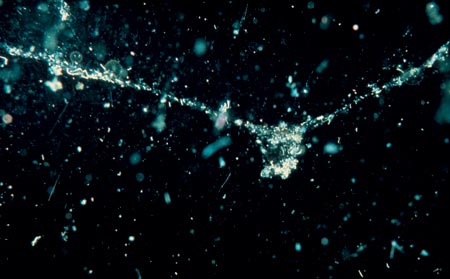
In the deep ocean, marine snow is a continuous shower of mostly organic detritus falling from the upper layers of the water column. Its origin lies in activities within the productive photic zone. Consequently, the prevalence of marine snow changes with seasonal fluctuations in photosynthetic activity and ocean currents. Thus marine snow is heavier in spring, and the reproductive cycles of some deep-sea animals are synchronized to take advantage of this occurence.
Marine snow has a composition which includes: dead or dying animals and plants (plankton), protists (diatoms), fecal matter, sand, soot and other inorganic dust. The "snowflakes" (which are more like clumps or strings) are aggregates of smaller particles held together by a sugary mucus, transparent exopolymer particles (TEPs); natural polymers exuded as waste products by bacteria and phytoplankton. These aggregates grow over time and may reach several centimetres in diameter, travelling for weeks before reaching the ocean floor.
However, most organic components of marine snow are consumed by microbes, zooplankton and other filter-feeding animals within the first 1,000 metres of their journey. In this way marine snow may be considered the foundation of deep-sea mesopelagic and benthic ecosystems: As sunlight cannot reach them, deep-sea organisms rely heavily on marine snow as an energy source. The small percentage of material not consumed in shallower waters becomes incorporated into the muddy "ooze" blanketing the ocean floor, where it is further decomposed through biological activity.
Furcacauda
According to the Systema Naturae 2000 Taxonomic classification, Furcacauda is a genus within the family of Furcacaudidae, within the order Thelodonti, the Class Agnatha, and the Subphylum Vertebrata. Canadian fossils give rise to the Furcacaudiformes during the Devonian and Silurian time periods. Furcacaudiformes were deep water jawless vertebrates with symmetrical fork and lobed-finned tails and smaller than typical loganellid and nikoliviid thelodonti scales.
Furcacaudiformes are noted to having a laterally compressed body, large anterior eyes, slightly posterior, lateral, and vertical to a small mouth, and a condensed curved row of branchial openings (gills) directly posterior to the eyes. Many but not all had laterally paired fins. Wilson and Caldwell also note the presence of a caudal peduncle and a long caudal fin made of two large lobes, one dorsal and one ventral separated by 8 to 14 smaller intermediate lobes, giving the appearance of a striated half-moon shaped tail resembling the tail of a heterostracan. A large square cavity within the gut connecting a small intestine to a anal opening lead many to believe that it is this genus that exhibits the first vertebrate stomach.
According to Wilson and Caldwell their discovery, based on sediment infillings of fossils of the Furcacauda heintze, gives credence to the evolutionary development of stomach before jaws.
Elephantfish
The family Mormyridae, sometimes called "elephantfish" (more properly freshwater elephantfish), are freshwater fish in the order Osteoglossiformes native to Africa. It is by far the largest family in the order with around 200 species. Members of the family are popular, if challenging, aquarium species. These fish are also known for having large brain size and unusually high intelligence.
They are not to be confused with the Australian ghost shark (Callorhinchus milii) which is sometimes referred to as the "elephantfish", but is better known as the elephant shark in the scientific community.
The elephantfishes are a diverse family, with a wide range of different sizes and shapes. The smallest are just 5 centimetres (2.0 in) in adult length, while the largest reach up to 1.5 metres (4.9 ft). They do, however, have a number of unique features in common. Firstly, the cerebellum (part of the brain) is greatly enlarged, giving them a brain to body size ratio similar to that of humans. This is likely to be related to the interpretation of bio-electrical signals. Secondly, the semicircular canals in the inner ear have an unusual structure and are associated with a gas-filled bladder entirely separate from the main swim bladder.
Some species possess modifications of the mouthparts to facilitate feeding upon small invertebrates buried in muddy substrates. The shape and structure of these leads to the popular name of "elephant nosed fish" for those species with particularly prominent mouth extensions. The extensions to the mouthparts usually consist of a fleshy elongation attached to the lower jaw. They are flexible, and equipped with touch, and possibly taste, sensors.
Among those members of the family lacking extended mouthparts, the body shape and general morphology of the fishes has led to some being known among aquarists by the name of "baby whale", despite the fact that true whales are mammals. Other "mormyrid mammalian misnomers" include the term "dolphin fishes", in reference to certain members of the Genus Mormyrops.
Elephantfishes are notable for their ability to generate weak electric fields that allow the fishes to sense their environment in turbid waters where vision is impaired by suspended matter. The generation of these electric fields and their use in providing the fishes with additional sensory input from the environment is the subject of considerable scientific research, as is research into communication between and within species.
Electric discharges are most often pulsatile, with Gymnarchus niloticus being an exception to this rule, discharging its electric organ near approximately 500 Hz, giving it a near-sinusoidal like discharge. The electric organ is developmentally related to muscle, as in Gymnotiform electric fish, as well as in electric rays and skates. There is a surprising degree of convergent evolution between the South American Gymnotiforms and the African Mormyridae, particularly in the sensory apparatus for detecting and processing electrical signals involved in electrolocation and electrocommunication.