Amphipods
Amphipoda is an order of malacostracan crustaceans with no carapace and generally with laterally compressed bodies. The name amphipoda means "different-footed", and refers to the different forms of appendages, unlike isopods, where all the legs are alike. Of the 7,000 species, 5,500 are classified into one suborder, Gammaridea. The remainder are divided into two or three further suborders. Amphipods range in size from 1 to 340 millimetres (0.039 to 13 in) and are mostly detritivores or scavengers. They live in almost all aquatic environments; 750 species live in caves and the order also includes terrestrial animals and sandhoppers such as Talitrus saltator.
Amphipods are typically less than 10 millimetres (0.39 in) long, but the largest recorded living amphipods were 28 centimetres (11 in) long, and were photographed at a depth of 5,300 metres (17,400 ft) in the Pacific Ocean. Samples from the Atlantic Ocean with a reconstructed length of 34 centimetres (13 in) have been assigned to the same species, Alicella gigantea. The smallest known amphipods are less than 1 millimetre (0.04 in) long. The size of amphipods is limited by the availability of dissolved oxygen, such that the amphipods in Lake Titicaca at an altitude of 3,800 metres (12,500 ft) can only grow up to 22 millimetres (0.87 in), compared to lengths of 90 millimetres (3.5 in) in Lake Baikal at 455 metres (1,500 ft).
Amphipods are found in almost all aquatic environments, from fresh water to water with twice the salinity of sea water. They are almost always an important component of aquatic ecosystems. Most species in the suborder Gammaridea are epibenthic, although they are often collected in plankton samples. Members of the Hyperiidea are all planktonic and marine. Many are symbionts of gelatinous animals, including salps medusae, siphonophores, colonial radiolarians and ctenophores, and most hyperiids are associated with gelatinous animals during some part of their life cycle.
Compared to other crustacean groups, such as the Isopoda, Rhizocephala or Copepoda, relatively few amphipods are parasitic on other animals. The most notable example of parasitic amphipods are the whale lice (family Cyamidae); unlike other amphipods, these are dorso-ventrally flattened, and have large, strong claws, with which they attach themselves to baleen whales. They are the only parasitic crustaceans which cannot swim during any part of their life cycle.
Related Articles :
Pram Bug and
Sandhopper
Anomalocaris
Anomalocaris ("abnormal shrimp") is an extinct genus of anomalocaridid, which are, in turn, thought to be closely related to the arthropods. The first fossils of Anomalocaris were discovered in the Ogygopsis Shale by Joseph Frederick Whiteaves, with more examples found by Charles Doolittle Walcott in the famed Burgess Shale. Originally several fossilized parts discovered separately (the mouth, feeding appendages and tail) were thought to be three separate creatures, a misapprehension corrected by Harry B. Whittington and Derek Briggs in a 1985 journal article.
Anomalocaris has been misidentified several times, in part due to its makeup of a mixture of mineralized and unmineralized body parts; the mouth and feeding appendage was considerably harder and more easily fossilized than the delicate body. Its name originates from a description of a detached 'arm', described by Joseph Frederick Whiteaves in 1892 as a separate crustacean-like creature due to its resemblance to the tail of a lobster or shrimp.
The first fossilized mouth was discovered by Charles Doolittle Walcott, who mistook it for a jellyfish and placed the genus Peytoia. Walcott also discovered a second feeding appendage but failed to realize the similarities to Whiteaves discovery and instead identified it as feeding appendage or tail of the extinct Sidneyia. The body was discovered separately and classified as a sponge in the genus Laggania; the mouth was found with the body, but was interpreted by its discoverer Simon Conway Morris as an unrelated Peytoia that had through happenstance settled and been preserved with Laggania. Later, while clearing what he thought was an unrelated specimen, Harry B. Whittington removed a layer of covering stone to discover the unequivocally connected arm thought to be a shrimp tail and mouth thought to be a jellyfish. Whittington linked the two species, but it took several more years for researchers to realize that the continuously juxtaposed Peytoia, Laggania and feeding appendage actually represented a single, enormous creature.
According to International Commission on Zoological Nomenclature rules, the oldest name takes priority, which in this case would be Anomalocaris. The name Laggania was later used for another genus of anomalocarid. "Peytoia" has been modified into Parapeytoia, a genus of Chinese anomalocarid. Anomalocaris is placed in the extinct family Anomalocaridae, and is now considered to be related to modern arthropods.
Sea Spiders
Sea spiders, also called Pantopoda or pycnogonids, are marine arthropods of class Pycnogonida. They are cosmopolitan, found especially in the Mediterranean and Caribbean Seas, as well as the Arctic and Antarctic Oceans. There are over 1300 known species, ranging in size from 1 to 10 millimetres (0.039 to 0.39 in) to over 90 cm (35 in) in some deep water species. Most are toward the smaller end of this range in relatively shallow depths, however, they can grow to be quite large in Antarctic waters.
Although "sea spiders" are not true spiders, or even arachnids, their traditional classification as chelicerates would place them closer to true spiders than to other well known arthropod groups, such as insects or crustaceans. However this is in dispute, as genetic evidence suggests they may even be an ancient sister group to all other living arthropods.
These small animals live in many different parts of the world, from Australia, New Zealand, and the Pacific coast of the United States, to the Mediterranean Sea and the Caribbean Sea, to the north and south poles. They are most common in shallow waters, but can be found as deep as 7,000 metres (23,000 ft), and live in both marine and estuarine habitats. Pycnogonids are well camouflaged beneath the rocks and among the algae that are found along shorelines.
Sea spiders either walk along the bottom with their stilt-like legs or swim just above it using an umbrella pulsing motion. Most are carnivorous and feed on cnidarians, sponges, polychaetes and bryozoans. Sea spiders are generally predators or scavengers. They will often insert their proboscis, a long appendage used for digestion and sucking food into its gut, into a sea anemone and suck out nourishment. The sea anemone, large in comparison to its predator, almost always survives this ordeal.
Packhorse Crayfish
Sagmariasus verreauxi is a species of spiny lobster that lives around northern New Zealand, the Kermadec Islands the Chatham Islands and Australia from Queensland to Tasmania. It is probably the longest decapod crustacean in the world, alongisde the American lobster Homarus americanus, growing to lengths of up to 60 centimetres (24 in). The species has many common names in English, including Australian crayfish, common crayfish, common Sydney crayfish, eastern crayfish, Eastern rock lobster, green cray, green crayfish, green lobster, green rock lobster, marine crayfish, New South Wales spiny lobster, packhorse crayfish, packhorse lobster, sea crayfish, smooth-tailed crayfish and Sydney crayfish. In Māori, it is called pawharu. S. verreauxi was formerly included in the genus Jasus, but has been separated into a monotypic genus Sagmarasius due to the lack of sculpturation on the abdomen, which is found in all other Jasus species. The name Sagmarasius derives from the Greek σαγμαριον (sagmarion), meaning packhorse, and the genus name Jasus, in reference to the common name "packhorse crayfish".
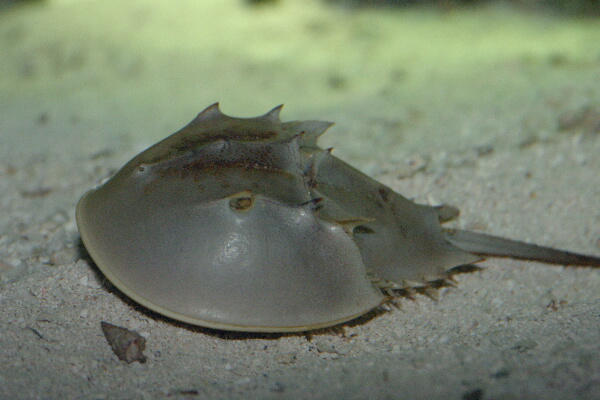
Horseshoe Crab
Limulus polyphemus, known as the horseshoe crab or Atlantic horseshoe crab, is a marinecheliceratearthropod. Despite its name, it is more closely related to spiders, ticks, and scorpions than to crabs. Horseshoe crabs are most commonly found in the Gulf of Mexico and along the northern Atlantic coast of North America. A main area of annual migration is Delaware Bay, although stray individuals are occasionally found in Europe.
The other three species in the family Limulidae are also called horseshoe crabs. The Japanese horseshoe crab (Tachypleus tridentatus) is found in the Seto Inland Sea, and is considered an endangered species because of loss of habitat. Two other species occur along the east coast of India: Tachypleus gigas and Carcinoscorpius rotundicauda. All four are quite similar in form and behavior.