Electric Eel
The Electric eel (Electrophorus electricus), is an electric fish, and the only species of the genus Electrophorus. It is capable of generating powerful electric shocks, which it uses for both hunting and self-defense. It is an apex predator in its South American range. Despite its name it is not an eel but rather a knifefish.
The electric eel has three abdominal pairs of organs that produce electricity: the Main organ, the Hunter's organ, and the Sachs organ. These organs make up four-fifths of its body, and are what give the electric eel the ability to generate two types of electric organ discharges (EODs), low voltage and high voltage. These organs are made of electrocytes, lined up so that the current flows through them and produces an electrical charge. When the eel locates its prey, the brain sends a signal through the nervous system to the electric cells. This opens the ion channel, allowing positively-charged sodium to flow through, reversing the charges momentarily. By causing a sudden difference in voltage, it generates a current.
The electric eel generates its characteristic electrical pulse in a manner similar to a battery, in which stacked plates produce an electrical charge. In the electric eel, some 5,000 to 6,000 stacked electroplaques are capable of producing a shock at up to 500 volts and 1 ampere of current (500 watts). Such a shock could be deadly for an adult human. (Electrocution death is due to current flow; the level of current that is fatal in humans is roughly 0.75A.)
The Sachs organ is associated with electrolocation. Inside the organ are many muscle-like cells, called electrocytes. Each cell can only produce 0.15 V, though working together the organ transmits a signal of about 10 V in amplitude at around 25 Hz. These signals are what is emitted by the main organ and Hunter's organ that can be emitted at rates of several hundred Hz.
The electric eel is unique among the gymnotiforms in having large electric organs capable of producing lethal discharges that allows them to stun prey. There are reports of this fish producing larger voltages, but the typical output is sufficient to stun or deter virtually any other animal. Juveniles produce smaller voltages (about 100 volts). Electric eels are capable of varying the intensity of the electrical discharge, using lower discharges for "hunting" and higher intensities for stunning prey, or defending themselves. When agitated, it is capable of producing these intermittent electrical shocks over a period of at least an hour without signs of tiring.
Chinese Giant Salamander
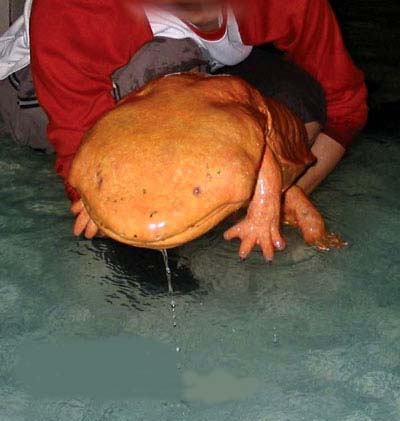
The Chinese giant salamander (Andrias davidianus) is the largest salamander in the world, reaching a length of 180 cm (6 ft), although it rarely - if ever - reaches that size today. Endemic to rocky mountain streams and lakes in China, it is considered critically endangered due to habitat loss, pollution, and over-collecting, as it is considered a delicacy and used in traditional Chinese medicine. Records from Taiwan may be the results of introductions. It has been listed as one of the top-10 "focal species" in 2008 by the Evolutionarily Distinct and Globally Endangered (EDGE) project.
It has a large head, small eyes and dark and wrinkly skin. It is one of only two extant species in the genus Andrias, the other being the slightly smaller, but otherwise very similar Japanese giant salamander (Andrias japonicus). The Chinese giant salamander feeds on insects, frogs, and fish. It has very poor eyesight, and therefore depends on special sensory nodes that run in a line on the creature's body, from head to tail. They are capable of sensing the slightest vibrations around them with the help of these nodes. The female lays 500 eggs in an underwater breeding cavity, which is guarded by the male until the eggs hatch after 50–60 days. The average adult salamander is 25–30 kg (55-66 lb) and 1.15 m (3.8 ft).
A medium-sized specimen, approximately 3 ft (0.91 m) long, was kept for several years at the Steinhardt Aquarium in San Francisco, California, and now is on display again in the "Water Planet" section of the new California Academy of Sciences building. Per early 2008, ISIS records only show five individuals held in US zoos (Zoo Atlanta, Cincinnati Zoo, and Saint Louis Zoological Park), and an additional four in European zoos (Zoo Dresden and Rotterdam Zoo). It is likely additional individuals are kept in non-ISIS zoos and animals parks in its native China. There are several of them in the aquarium of Shanghai. It has been bred in captivity, but it is doubtful if this can be achieved to an extent where the pressure on the wild populations is reduced.
It has been argued that the correct scientific name of this species is Andrias scheuchzeri (in which case Andrias davidianus would be a junior synonym) – a name otherwise restricted to an extinct species described from Swiss fossils.
Pygmy Killer Whale
The pygmy killer whale (Feresa attenuata) is a small, rarely-seen cetacean of the oceanic dolphin family (Delphinidae). It derives its common name from sharing some physical characteristics with the orca ("killer whale".) It is the smallest species that has "whale" in its common name. In fact, "killer" may be more apt in the case of the pygmy killer whale than its larger cousin. When a number of Pygmy Killers were brought into captivity in Hawaii and South Africa they were extremely aggressive—even killing one another. A pod captured in Japan did not display such aggression.
The pygmy killer is an average-sized dolphin (a little larger and heavier than a grown man) and may easily be confused at sea with other species, in particular the melon-headed whale. The body is robust and dark-colored. The cape is particularly dark. The head is rounded without a beak. The sides are lighter and the belly is often white. Several individuals have been seen with a white lining around the mouth and chin. The dorsal fin is tall and slightly falcate.
The pygmy avoids human contact. Some spy-hopping, breaching and other active behavior has been recorded but it is not an acrobatic animal.
These dolphins always move in groups, usually of 10 to 30, but occasionally much larger.
Data from strandings, which seem to be common in the species, indicates a diet of cephalopods and small fish. They have been observed attacking, killing and eating other cetacean species such as the Common Dolphin.
Jellyfish Blooms
The presence of ocean blooms is usually seasonal, responding to prey availability and increasing with temperature and sunshine. Ocean currents tend to congregate jellyfish into large swarms or "blooms", consisting of hundreds or thousands of individuals. In addition to sometimes being concentrated by ocean currents, blooms can result from unusually high populations in some years. Bloom formation is a complex process that depends on ocean currents, nutrients, temperature, predation, and oxygen concentrations. Jellyfish are better able to survive in oxygen-poor water than competitors, and thus can thrive on plankton without competition. Jellyfish may also benefit from saltier waters, as saltier waters contain more iodine, which is necessary for polyps to turn into jellyfish. Rising sea temperatures caused by climate change may also contribute to jellyfish blooms, because many species of jellyfish are better able to survive in warmer waters. Jellyfish are likely to stay in blooms that are quite large and can reach up to 100,000 in each.
The global increase in jellyfish bloom frequency may stem from human impact. In some locations jellyfish may be filling ecological niches formerly occupied by now overfished creatures, but this hypothesis lacks supporting data. Jellyfish researcher Marsh Youngbluth further clarifies that "jellyfish feed on the same kinds of prey as adult and young fish, so if fish are removed from the equation, jellyfish are likely to move in."
Jellyfish blooms cause problems for mankind. The most obvious are human stings (sometimes deadly) and tourism declines on coasts.
Other severe implications are destroying fish nets, poisoning or crushing captured fish, consuming fish eggs and young fish.
Clogging also causes many problems including stoppage of nuclear power plants and desalination plants, as well as clogging engines of ships and even overturning of boats by one of the largest species, the Nomura's jellyfish.
Ring of Fire
The Pacific Ring of Fire (or sometimes just the Ring of Fire) is an area where large numbers of earthquakes and volcanic eruptions occur in the basin of the Pacific Ocean. In a 40,000 km (25,000 mi) horseshoe shape, it is associated with a nearly continuous series of oceanic trenches, volcanic arcs, and volcanic belts and/or plate movements. The Ring of Fire has 452 volcanoes and is home to over 75% of the world's active and dormant volcanoes. It is sometimes called the circum-Pacific belt or the circum-Pacific seismic belt.
About 90% of the world's earthquakes and 80% of the world's largest earthquakes occur along the Ring of Fire. The next most seismic region (5–6% of earthquakes and 17% of the world's largest earthquakes) is the Alpide belt, which extends from Java to Sumatra through the Himalayas, the Mediterranean, and out into the Atlantic. The Mid-Atlantic Ridge is the third most prominent earthquake belt.
Hammerhead Shark
The hammerhead sharks are a group of sharks in the family Sphyrnidae, so named for the unusual and distinctive structure of their heads, which are flattened and laterally extended into a "hammer" shape called a "cephalofoil". Most hammerhead species are placed in the genus Sphyrna; some authorities place the winghead shark in its own genus, Eusphyra. Many, not necessarily mutually exclusive, functions have been proposed for the cephalofoil, including sensory reception, maneuvering, and prey manipulation. Hammerheads are found worldwide in warmer waters along coastlines and continental shelves. Unlike most sharks, hammerheads usually swim in schools. Some of these schools can be found near Malpelo Island in Colombia, the Cocos Islands by Costa Rica and near Molokai Island in Hawaii.
The nine known species range from 0.9 to 6 m (3.0 to 20 ft) long. The average hammerhead shark weighs about 500 pounds, but some may grow up to 1000. All the species have a projection of their face on all sides of the head that gives it a resemblance to a flattened hammer.
It was determined recently that the hammer-like shape of the head evolved to enhance the animal's vision. The positioning of the eyes give the shark good binocular vision, as well as 360-degree vision in the vertical plane, meaning they can see above and below them at all times. The shape of the head was previously thought to help the shark find food, aiding in close-quarters maneuverability and allowing sharp turning movement without losing stability. However, it was found that the unusual structure of its vertebrae allowed it to make the turns correctly, more often than its head. The hammer would also shift and provide lift.
Hammerheads are one of the most negatively buoyant of sharks. Like all sharks, hammerheads have electroreceptory sensory pores called ampullae of Lorenzini. By distributing the receptors over a wider area, hammerheads can sweep for prey more effectively. These sharks have been able to detect an electrical signal of half a billionth of a volt. The hammer also allows the nostrils to be placed farther apart, increasing its ability to detect chemical gradients and localize the source.
Hammerheads have disproportionately small mouths and seem to do a lot of bottom-hunting. They are also known to form schools during the day, sometimes in groups of over 100. In the evening, like other sharks, they become solitary hunters.
Hammerheads are notably one of the few animals that acquire a tan from prolonged exposure to sunlight. Tanning occurs when a hammerhead is in shallow waters or close to the surface for long periods.
Maelstrom
The original Maelstrom (described by Poe and others) is the Moskstraumen, a powerful tidal current in the Lofoten Islands off the Norwegian coast. The Maelstrom is formed by the conjunction of the strong currents that cross the Straits (Moskenstraumen) between the islands and the great amplitude of the tides. The Maelstrom’s name comes from the Dutch words malen, to crush and stroom, meaning current.
In Norwegian the most frequently used name is Moskstraumen or Moskenstraumen (current of [island] Mosken).
The fictional depictions of the Maelstrom by Edgar Allan Poe and Jules Verne describe it as a gigantic circular vortex that reaches the bottom of the ocean, when in fact it is a set of currents and crosscurrents with a rate of 18 km.
Two of the most notable literary references to the Lofoten Maelstrom date from the nineteenth century. The first is the Edgar Allan Poe story "A Descent into the Maelström" (1841). The second is 20,000 Leagues Under the Sea (1869), the famous novel by Jules Verne. At the end of this novel, Captain Nemo seems to commit suicide, sending his Nautilus submarine into the Maelstrom (although in Verne's sequel Nemo and Nautilus survived).
In Spanish and other languages, Maelstrom is used as a synonym for whirlpool. Hence, the word "Maelstrom" appears in diverse contexts metaphorically to make reference to different subjects or objects that suggest great chaotic or sinister forces. The word maelstrom is used to denote powerful, inescapable destructive forces.
Greek Poet Homer describes a maelstrom in his "Odyssey" as Odysseus must choose to sail near the six-headed monster Scylla, or near the whirlpool Charybdis in order to reach Ithaca.
Pram Bug
Phronima is a small, deep sea hyperiid amphipod of the family Phronimidae. It is found throughout the world's oceans, except in polar regions. The body of Phronima is transparent. Females attack salps, using their mouth and claws to eat the animal and hollow out its gelatinous shell. She then enters the barrel and lays her eggs inside. She then propels the barrel through the water as the larvae develop, providing them with fresh food and water.
Related Articles :
Amphipods and
Sandhopper
Scapanorhynchus
Scapanorhynchus ("Spade Snout") is an extinct genus of shark from the Cretaceous era. Their extreme similarities to the living goblin shark, Mitsukurina owstoni, lead some experts to consider reclassifying it as Scapanorhynchus owstoni. However, most shark specialists regard the goblin shark to be distinct enough from its prehistoric relatives to merit placement in its own genus.
Scapanorhynchus had an elongated, albeit, flattened snout, and sharp awl-shaped teeth, ideal for seizing fish, or tearing chunks of flesh from its prey.
Tigerfish
Tigerfish is the common name for a variety of species from several different families of fish, usually on account of their colouration or otherwise fearsome appearance.
Several species in the genus Hydrocynus of the family Alestiidae are called "tigerfish" and are particularly prized as gamefish. These African fish are found in many rivers and lakes on the continent and are fierce predators with distinctive protruding teeth.
The two most common species are probably most recognizable in Southern Africa. The first is the Goliath Tiger (Hydrocynus goliath), which is found in the Congo River system, the largest of the family. The second-largest, and the southernmost species, is the Tigerfish (Hydrocynus vittatus), commonly found in the Zambezi River and in the two biggest lakes along the Zambezi, Lake Kariba in Zambia, Zimbabwe, and Cabora Bassa in Mozambique and Jozini dam in South Africa.
The name "tigerfish" has occasionally been used for species of cichlid in the genus Rhamphochromis. These are large, silver-colored fishes that may have one or two black horizontal lines running the length of the body. These fish are native to Lake Malawi in Africa. They can measure up to 2 meters (6 ft. 7 in.) in length and weigh up to 50 kg (105 lbs.) They also have very sharp teeth that can rip through skin easily; however, they are not known to eat humans.
Tigerfish can be considered Africa's equivalent of the South American piranha, though they belong to a completely different family, as they are famous for their ferocity when hunting. They have razor-sharp teeth that are interlocking, along with streamlined, muscular bodies built for speed. Tigerfish are aggressive predators. A tigerfish has a gas-filled sac in its body that it uses as a sound receiver. This transmits vibrations from the water, enabling it to detect any animals nearby and respond accordingly. A school of juveniles can tackle animals of almost any size, including any land animals that stray too close to the water's edge. Adults tend to travel in smaller groups of four or five, but they are no less dangerous. Even an individual can take down prey as large as itself. When food is scarce or the competition for food is too great, tigerfish may resort to cannibalism. This is particularly common in the dry season. Tigerfish have also been known to attack humans, these attacks can be devastating owing to their sharp teeth and aggressive hunting tactics.
Rogue Waves
Rogue waves (also known as freak waves, monster waves, killer waves, extreme waves, and abnormal waves) are relatively large and spontaneous ocean surface waves that occur far out in sea, and are a threat even to large ships and ocean liners. In oceanography, they are more precisely defined as waves whose height is more than twice the significant wave height (SWH), which is itself defined as the mean of the largest third of waves in a wave record. Therefore rogue waves are not necessarily the biggest waves found at sea; they are, rather, surprisingly large waves for a given sea state. "Rogue waves are not tsunamis, which are set in motion by earthquakes [and] travel at high speed, building up as they approach the shore. Rogue waves seem to occur in deep water or where a number of physical factors such as strong winds and fast currents converge. This may have a focusing effect, which can cause a number of waves to join together."
Once thought by scientists to exist only in legends, rogue waves are now known to be a natural ocean phenomenon. Eyewitness accounts from mariners and damages inflicted on ships have long suggested they occurred; however, their scientific measurement was only positively confirmed following measurements of the "Draupner wave," a rogue wave at the Draupner platform, in the North Sea on January 1, 1995. During this event, minor damage was inflicted on the platform, confirming that the reading was valid. Satellite images have also confirmed their existence.
Freak waves have been cited in the media as a likely source of the sudden, inexplicable disappearance of many ocean-going vessels. One of the very few cases in which evidence exists that may indicate a freak wave incident is the 1978 loss of the freighter MS München, detailed below. In February 2000, a British oceanographic research vessel sailing in the Rockall Trough west of Scotland encountered the largest waves ever recorded by scientific instruments in the open ocean, with a SWH of 18.5 meters (61 ft) and individual waves up to 29.1 meters (95 ft). "In 2004 scientists using three weeks of radar images from European Space Agency satellites found ten rogue waves, each 25 metres or higher."
A rogue wave is not the same as a tsunami. Tsunamis are mass displacement-generated waves which propagate at high speed and are more or less unnoticeable in deep water; they only become dangerous as they approach the shoreline and do not present a threat to shipping (the only ships lost in the 2004 Asian tsunami were in port). A rogue wave, on the other hand, is a spatially and temporally localized event that most frequently occurs far out at sea.
Rogue waves may sometimes be referred to as "hundred-year waves," due to the supposed likelihood of their occurrence. They should not be confused, however, with the hundred-year wave, which is a statistical prediction of the highest wave likely to occur in a hundred-year period in a particular body of water. These predictions are typically based on wave models which do not take rogue waves into account.
Sea Spiders
Sea spiders, also called Pantopoda or pycnogonids, are marine arthropods of class Pycnogonida. They are cosmopolitan, found especially in the Mediterranean and Caribbean Seas, as well as the Arctic and Antarctic Oceans. There are over 1300 known species, ranging in size from 1 to 10 millimetres (0.039 to 0.39 in) to over 90 cm (35 in) in some deep water species. Most are toward the smaller end of this range in relatively shallow depths, however, they can grow to be quite large in Antarctic waters.
Although "sea spiders" are not true spiders, or even arachnids, their traditional classification as chelicerates would place them closer to true spiders than to other well known arthropod groups, such as insects or crustaceans. However this is in dispute, as genetic evidence suggests they may even be an ancient sister group to all other living arthropods.
These small animals live in many different parts of the world, from Australia, New Zealand, and the Pacific coast of the United States, to the Mediterranean Sea and the Caribbean Sea, to the north and south poles. They are most common in shallow waters, but can be found as deep as 7,000 metres (23,000 ft), and live in both marine and estuarine habitats. Pycnogonids are well camouflaged beneath the rocks and among the algae that are found along shorelines.
Sea spiders either walk along the bottom with their stilt-like legs or swim just above it using an umbrella pulsing motion. Most are carnivorous and feed on cnidarians, sponges, polychaetes and bryozoans. Sea spiders are generally predators or scavengers. They will often insert their proboscis, a long appendage used for digestion and sucking food into its gut, into a sea anemone and suck out nourishment. The sea anemone, large in comparison to its predator, almost always survives this ordeal.
Cretoxyrhina
Cretoxyrhina mantelli was a large shark that lived during the Cretaceous period, about 100 to 82 million years ago. It was featured in the "Prehistoric Sharks" episode of Paleoworld.
This shark was first identified by a famous Swiss Naturalist, Louis Agassiz in 1843, as Cretoxyhrina mantelli. However, the most complete specimen of this shark was discovered in 1890, by a fossil hunter, Charles H. Sternberg. He published his findings of this specimen in 1907. This specimen comprising nearly complete associated vertebral column and over 250 associated teeth. Such kind of exceptional preservation of fossil sharks is rare because shark's skeleton is made of cartilage, which is not prone to fossilization. Charles dubbed this specimen Oxyrhina mantelli. This specimen represented a 20-foot-long (6.1 m) shark. It was excavated from Hackberry creek, Gove county, Kansas.
In later years, several other specimens have also been found. One such specimen was discovered in 1891 by George Sternberg, and was stored in a Munich museum. This specimen was also reported to be 20 feet long but was destroyed during a bombing raid on Munich in WWII.
This shark had no common name in the early literature (i.e. over 30 synonyms were assigned), and since it fed by slicing up its victims into bite-size pieces, paleontologists, K. Shimada and M. J. Everhart, assigned the title of the Ginsu Shark to Cretoxyhrina mantelli. The word Ginsu refers to slicing and dicing.
The Ginsu shark was the largest shark in its time and was among the chief predators of the seas. Fossil records revealed that it preyed upon a variety of marine animals such as, Mosasaurs, Plesiosaurs, Xiphactinus, and protostegid turtles.
Deep Sea Gigantism
In zoology, deep-sea gigantism, also known as abyssal gigantism, is the tendency for species of crustaceans, invertebrates and other deep-sea-dwelling animals to display a larger size than their shallow-water counterparts. Examples of this phenomenon include the giant isopod, the Japanese spider crab, the king of herrings (an oarfishSeven-arm Octopus, and a number of squid species: the Colossal Squid (up to 14 m in length), the giant squid (up to 13 m), the Robust Clubhook Squid, the Dana Octopus Squid, of up to 12 m), the
Galiteuthis phyllura, Kondakovia longimana, and the bigfin squids.
It is not known whether this effect comes about as a result of adaptation for scarcer food resources (therefore delaying sexual maturity and resulting in greater size), greater pressure, or for other reasons. The Blue Planet series posited that larger specimens do well in the abyssal environment due to the advantages in body temperature regulation and a diminished need for constant activity, both inherent in organisms with a lower surface area to mass ratio (see the square-cube law).
One example for which scientists do have an explanation is the giant tube worm. These creatures live off hydrothermal vents, which supply them with enormous amounts of energy.
Leviathan Melvillei
Leviathan melvillei is an extinct species of physeteroid whale, which lived during the Miocene epoch.
In November 2008, fossil remains of Leviathan melvillei were discovered in the sediments of Pisco formation at Cerro Colorado, 35 km south-southwest of Ica, Peru. The remains include a partially preserved skull with teeth and mandible. Rotterdam Natural History Museum researcher Klaas Post stumbled across them on the final day of a field trip there in November 2008. Post was part of an international team of researchers, led by Dr Christian de Muizon, director of the Natural History Museum in Paris, and included other palaeontologists from Utrecht University and the natural history museums of Rotterdam, Pisa, Lima and Brussels.
The fossils have been dated at 12–13 million years old and were prepared in Lima, Peru, and are now part of the collection of the Natural History Museum there.
The skull of Leviathan melvillei is 3 metres (10 ft) long. Unlike the modern sperm whale, Physeter macrocephalus, L. melvillei had functional dentition in both of its upper and lower jaws. The jaws of L. melvillei were robust and its temporal fossa was also considerably larger than in the modern-age sperm whale. L. melvillei is one of the largest raptorial predators yet known, with whale experts using the phrase "the biggest tetrapod bite ever found" to explain their find. The teeth of L. melvillei are up to 36 centimetres (1.18 ft) long and are claimed to be the largest of any animal yet known. Larger 'teeth' (tusks) are known - walrus and elephant tusks, for example - but these are not used directly in eating (although, for example, walruses use their teeth to dredge shellfish, before eating them).
Lionfish
A Lionfish is any of several species of venomous marine fish in the genera Pterois, Parapterois, Brachypterois, Ebosia or Dendrochirus, of the family Scorpaenidae. The lionfish is also known as the Turkey Fish, Scorpion or Fire Fish. They are notable for their extremely long and separated spines, and have a generally striped appearance, red, green, navy green, brown, orange, yellow, black, maroon, or white.
The lionfish is native to the Indian Pacific oceanic region. This range extends from western Australia and Malaysia east to French Polynesia and the Pitcairn Islands. In addition, the range also extends north to southern Japan and southern Korea and south to parts of coastal Australia. The Lionfish has also recently been discovered on the shores of Jamaica (W.I.) and Panama.
Although the lionfish is not native to all regions in the world, these fish continue to spread throughout many parts of the world. Due to a recent introduction, the lionfish has been spotted in the warmer coral regions of the eastern Atlantic Ocean around the Azores and extending into the Mediterranean Sea, and also in the Caribbean Sea (Cozumel, Jamaica, the Dominican Republic, Belize, Roatan, Puerto Rico, and Cuba as of 2010) and in the Red Sea . It has been speculated that this introduction may well have been caused when Hurricane Andrew destroyed an aquarium in southern Florida.. However, a more recent report states that NOAA ecologist James Morris Jr. has discovered that a Lionfish was caught off Dania, FL prior to Hurricane Andrew, as long ago as 1985. Morris indicated that the "most likely vector" was release of fish and/or eggs into the wild by people in the aquarium trade. DNA from captured lionfish in this region shows that they all originated from the same six or seven fish. The lion fish has also a low breeding system. Pterois volitans lionfish has also been found in waters near Long Island , New York, where as a 'tropical fish', it was not expected to be able to survive.
Treatment of invasive Lionfish in the Caribbean varies - in Cozumel they are frequently captured alive in order to collect a bounty that has been placed upon them, while in Roatan they are frequently killed on sight by local divemasters, with as many as five or six killed during a single 1-hour dive.
The lionfish is one of the most venomous fish on the ocean floor. Lionfish have venomous dorsal spines that are used purely for defense. When threatened, the fish often faces its attacker in an upside down posture which brings its spines to bear. However, a lionfish's sting is usually not fatal to humans. If a human is envenomed, that person will experience extreme pain, and possibly headaches, vomiting, and breathing difficulties. A common treatment is soaking the afflicted area in hot water, as very few hospitals carry specific treatments. However, immediate emergency medical treatment is still advised, as some people are more susceptible to the venom than others.
Colossal Squid
The Colossal Squid (Mesonychoteuthis hamiltoni, from Greek mesos (middle), nychus (claw), and teuthis (squid)), sometimes called the Antarctic or Giant Cranch Squid, is believed to be the largest squid species in terms of mass. It is the only known member of the genus Mesonychoteuthis. Though it is known from only a few specimens, current estimates put its maximum size at 12–14 metres (39–46 feet) long, based on analysis of smaller and immature specimens, making it the largest known invertebrate.
Unlike the giant squid, whose arms and tentacles only have suckers lined with small teeth, the Colossal Squid's limbs are also equipped with sharp hooks: some swiveling, others three-pointed. Its body is wider and stouter, and therefore heavier, than that of the giant squid. Colossal Squids are believed to have a longer mantle than giant squids, although their tentacles are shorter.
The squid exhibits abyssal gigantism. The beak of Mesonychoteuthis hamiltoni is the largest known of any squid, exceeding that of Architeuthis (giant squid) in size and in robustness. The Colossal Squid also has the largest eyes documented in the animal kingdom.
Tongue-Eating Louse
Cymothoa exigua, or the tongue-eating louse, is a parasitic crustacean of the family Cymothoidae. It tends to be 3 to 4 centimetres (1.2 to 1.6 in) long. This parasite enters through the gills, and then attaches itself at the base of the spotted rose snapper's (Lutjanus guttatus) tongue. It extracts blood through the claws on its front, causing the tongue to atrophy from lack of blood. The parasite then replaces the fish's tongue by attaching its own body to the muscles of the tongue stub. The fish is able to use the parasite just like a normal tongue. It appears that the parasite does not cause any other damage to the host fish. Once C. exigua replaces the tongue, some feed on the host's blood and many others feed on fish mucus. This is the only known case of a parasite functionally replacing a host organ. It is currently believed that C. exigua are not harmful to humans unless picked up alive, in which case they can bite.
There are many species of Cymothoa, but only C. exigua is known to consume and replace its host's tongue.
In 2005, a fish parasitised by what could be Cymothoa exigua was discovered in the United Kingdom. As the parasite is normally found off the coast of California, this led to speculation that the parasite's range may be expanding, However, it is also possible that the isopod traveled from the Gulf of California in the snapper's mouth, and its appearance in the UK is an isolated incident. The animal in question will be put on display in the Horniman Museum.
Dunkleosteus
Dunkleosteus (From "(David) Dunkle" + osteus (οστεος, Greek: bone); meaning "Dunkle's Bone") is a prehistoric fish, one of the largest arthrodire placoderms ever to have lived, existing during the Late Devonian period, about 380-360 million years ago.
This hunter, measuring up to 10 metres (33 ft) and weighing 3.6 tonnes (4.0 short tons), was a hypercarnivorousapex predator. Few other placoderms, save, perhaps, its contemporary, Titanichthys, rivaled Dunkleosteus in size.
Dunkleosteus is a member of the pachyosteomorph arthrodires, and is more specifically usually placed in the family Dinichthyidae, a family composed mostly of large, carnivorous arthrodires like Gorgonichthys. Anderson (2009) suggests that because of its primitive jaw structure Dunkleosteus should be placed outside the family Dinichthyidae, perhaps close to the base of the clade Pachyosteomorpha, near Eastmanosteus, but this idea has yet to be tested.
This is the first extinct organism that will be appearing on the site. More will be featured periodically.