Electric Catfish
Electric catfish is the common name for the catfish (order Siluriformes) family Malapteruridae. This family includes two genera, Malapterurus and Paradoxoglanis with 19 species. Several species of this family have the ability to produce an electric shock of up to 350 volts using electroplaques of an electric organ. Electric catfish are found in tropical Africa and the Nile River. Electric catfish are usually nocturnal and feed primarily on other fish, incapacitating their prey with electric discharges.
Malapteruridae is the only group of catfish with a well-developed electrogenic organ; however, electroreceptive systems are widespread in catfishes. The electrogenic organ is derived from anterior body musculature and lines the body cavity. Electric catfish do not have dorsal fins or fin spines. They have three pairs of barbels (the nasal pair is absent). The swim bladder with elongate posterior chambers, two chambers in Malapterrus and three in Paradoxoglanis.
The Nile fish was well known to the ancient Egyptians. The Egyptians have depicted the fish in their mural paintings and elsewhere; the first extant depiction of an electric catfish is that on the slate palette of the pre-dynastic Egyptian ruler Narmer, about 3100 BC. An account of its electric properties was given by an Arab physician of the 12th century; then as now the fish was known by the suggestive name of Raad or Raash, which means thunder (literally trembler, shaker).
Though the shock an electric catfish can generate is not known to be fatal to humans, the catfish does use its electricity as a weapon to ward off predators.
Brontoscorpio
Brontoscorpio anglicus ("English thunder scorpion") was a 1-metre long aquatic scorpion that lived during the Silurian period. When alive, B. anglicus would have resembled an oversized scorpion, albeit with relatively large (for a scorpion) compound eyes; it was an important predator of its time, given that the arthropods were among the largest animals on Earth during the Silurian.
All post-Paleozoic scorpions are terrestrial, while during the Silurian many of the known taxa made the transition from aquatic to terrestrial environments. It has been inferred that Brontoscorpio was capable of leaving the water and entering land, whether to evade other predators, such as large nautiloids, eurypterids, or even other aquatic scorpions; or pursue prey, such as other, smaller terrestrial scorpions. However, given its great size, B. anglicus had to return to the water when it tired of supporting its own weight, or at the very least whenever it moulted its exoskeleton (on land, it would risk being crushed by its own mass). Marine scorpions such as B. anglicus captured, stung, and ate small sea animals such as fish like acanthodians, heterostracans, smaller scorpions and trilobites.
As with other arachnids, such as modern scorpions, Brontoscorpio respired through gas exchange via pores in its exoskeleton and the inner linings of its book lungs. Its tail was tipped with a large, venomous stinger that was, according to Walking with Monsters, the size of a light bulb.
Pearlfish
Pearlfish is a general name for a variety of marine fish species in the Carapidae family. Pearlfish have been found in tropical waters of the Atlantic, Indian, and Pacific Oceans at depths up to 2,000 metres (6,600 ft) along oceanic shelves and slopes.
Pearlfish are slender fish, distinguished by having dorsal fin rays that are shorter than their anal fin rays. They have translucent, scaleless bodies reminiscent of eels. The largest pearlfish are about 50 centimetres (20 in) in length. They reproduce by laying oval-shaped eggs, about 1 millimeter in length.
Pearlfish are unusual in that the adults of most species live inside various types of invertebrate. Typically, they live inside clams, starfish or sea squirts, and are simply commensal, not harming their hosts. However, some species are known to be parasitic on sea cucumbers, eating their gonads. Regardless of the habits of the adults, the larvae of pearlfish are free-living among the plankton. Pearlfish larvae can be distinguished by the presence of a long filament in front of their dorsal fin, sometimes with various appendages attached.
Goblin Shark
The goblin shark, Mitsukurina owstoni, is a deep-sea shark, the sole living species in the family Mitsukurinidae. The most distinctive characteristic of the goblin shark is the unorthodox shape of its head. It has a long, trowel-shaped, beak-like rostrum or snout, much longer than other sharks' snouts. Some other distinguishing characteristics of the shark are the color of its body, which is mostly pink, and its long, protrusible jaws. When the jaws are retracted, the shark resembles a pink grey nurse shark, Carcharias taurus, with an unusually long nose.
Mitsukurina owstoni is found in the deep ocean, far below where the sun's light can reach at depths greater than 200 m. They can be found throughout the world, from Australia in the Pacific Ocean to the Gulf of Mexico in the Atlantic Ocean. They are best known from the waters around Japan, where the species was first discovered.
Goblin sharks feed on a variety of organisms that live in deep waters. Among some of their known prey are deep-sea squid, crabs and deep-sea fish. Very little is known about the species' life history and reproductive habits, as encounters with them have been relatively rare. As seemingly rare as they are however, there seems to be no real threat to their populations and so they are not classified as endangered species by the IUCN.
Sea Snakes
Sea snakes are venomous elapid snakes that inhabit marine environments for most or all of their lives. Though they evolved from terrestrial ancestors, most are extensively adapted to a fully aquatic life and are unable to even move on land, except for the genus Laticauda, which retain ancestral characteristics which allow limited land movement. They are found in warm coastal waters from the Indian Ocean to the Pacific. All have paddle-like tails and many have laterally compressed bodies that give them an eel-like appearance. However, unlike fish, they do not have gills and must come to the surface regularly to breathe. Nevertheless, they are among the most completely aquatic of all air-breathing vertebrates. Among this group are species with some of the most potent venoms of all snakes. Some have gentle dispositions and bite only when provoked, but others are much more aggressive. Currently, 17 genera are described as sea snakes, comprising 62 species.
Most sea snakes are completely aquatic and have adapted to their environment in many ways, the most characteristic of which is a paddle-like tail that has increased their swimming ability. To a varying degree, the bodies of many species are laterally compressed, especially in the pelagic species. This has often caused the ventral scales to become reduced in size, even difficult to distinguish from the adjoining scales. Their lack of ventral scales means that they have become virtually helpless on land, but as they live out their entire life cycle at sea, they have no need to leave the water.
The only genus that has retained the enlarged ventral scales is the sea kraits, Laticauda, with only five species. These snakes are considered to be more primitive, as they still spend much of their time on land, where their ventral scales afford them the necessary grip. Laticauda are also the only sea snakes with internasal scales, i.e., their nostrils are not located dorsally.
Like their cousins in the Elapidae family, the majority of sea snakes are highly venomous; however, when bites occur, it is rare for much venom to be injected, so that envenomation symptoms usually seem non-existent or trivial. For example, Pelamis platurus has a venom more potent than any other terrestrial snake species in Costa Rica, but despite its abundance in the waters off its western coast, few human fatalities have been reported. Nevertheless, all sea snakes should be handled with great caution.
Cone Snail
Conus is a large genus of small to large predatory sea snails, marine gastropod molluscs, with the common names of cone snails, cone shells or cones. This genus is in the subfamily Coninae within the family Conidae. Geologically speaking, the genus is known from the Eocene to the Recent periods. Conus snails are mostly tropical in distribution. They are all venomous to one degree or another. The larger species hunt fish using harpoon-like teeth and a poison gland. The smaller ones hunt and eat marine worms.
Conus species have shells that are shaped more or less like geometric cones. Many species have colorful patterning on the shell surface.
Live cone snails should be handled with care or not handled at all, as they are capable of "stinging" humans with unpleasant results. The sting of small cones is no worse than a bee sting, but the sting of a few of the larger species of tropical cone snails can be serious, and has even occasionally been fatal to human beings.
Cone venom shows great promise as a source of new, medically important substances.
Tongue-Eating Louse
Cymothoa exigua, or the tongue-eating louse, is a parasitic crustacean of the family Cymothoidae. It tends to be 3 to 4 centimetres (1.2 to 1.6 in) long. This parasite enters through the gills, and then attaches itself at the base of the spotted rose snapper's (Lutjanus guttatus) tongue. It extracts blood through the claws on its front, causing the tongue to atrophy from lack of blood. The parasite then replaces the fish's tongue by attaching its own body to the muscles of the tongue stub. The fish is able to use the parasite just like a normal tongue. It appears that the parasite does not cause any other damage to the host fish. Once C. exigua replaces the tongue, some feed on the host's blood and many others feed on fish mucus. This is the only known case of a parasite functionally replacing a host organ. It is currently believed that C. exigua are not harmful to humans unless picked up alive, in which case they can bite.
There are many species of Cymothoa, but only C. exigua is known to consume and replace its host's tongue.
In 2005, a fish parasitised by what could be Cymothoa exigua was discovered in the United Kingdom. As the parasite is normally found off the coast of California, this led to speculation that the parasite's range may be expanding, However, it is also possible that the isopod traveled from the Gulf of California in the snapper's mouth, and its appearance in the UK is an isolated incident. The animal in question will be put on display in the Horniman Museum.
Box Jellyfish
Chironex fleckeri, commonly known as sea wasp, is an infamous lethally venomous species of Box jellyfish living in coastal waters from northern Australia and New Guinea north to the Philippines and Vietnam. It is considered the most lethal jellyfish in the world because of the numerous incidents resulting in injury or death to humans.
The amount of venom in one animal is enough to kill 60 adult humans.
First aid consists of washing the sting area with vinegar, and in no circumstance should alcohol, alcohol-based lotions, or methylated spirits be applied. Cardiopulmonary resuscitation (CPR) may be required. Medical help should be sought as soon as possible after considering these needs.
Notorious for its dangerous sting, C. fleckeri has tentacles up to 3 metres (9.8 ft) long which are covered in thousands upon thousands of cnidocytes which, on contact, release microscopic darts, each delivering an extremely powerful venom. Being stung commonly results in excruciating pain, and if the sting area is significant, an untreated victim may die in as little as 3 minutes.
Coconut Crab
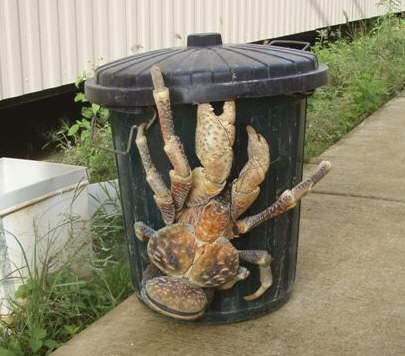
The coconut crab, Birgus latro, is the largest land-living arthropod in the world, and is probably at the upper limit of how big terrestrial animals with exoskeletons can become in today's atmosphere. The species inhabits the coastal forest regions of many Indo-Pacific islands, although localized extinction has occurred where the crab is sympatric with man. Generally nocturnal, they remain hidden during the day and emerge only on some nights to forage. Their body is divided into four regions; the cephalic lobe, forepart, trunk, and opisthosoma. It is a highly apomorphic hermit crab and is known for its ability to crack coconuts with its strong pincers to eat the contents. It is the only species of the genus Birgus.
Hairy Angler
The Hairy angler (Caulophryne polynema) is an ocean fish, and was first discovered by a BBC film crew while creating the documentary series The Blue Planet.
The female is about the size of a football and its body is covered in long antennae, which it uses to detect the movements of any prey nearby. The male is a tenth the size; about the size of a ping pong ball. The male also forms a parasitic relation with the female, attaching himself to her flesh and ultimately fusing with her blood stream.
Geoduck
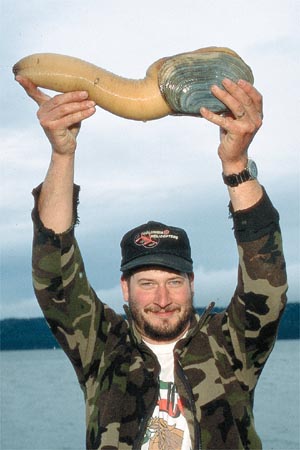
The geoduck (pronounced /ˈɡuː.iːdʌk/ "gooey duck"), Panopea generosa, is a species of very large saltwaterclam, a marine bivalve mollusk in the family Hiatellidae.
The shell of this clam is large and contains small wings, about 15 centimetres (5.9 in) to over 20 centimetres (7.9 in) in length, but the extremely long siphons make the clam itself very much longer than this: the "neck" or siphons alone can be 1 metre (3.3 ft) in length.
Blobfish
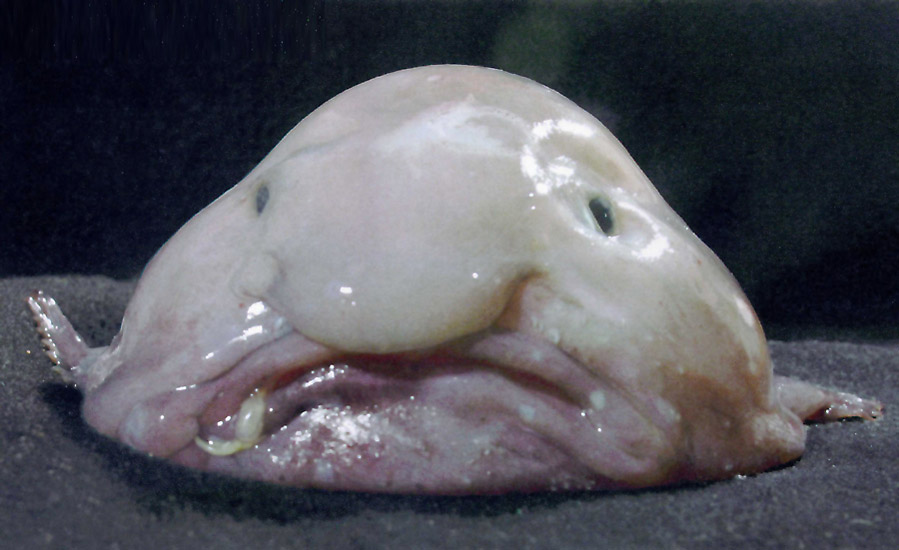
The blobfish (Psychrolutes marcidus) is a deep sea fish of the family Psychrolutidae. Inhabiting the deep waters off the coasts of mainland Australia and Tasmania, it is rarely seen by humans.
Blobfish live at depths where the pressure is several dozens of times higher than at sea level, which would likely make gas bladders inefficient for maintaining buoyancy. Instead, the flesh of the blobfish is primarily a gelatinous mass with a density slightly less than water; this allows the fish to float above the sea floor without expending energy on swimming. Its relative lack of muscle is not a disadvantage as it primarily swallows edible matter that floats by in front of it.
Blobfish can be caught by bottom trawling with nets. Such trawling in the waters off Australia may threaten the blobfish in what may be its only habitat.
Portuguese Man-o-War
The Portuguese Man o' War (Physalia physalis), also known as man of war, is a venomous marine invertebrate. The common name comes from a Portuguese war ship type of the 15th and 16th century, the caravel (in Portuguese, Caravela), which had triangular sails similar in outline to the bladder of the Portuguese Man o' War.
While the Portuguese Man o' War resembles a jellyfish, it is in fact a siphonophore – a colony of four kinds of minute, highly modified individuals, which are specialized polyps and medusoids. Each such zooid in these pelagic colonial hydroids or hydrozoans has a high degree of specialization and, although structurally similar to other solitary animals, are all attached to each other and physiologically integrated rather than living independently. Such zooids are specialized to such an extent that they lack the structures associated with other functions and are therefore dependent for survival on the others to do what the particular zooid cannot do by itself.
Predatory Tunicate
Predatory tunicates (Megalodicopia hians) are tunicates which live anchored along the deep sea canyon walls and seafloor, waiting for tiny animals to drift or swim into their hood-shaped mouths. Looking something like a cross between a jellyfish and a Venus Flytrap, its mouthlike hood is quick to close when a small animal drifts inside. Once the predatory tunicate catches a meal, it keeps its trap shut until it is ready to eat again. They are known to live in the Monterey Canyon at depths of 200-1,000 m (656-3,281 ft).
Blue-Ringed Octopus
The blue-ringed octopuses (genus Hapalochlaena) are three (or perhaps four) octopus species that live in tide pools in the Pacific Ocean, from Japan to Australia. Despite their small size and relatively docile nature, they are currently recognized as one of the world's most venomous animals. They can be recognized by their characteristic blue and black rings and yellowish skin. They hunt small crabs, hermit crabs, and shrimp, and may bite attackers, including humans, if provoked.
Black Swallower
The black swallower, Chiasmodon niger, is a species of deep sea fish in the family Chiasmodontidae, notable for its ability to swallow fish larger than itself (for which it is sometimes named the "great swallower"). It has a worldwide distribution in tropical and subtropical waters, in the mesopelagic and bathypelagic zones at a depth of 700-2,745 meters (2,300-9,000 ft).
Bobbit Worm
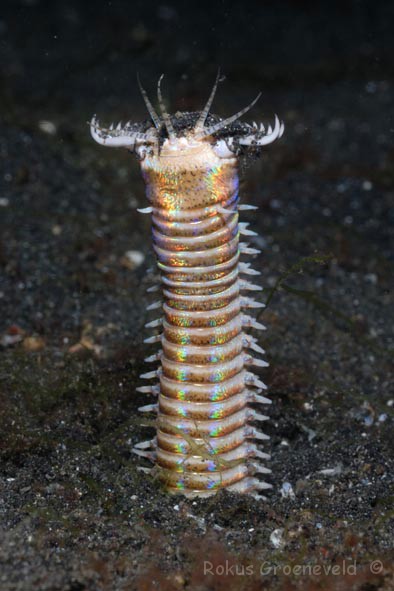
Eunice aphroditois, the Bobbit worm, is an aquatic predatory polychaete worm dwelling at the ocean floor at depths of approximately 10 metres (33 ft) to 40 metres (130 ft).
This organism buries its long body into an ocean bed composed of gravel, mud or corals, where it waits patiently for outside stimulus to reach one of its five antennae.
Armed with sharp teeth, it is known to attack with such speeds that its prey is sometimes sliced in half. Although the worm hunts for food, it is omnivorous.
Cookiecutter Shark
The name "cookiecutter shark" refers to its feeding habit of gouging round plugs, like a cookie cutter, out of larger animals. Marks made by cookiecutter sharks have been found on a wide variety of marine mammals and fishes, as well as on submarines, undersea cables, and even human bodies. It also consumes whole relatively smaller prey such as squid. Cookiecutter sharks have adaptations for hovering in the water column and likely rely on stealth and subterfuge to capture more active prey. Its dark collar seems to mimic the silhouette of a small fish, while the rest of its body blends into the downwelling light via its ventral photophores. When a would-be predator approaches the lure, the shark attaches itself using its suctorial lips and specialized pharynx and neatly excises a chunk of flesh using its bandsaw-like set of lower teeth. This species has been known to travel in schools.
Japanese Spider Crab
The Japanese spider crab has the greatest leg span of any arthropod, reaching 3.8 metres (12 ft 6 in) from claw to claw. The body may grow to a size of 40 centimetres or 16 in (carapace width) and the whole crab can weigh up to 41 pounds (19 kg). It is the males which have the longest chelipeds; females have much shorter chelipeds, which are shorter than the following pair of legs. Apart from its outstanding size, the Japanese spider crab differs from other crabs in a number of ways. The first pleopods of males are unusually twisted, and its larvae appear primitive. The crab is orange, with white spots along the legs. It is reported to have a gentle disposition "in spite of its ferocious appearance".
Sea Lamprey
The Sea lamprey (Petromyzon marinus) is a parasitic lamprey (a kind of jawless fish) found on the Atlantic coasts of Europe and North America, in the western Mediterranean Sea, and in the Great Lakes. It is brown or gray on its back and white or gray on the underside and can grow to be up to 90 cm (35.5 in) long. Sea lampreys prey on a wide variety of fish. The lamprey uses its suction-cup like mouth to attach itself to the skin of a fish and rasps away tissue with its sharp probing tongue and teeth. Secretions in the lamprey's mouth prevent the victim's blood from clotting. Victims typically die from excessive blood loss or infection.