Showing posts with label It's Smiling. Show all posts

Thursday, January 20, 2011

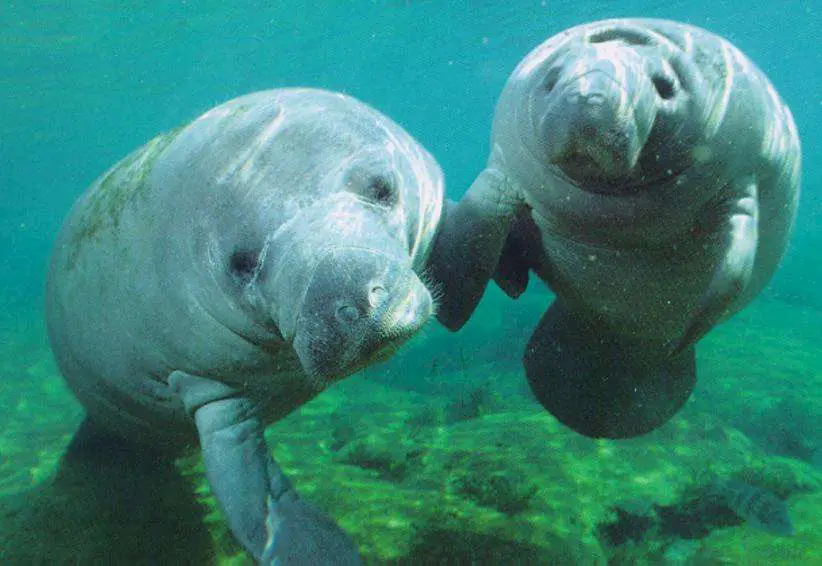
January 20, 2011 : Manatee


Manatee

Manatees (family Trichechidae, genus Trichechus) are large, fully aquatic, mostly herbivorous marine mammals sometimes known as sea cows. There are three accepted living species of Trichechidae, representing three of the four living species in the order Sirenia: the Amazonian manatee (
Trichechus inunguis), the West Indian manatee (Trichechus manatus), and the West African manatee (Trichechus senegalensis). They measure up to 3.6 metres (12 ft)), and have paddle-like flippers. The name manatí comes from the Taíno, a pre-Columbian people of the Caribbean, meaning "breast".

Half a manatee's day is spent sleeping in the water, surfacing for air regularly at intervals no greater than 20 minutes. Manatees spend most of the rest of the time grazing in shallow waters at depths of 1–2 metres (3.3–6.6 ft). The Florida subspecies (T. m. latirostris) has been known to live up to 60 years.

Manatees inhabit the shallow, marshy coastal areas and rivers of the Caribbean Sea and the Gulf of Mexico (T. manatus, West Indian Manatee), the Amazon Basin (T. inunguis, Amazonian Manatee), and West Africa (T. senegalensis, West African Manatee). A fourth species, the Dwarf Manatee (T. "pygmaeus"), was recently proposed for a population found in the Brazilian Amazon, although some believe it to be an immature Amazon Manatee.

They enjoy warmer waters and are known to congregate in shallow waters, and frequently migrate through brackish water estuaries to freshwater springs. Manatees cannot survive below 15°C (288 K; 60°F). Their natural source for warmth during winter is warm-spring fed rivers.

Thursday, December 30, 2010

December 30, 2010 : Beluga Whale


Beluga Whale

The beluga or white whale, Delphinapterus leucas, is an Arctic and sub-Arctic species of cetacean. It is one of two members of the family Monodontidae, along with the narwhal. This marine mammal is commonly referred to simply as the beluga or sea canary due to its high-pitched twitter. It is up to 5 meters (16 ft) in length and an unmistakable all-white color with a distinctive protuberance on the head. From a conservation perspective, the beluga is considered "near threatened" by the International Union for Conservation of Nature; however the subpopulation from the Cook Inlet in Alaska is considered critically endangered and is under the protection of the United States' Endangered Species Act. Of seven Canadian beluga populations, two are listed as endangered, inhabiting eastern Hudson Bay, and Ungava Bay.

Belugas are highly sociable. Groups of males may number in the hundreds, while mothers with calves generally mix in slightly smaller groups. When pods aggregate in estuaries, they may number in the thousands. This can represent a significant proportion of the entire population and is when they are most vulnerable to hunting.

Pods tend to be unstable, meaning that they tend to move from pod to pod. Radio tracking has shown that belugas can start out in a pod and within a few days be hundreds of miles away from that pod. Mothers and calves form the beluga's closest social relationship. Nursing times of two years have been observed and lactational anestrus may not occur. Calves often return to the same estuary as their mother in the summer, meeting her sometimes even after becoming fully mature.

Belugas can be playful—they may spit at humans or other whales. It is not unusual for an aquarium handler to be drenched by one of his charges. Some researchers believe that spitting originated with blowing sand away from crustaceans at the sea bottom.

Unlike most whales, it is capable of swimming backwards.

Thursday, September 9, 2010

September 9, 2010 : Whale Shark


Whale Shark

The whale shark, Rhincodon typus, is a slow-moving filter feeding shark, the largest living fish species. The largest confirmed individual was 12.65 metres (41.50 ft) in length. The heaviest weighed more than 36 tonnes (79,000 lb), but unconfirmed claims report considerably larger whale sharks. This distinctively-marked fish is the only member of its genus Rhincodon and its family, Rhincodontidae (called Rhinodontes before 1984), which belongs to the subclass Elasmobranchii in the class Chondrichthyes. The shark is found in tropical and warm oceans, lives in the open sea with a lifespan of about 70 years. The species originated about 60 million years ago. Although whale sharks have very large mouths, they feed mainly, though not exclusively, on plankton, microscopic plants and animals, although the BBC program Planet Earth filmed a whale shark feeding on a school of small fish.

The species was distinguished in April 1828, following the harpooning of a 4.6-metre (15.1 ft) specimen in Table Bay, South Africa. Andrew Smith, a military doctor associated with British troops stationed in Cape Town described it the following year. He published a more detailed description in 1849. The name "whale shark" comes from the fish's physiology; as large as a whale, it too is a filter feeder.

As a filter feeder it has a capacious mouth which can be up to 1.5 metres (4.9 ft) wide and can contain between 300 and 350 rows of tiny teeth. It has five large pairs of gills. Two small eyes are located towards the front of the shark's wide, flat head. The body is mostly grey with a white belly; three prominent ridges run along each side of the animal and the skin is marked with a "checkerboard" of pale yellow spots and stripes. These spots are unique to each individual and are useful for counting populations. Its skin can be up to 10 centimetres (3.9 in) thick. The shark has a pair each of dorsal fins and pectoral fins. Juveniles' tails have a larger upper than lower fin while the adult tail becomes semi-lunate (crescent-shaped). Spiracles are just behind the eyes.

Saturday, September 4, 2010

September 4, 2010 : Moray Eel


Moray Eel
 

Moray eels are cosmopolitan eels of the family Muraenidae. The approximately 200 species in 15 genera are almost exclusively marine, but several species are regularly seen in brackish water and a few, for example the freshwater moray (Gymnothorax polyuranodon) can sometimes be found in freshwater. With a maximum length of 11.5 centimetres (4.5 in), the smallest moray is likely the Snyder's moray (Anarchias leucurus), while the longest species, the slender giant moray (Strophidon sathete) reaches up to 4 metres (13 ft). The largest in terms of total mass is the giant moray (Gymnothorax javanicus), which reaches almost 3 metres (9.8 ft) and can weigh over 36 kilograms (79 lb).
 

The dorsal fin extends from just behind the head along the back and joins seamlessly with the caudal and anal fins. Most species lack pectoral and pelvic fins, adding to their serpentine appearance. Their eyes are rather small; morays rely on their highly developed sense of smell, lying in wait to ambush prey.

The body is generally patterned. Camouflage is also present inside the mouth. Their jaws are wide, framing a protruding snout. They possess large teeth, designed to tear flesh as opposed to holding or chewing.
 

Moray eels' heads are too narrow to create the negative pressure that most fish use to swallow prey. Quite possibly because of this, they have a second set of jaws in their throat called pharyngeal jaws, which also possess teeth. When feeding, morays launch these jaws into the mouth, where they grasp prey and transport it into the throat and digestive system. Moray eels are the only animal that uses pharyngeal jaws to actively capture and restrain prey. Larger morays are capable of seriously wounding humans.
 

The Morays are frequently thought of as particularly vicious or ill-tempered animals. In truth, morays hide from humans in crevices and would rather flee than fight. Morays are shy and secretive, and attack humans only in self-defense or mistaken identity. Most attacks stem from disruption of a moray's burrow (to which they do react strongly), but an increasing number also occur during hand-feeding of morays by divers, an activity often used by dive companies to attract tourists. Morays have poor vision and rely mostly on their acute sense of smell, making distinguishing between fingers and held food difficult; numerous divers have lost fingers while attempting hand feedings. For this reason the hand feeding of moray eels has been banned in some locations, including the Great Barrier Reef. The moray's rear-hooked teeth and primitive but strong bite mechanism also makes bites on humans more severe, as the eel cannot release its grip even in death and must be manually pried off. While the majority are not believed to be venomous, circumstantial evidence suggests that a few species may be.

Tuesday, August 10, 2010

August 10, 2010 : Piglet Squid


Piglet Squid

The animal, named because of its tuft of bristle-like arms and tentacles and rotund shape, is normally found more than 320 feet (100m) below the surface of the ocean.

Because of its deep water habit, little is known of the behaviour of the squid, although not surprisingly, judging by its body shape, it is known to be a sluggish swimmer.

The squids' bodies are almost completely clear except for some pigment-containing cells, or chromatophores, which give this specimen its distinctive appearance.

Properly called Helicocranchia pfefferi, the animals are also noted for the light producing organs known as photophores located beneath each of their large eyes.

This specimen, about the size of an orange, was collected by the Cabrillo Marine Aquarium where director Mike Schaat managed to capture it on film.

Tuesday, August 3, 2010

August 3, 2010 : Goblin Shark


Goblin Shark 

The goblin shark, Mitsukurina owstoni, is a deep-sea shark, the sole living species in the family Mitsukurinidae. The most distinctive characteristic of the goblin shark is the unorthodox shape of its head. It has a long, trowel-shaped, beak-like rostrum or snout, much longer than other sharks' snouts. Some other distinguishing characteristics of the shark are the color of its body, which is mostly pink, and its long, protrusible jaws. When the jaws are retracted, the shark resembles a pink grey nurse shark, Carcharias taurus, with an unusually long nose.

Mitsukurina owstoni is found in the deep ocean, far below where the sun's light can reach at depths greater than 200 m. They can be found throughout the world, from Australia in the Pacific Ocean to the Gulf of Mexico in the Atlantic Ocean. They are best known from the waters around Japan, where the species was first discovered.
 

Goblin sharks feed on a variety of organisms that live in deep waters. Among some of their known prey are deep-sea squid, crabs and deep-sea fish. Very little is known about the species' life history and reproductive habits, as encounters with them have been relatively rare. As seemingly rare as they are however, there seems to be no real threat to their populations and so they are not classified as endangered species by the IUCN.

Saturday, May 29, 2010

May 29, 2010 : Seawolf


Seawolf

The Atlantic wolffish (
Anarhichas lupus), also known as the Seawolf, Atlantic catfish, ocean catfish, wolf eel (the common name for its Pacific relative), or sea cat, is a marine fish, the largest of the wolffish family Anarhichadidae. The numbers of the Atlantic wolffish are rapidly depleting due to overfishing and by-catch, and is currently a Species of Concern according to the National Oceanic and Atmospheric Administration's (NOAA) National Marine Fisheries Service (NMFS). Although it is a fearsome looking creature, the Atlantic wolffish is only a threat when defending itself outside of the water. Apart from their unique appearance wolffish are also distinguished by the natural antifreeze they produce to keep their blood moving fluidly in their very cold habitat, involvement by both the male and female in brood bearing, and the large size of their eggs. They are also an important factor in controlling green crab and sea urchin populations, which can become overly disruptive to habitats if they are left unchecked. Wolffish population success is also an important indicator of the health of other bottom dweller populations, such as cod.