Dunkleosteus (From "(David) Dunkle" + osteus (οστεος, Greek: bone); meaning "Dunkle's Bone") is a prehistoric fish, one of the largest arthrodire placoderms ever to have lived, existing during the Late Devonian period, about 380-360 million years ago.
This hunter, measuring up to 10 metres (33 ft) and weighing 3.6 tonnes (4.0 short tons), was a hypercarnivorousapex predator. Few other placoderms, save, perhaps, its contemporary, Titanichthys, rivaled Dunkleosteus in size.
Dunkleosteus is a member of the pachyosteomorph arthrodires, and is more specifically usually placed in the family Dinichthyidae, a family composed mostly of large, carnivorous arthrodires like Gorgonichthys. Anderson (2009) suggests that because of its primitive jaw structure Dunkleosteus should be placed outside the family Dinichthyidae, perhaps close to the base of the clade Pachyosteomorpha, near Eastmanosteus,but this idea has yet to be tested.
This is the first extinct organism that will be appearing on the site. More will be featured periodically.
Toadfishes are usually scaleless, with eyes set high on large heads. Their mouths are also large, with both maxillapremaxilla, and often decorated with barbels and skin flaps. They are generally drab in colour, although those living coral reefs may have brighter patterns. They range in size from 7.5 centimetres (3.0 in) length in and Thlassophryne megalops, to 57 centimetres (22 in) in the Pacuna toadfish.
Toadfishes of the genus Porichthys, the midshipman fishes, have photophores and four lateral lines. All toadfishes possess sharp spines on the first dorsal fin and on the opercle (gill cover). In fish of the subfamily Thalassophryninae, these are hollow and connect to venom glands capable of delivering a painful wound to predators.
Seawolf
The Atlantic wolffish (Anarhichas lupus), also known as the Seawolf, Atlantic catfish, ocean catfish, wolf eel (the common name for its Pacific relative), or sea cat, is a marine fish, the largest of the wolffish family Anarhichadidae. The numbers of the Atlantic wolffish are rapidly depleting due to overfishing and by-catch, and is currently a Species of Concern according to the National Oceanic and Atmospheric Administration's (NOAA) National Marine Fisheries Service (NMFS). Although it is a fearsome looking creature, the Atlantic wolffish is only a threat when defending itself outside of the water. Apart from their unique appearance wolffish are also distinguished by the natural antifreeze they produce to keep their blood moving fluidly in their very cold habitat, involvement by both the male and female in brood bearing, and the large size of their eggs. They are also an important factor in controlling green crab and sea urchin populations, which can become overly disruptive to habitats if they are left unchecked. Wolffish population success is also an important indicator of the health of other bottom dweller populations, such as cod.
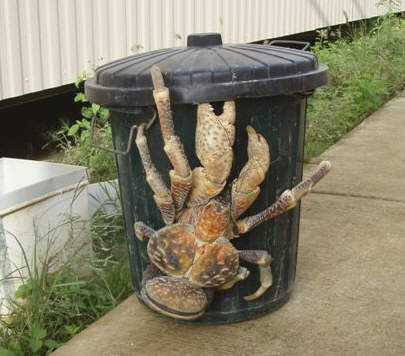
The coconut crab, Birgus latro, is the largest land-living arthropod in the world, and is probably at the upper limit of how big terrestrial animals with exoskeletons can become in today's atmosphere. The species inhabits the coastal forest regions of many Indo-Pacific islands, although localized extinction has occurred where the crab is sympatric with man. Generally nocturnal, they remain hidden during the day and emerge only on some nights to forage. Their body is divided into four regions; the cephalic lobe, forepart, trunk, and opisthosoma. It is a highly apomorphic hermit crab and is known for its ability to crack coconuts with its strong pincers to eat the contents. It is the only species of the genus Birgus.
Synanceia is a genus of fish of the family Synanceiidae, the Stonefishes, whose members are venomous, dangerous, and even fatal to humans. It is the most venomous fish in the world. They are found in the coastal regions of Indo-Pacific oceans. They are primarily marine, though some species are known to live in rivers. Its species have potent neurotoxins secreted from glands at the base of their needle-like dorsal fin spines which stick up when disturbed or threatened. The vernacular name of the species, the stonefish, derives from being able to camouflage and transform itself to a gray and mottled color similar to the color of a stone. Divers have sometimes stepped on them, thinking they are stones.
The coelacanths, which are related to lungfishes and tetrapods, were believed to have been extinct since the end of the Cretaceous period. The coelacanth is actually more related to tetrapods than the ray-finned fish. They were considered the "missing link" between the fish and the tetrapods until the first Latimeria specimen was found off the east coast of South Africa, off the Chalumna River in 1938.
The first specimen of this species was only photographed at a local market by Arnaz and Mark Erdmann before being bought by a shopper.
The Hairy angler (Caulophryne polynema) is an ocean fish, and was first discovered by a BBC film crew while creating the documentary series The Blue Planet.
The female is about the size of a football and its body is covered in long antennae, which it uses to detect the movements of any prey nearby. The male is a tenth the size; about the size of a ping pong ball. The male also forms a parasitic relation with the female, attaching himself to her flesh and ultimately fusing with her blood stream.
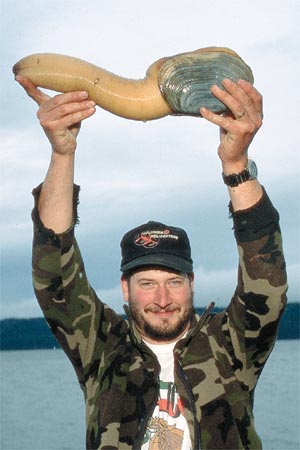
The geoduck (pronounced /ˈɡuː.iːdʌk/ "gooey duck"), Panopea generosa, is a species of very large saltwaterclam, a marine bivalve mollusk in the family Hiatellidae.
The shell of this clam is large and contains small wings, about 15 centimetres (5.9 in) to over 20 centimetres (7.9 in) in length, but the extremely long siphons make the clam itself very much longer than this: the "neck" or siphons alone can be 1 metre (3.3 ft) in length.
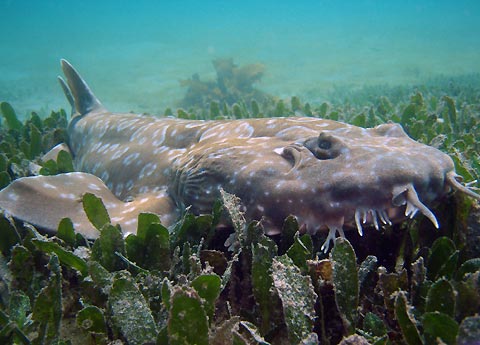
Wobbegong is the common name given to the 11 species of carpet sharks in the family Orectolobidae. They are found in shallow temperate and tropical waters of the western Pacific Ocean and eastern Indian Ocean, chiefly around Australia and Indonesia, although one species (the Japanese wobbegong, Orectolobus japonicus) occurs as far north as Japan. The word wobbegong is believed to come from an Australian Aboriginal language, meaning "shaggy beard", referring to the growths around the mouth of the shark of the western Pacific.
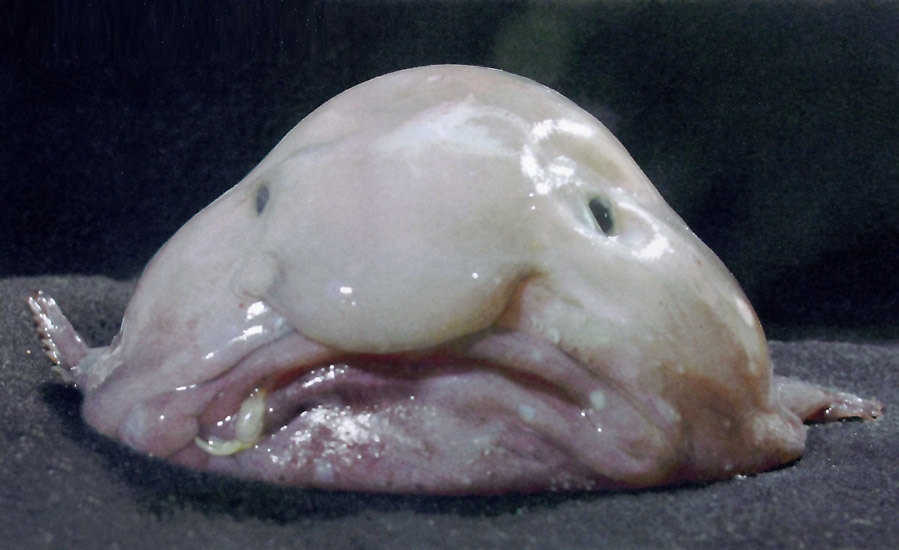
The blobfish (Psychrolutes marcidus) is a deep sea fish of the family Psychrolutidae. Inhabiting the deep waters off the coasts of mainland Australia and Tasmania, it is rarely seen by humans.
Blobfish live at depths where the pressure is several dozens of times higher than at sea level, which would likely make gas bladders inefficient for maintaining buoyancy. Instead, the flesh of the blobfish is primarily a gelatinous mass with a density slightly less than water; this allows the fish to float above the sea floor without expending energy on swimming. Its relative lack of muscle is not a disadvantage as it primarily swallows edible matter that floats by in front of it.
Blobfish can be caught by bottom trawling with nets. Such trawling in the waters off Australia may threaten the blobfish in what may be its only habitat.
Grenadiers or rattails (less commonly whiptails) are generally large, brown to black gadiform marine fish of the family Macrouridae. Found at great depths from the Arctic to Antarctic, members of this family are among the most abundant of the deep-sea fishes.
The Macrouridae are a large and diverse family with some 34 genera and 383 species recognized (well over half of which are contained in just three genera, Caelorinchus, Coryphaenoides and Nezumia). They range in length from approximately 10 centimetres (3.9 in) in the graceful grenadier (Hymenocephalus gracilis) to 1.5 metres (4.9 ft) in the giant grenadier, Albatrossia pectoralis. An important commercial fishery exists for the larger species, such as the giant grenadier and roundnose grenadier, Coryphaenoides rupestris. The family as a whole may represent up to 15 percent of the deep-sea fish population.
The argonauts (genus Argonauta, the only extant genus in the Argonautidae family) are a group of pelagic octopuses. They are also called paper nautiluses, referring to the paper-thin shell that females secrete. This structure lacks the gas-filled chambers present in chambered nautilus shells and is not an inherited cephalopod shell, but rather an evolutionary innovation unique to the genus Argonauta. It is used as an eggcase and for trapped surface air to maintain buoyancy.
Portuguese Man-o-War
The Portuguese Man o' War (Physalia physalis), also known as man of war, is a venomous marine invertebrate. The common name comes from a Portuguese war ship type of the 15th and 16th century, the caravel (in Portuguese, Caravela), which had triangular sails similar in outline to the bladder of the Portuguese Man o' War.
While the Portuguese Man o' War resembles a jellyfish, it is in fact a siphonophore – a colony of four kinds of minute, highly modified individuals, which are specialized polyps and medusoids. Each such zooid in these pelagic colonial hydroids or hydrozoans has a high degree of specialization and, although structurally similar to other solitary animals, are all attached to each other and physiologically integrated rather than living independently. Such zooids are specialized to such an extent that they lack the structures associated with other functions and are therefore dependent for survival on the others to do what the particular zooid cannot do by itself.
The Trieste was a Swiss-designed deep-diving research bathyscaphe ("deep boat") with a crew of two, which reached a record-breaking depth of about 10,911 metres (35,797 ft), in the deepest known part of any ocean on Earth, the Challenger Deep in the Mariana Trench, on January 23, 1960.
The Challenger Deep is the deepest surveyed point in the oceans, with a depth of approximately 36,000 feet (11,000 meters). It is located at the southern end of the Mariana Trench near the Mariana Islands group. The Challenger Deep is a relatively small slot-shaped depression in the bottom of a considerably larger crescent-shaped trench, which itself is an unusually deep feature in the ocean floor.
The closest land to the Challenger Deep is Fais Island (one of the outer islands of Yap), 289 km (180 mi) southwest, and Guam, 306 km (190 mi) to the northeast. The depression is named after the British Royal Navy survey ship HMS Challenger, whose expedition of 1872–76 made the first recordings of its depth.
They have a highly vascularized, red "plume" at the tip of their free end which is an organ for exchanging compounds with the environment (e.g., H2S, CO2, O2, etc). The tube worm does not have many predators, as few creatures live on the sea bottom at such depths. If threatened, the plume may be retracted into the worm's protective tube. The plume provides essential nutrients to bacteria living inside a specialized organ within its body (i.e., trophosome) as part of a symbiotic relationship. They are remarkable in that they have no digestive tract, but the bacteria (which may make up half of a worm's body weight) turn oxygen, hydrogen sulfide, carbon dioxide, etc. into organic molecules on which their host worms feed. This process, known as chemosynthesis, was first recognized by Colleen Cavanaugh while she was a graduate student at Harvard.
The goliath grouper is found primarily in shallow tropical waters among coral and artificial reefs at depths of up to 165 feet (50 m). Their range includes the Florida Keys, the Bahamas, most of the Caribbean, and practically all of the Brazilian coast, where they are known as mero. On some occasions it is caught in New England off Maine and Massachusetts but it is not that common. In the eastern Atlantic Ocean, it occurs from Congo to Senegal.
Young grouper may live in brackish estuaries, canals, and mangrove swamps, unusual behavior among grouper.
Predatory tunicates (Megalodicopia hians) are tunicates which live anchored along the deep sea canyon walls and seafloor, waiting for tiny animals to drift or swim into their hood-shaped mouths. Looking something like a cross between a jellyfish and a Venus Flytrap, its mouthlike hood is quick to close when a small animal drifts inside. Once the predatory tunicate catches a meal, it keeps its trap shut until it is ready to eat again. They are known to live in the Monterey Canyon at depths of 200-1,000 m (656-3,281 ft).
The blue-ringed octopuses (genus Hapalochlaena) are three (or perhaps four) octopus species that live in tide pools in the Pacific Ocean, from Japan to Australia. Despite their small size and relatively docile nature, they are currently recognized as one of the world's most venomous animals. They can be recognized by their characteristic blue and black rings and yellowish skin. They hunt small crabs, hermit crabs, and shrimp, and may bite attackers, including humans, if provoked.
The tripod fish, Bathypterois grallator, is a bathypelagic (deep sea) fish named for the long extensions of its pelvic and lower caudal fins, on which it stands on the sea floor. The tripod fish is closely related to the smaller spiderfish (Bathypterois longifilis), which is similar in appearance and habits but smaller and with much shorter fin extensions; the two species are often found standing very near to one another on the ocean floor.
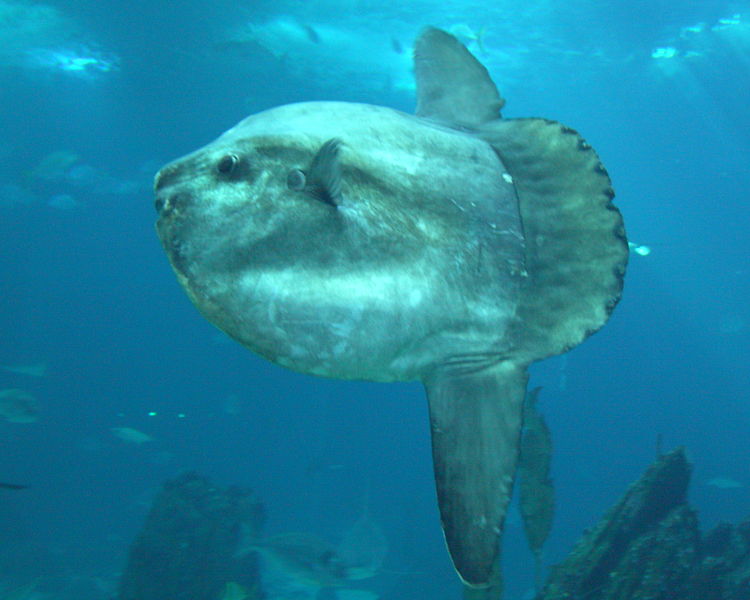
Ocean Sunfish
The ocean sunfish, Mola mola, or common mola, is the heaviest known bony fish in the world. It has an average adult weight of 1,000 kg (2,200 lb). The species is native to tropical and temperate waters around the globe. It resembles a fish head with a tail, and its main body is flattened laterally. Sunfish can be as tall as they are long when their dorsal and ventral fins are extended.
Sunfish live on a diet that consists mainly of jellyfish, but because this diet is nutritionally poor, they consume large amounts in order to develop and maintain their great bulk. Females of the species can produce more eggs than any other known vertebrate. Sunfish fry resemble miniature pufferfish, with large pectoral fins, a tail fin and body spines uncharacteristic of adult sunfish.