Scientists at Dalhousie University in Halifax, Canada, collected samples of the R.M.S. Titanic's icicle-like rust formations, called rusticles, in 1991.
Although the formations were teaming with life, nobody had identified the specific microbes on the ship, instead grouping them into broad categories such as bacteria or fungi.
So Henrietta Mann and then graduate student Bhavleen Kaur, now of the Ontario Science Centre, decided to isolate and identify one species of bacteria from the mess of microscopic life-forms.
The one they chose turned out to be a new species, which the pair dubbed Halomonas titanicae. The bacteria is part of a family that had never been seen before in waters as deep as those in which the Titanic sits, about 2.4 miles (3.8 kilometers) below the surface, Kaur said.
The taimen (Hucho taimen), also known as Siberian taimen and Siberian salmon, is a species of fish in the salmon family (family Salmonidae) of order Salmoniformes.
The taimen is distributed from the Volga and Pechora River basins east to the Yana River in the north and that of the Amur River in the south. On a larger scale, this includes parts of the Caspian and Arctic drainages in Eurasia and portions of the Pacific drainage in Mongolia and Russia (the Amur River). In Mongolia the taimen is found in both the Arctic and Pacific drainages, specifically the Yenisei/Selenga, the Lena, and the Amur River Basins. The taimen lives in flowing water and is only occasionally found in lakes, usually near the mouth of a tributary. The taimen is not anadromous, but does show increased movement rates during the spawning season. The average home range size of taimen in the Eg-Uur River of Mongolia is 23km, but some tagged individuals show home ranges up to 93km. Some authors consider the taimen to be a subspecies of the Huchen, i.e. Hucho hucho taimen.
Coloration varies geographically, but is generally olive green on the head blending to reddish brown in the tail. Adipose, anal, and caudal fins are often dark red. The belly ranges from nearly white to dark gray. The taimen is the largest salmonid in the world. The maximum size is not well known, but a fish caught in the Kotui River in Russia with a length of 210 cm (83 in) and a weight of 105 kg (231 lb) is the largest reliable record (Holcik et al. 1988). The IGFA world record is a little under 100 lb or 45 kg. It can reach at least 55 years of age.
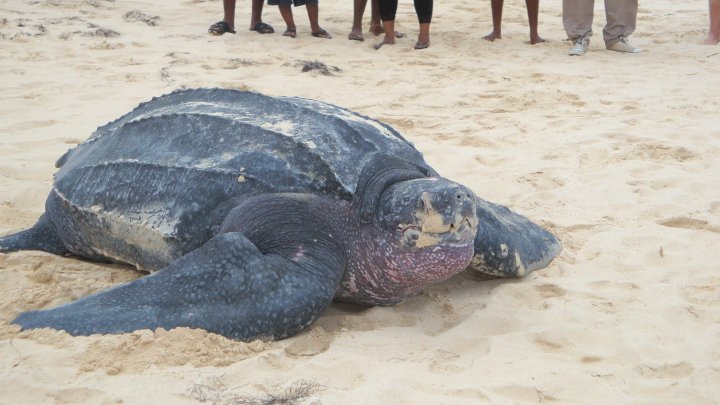
Leatherback Turtle
The leatherback turtle (Dermochelys coriacea) is the largest of all living sea turtles and the fourth largest modern reptile behind three crocodilians. It is the only living species in the genus Dermochelys. It can easily be differentiated from other modern sea turtles by its lack of a bony shell. Instead, its carapace is covered by skin and oily flesh. Dermochelys coriacea is the only extant member of the family Dermochelyidae.
Leatherback turtles have the most hydrodynamic body design of any other sea turtle, with a large, teardrop shaped body. A large pair of front flippers power the turtles through the water. Like other sea turtles, the leatherback's flattened forelimbs are adapted for swimming in the open ocean. Claws are absent from both pairs of flippers. The Leatherback's flippers are the largest in proportion to its body among extant sea turtles. Leatherback's front flippers can grow up to 2.7 meters (9 ft) in large specimens, the largest flippers (even in comparison to its body) of any sea turtle.
The leatherback has several characteristics that distinguish it from other sea turtles. Its most notable feature is the lack of a bony carapace. Instead of scutes, thick, leathery skin with embedded minuscule osteoderms. Seven distinct ridges rise from the carapace, crossing from the anterior to posterior margin of the turtle's back. Leatherbacks are unique among reptiles in that their scales lack β-keratin. The entire turtle's dorsal surface is colored dark grey to black with a scattering of white blotches and spots. Demonstrating countershading, the turtle's underside is lightly colored.
Instead of teeth, the leatherback turtle has points on the tomium of its upper lip, with backwards spines in its throat to help it swallow food.
Cape Horn island (Dutch: Kaap Hoorn, Spanish: Cabo de Hornos; named after the city of Hoorn in the Netherlands) is the southernmost headland of the Tierra del Fuego archipelago of southern Chile.
Cape Horn is the most southerly point of South America, and marks the northern boundary of the Drake Passage; for many years it was a major milestone on the clipper route, by which sailing ships carried trade around the world. However, the waters around the Cape are particularly hazardous, owing to strong winds, large waves, strong currents and icebergs; these dangers have made it notorious as a sailors' graveyard.
The need for ships to round the Cape Horn was greatly reduced by the opening of the Panama Canal in 1914. However, sailing around the Horn is widely regarded as one of the major challenges in yachting. Thus, a few recreational sailors continue to sail this route, sometimes as part of a circumnavigation of the globe, and almost all of these choosing routes through the channels to the north of the actual Cape (though many take a detour through the islands and anchor to wait for fair weather to actually visit Horn Island or even sail around it to replicate a rounding of this historic point). Several prominent ocean yacht races, notably the Volvo Ocean Race, the VELUX5OCEANS and the Vendée Globe, sail around the world via the Horn, and speed records for round-the-world sailing are recognized for following this route.
The Pompeii worm (Alvinella pompejana) is a deep-sea polychaete vermiform extremophile found only at hydrothermal vents in the Pacific Ocean, discovered in the early 1980s off the Galápagos Islands by Frenchresearchers. They can reach up to 5 inches in length and are pale gray with red tentacle-like gills on their heads. Perhaps most fascinating, is that their tail end is often resting in temperatures as high as 176 °F (80 °C), while their feather-like head sticks out of the tubes into water that is a much cooler 72 °F (22 °C). Scientists are attempting to understand how Pompeii worms can withstand such extreme temperatures by studying the bacteria that form a "fleece-like" covering on their backs. Living in a symbiotic relationship, the worms secrete mucus from tiny glands on their backs to feed the bacteria, and in return they are protected by some degree of insulation. The bacteria have also been discovered to be chemolithotrophic, contributing to the ecology of the vent community. Recent researches suggest that the bacteria might play an important role in the feeding of the worms.
Attaching themselves to black smokers, the worms have been found to thrive at temperatures of up to 80 °C (176 °F), making the Pompeii worm the most heat-tolerant complex animal known to science after the tardigrades (or water bears), which are able to survive temperatures over 150 °C.
The giant clam, Tridacna gigas, or traditionally, pa’ua, is the largest living bivalve mollusk. T. gigas is one of the most endangered clam species. It was mentioned as early as 1825 in scientific reports. One of a number of large clam species native to the shallow coral reefs of the South Pacific and Indian oceans, they can weigh more than 200 kilograms (441 lb) measure as much as 1.2 meters (4 ft) across, and have an average lifespan in the wild of 100 years or more. They are also found off the shores of the Philippines, where they are called taklobo. T. gigas. Its range covers the Indo-Pacific, but populations are diminishing quickly and the giant clam has become extinct in many areas where it was once common. lives in flat coral sand or broken coral and can be found at depth of as much as 20 meters (66 ft)T. maxima has the largest geographical distribution among giant clam species; it can be found in high- or low-islands, lagoons, or fringing reefs. Its rapid growth rate is likely due to its ability to cultivate plants in its body tissue.
This species of very large, strong-swimming nudibranch is one of the largest of all nudibranchs: specimens of well over 40 cm in length have been reported.
The species name, sanguineus, refers to its bright red coloration, but a yellow variant also exists.
This nudibranch has two very different modes of locomotion: crawling and swimming. When it crawls, the wide edges of the mantle (the parapodia) are rolled up close to the body. When the animal swims however, the red parapodia unfurl, and are whirled through the water in a spectacular undulating motion, propelling the animal forwards.
The animal was given the common name "Spanish dancer" because the whirling swimming movement, and the red color of the mantle, are reminiscent of the skirt movements of a flamenco dancer.
The Emperor shrimp, Periclimenes imperator, is a commensal that is commonly found living on Hexabranchus sanguineus.
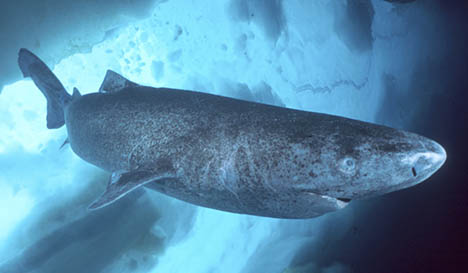
The Greenland shark, Somniosus microcephalus, also known as the sleeper shark, gurry shark, ground shark, grey shark, or by the Inuit Eqalussuaq, is a large shark native to the waters of the North Atlantic Ocean around Greenland and Iceland. These sharks live farther north than any other shark species. They are closely related to the Pacific sleeper shark. This is one of the largest species of shark, of dimensions comparable to those of the Great White Shark. Large Greenland Sharks grow to 6.4 m (21 ft) and 1000 kg (2200 lbs), and possibly up to 7.3 m (24 ft). It rivals the Pacific sleeper shark (possibly up to 7 m or 23 ft long) as the largest species in the Somniosidae family. The greenland shark is known to be long-lived.
The coelacanths, which are related to lungfishes and tetrapods, were believed to have been extinct since the end of the Cretaceous period. The coelacanth is actually more related to tetrapods than the ray-finned fish. They were considered the "missing link" between the fish and the tetrapods until the first Latimeria specimen was found off the east coast of South Africa, off the Chalumna River in 1938.
The first specimen of this species was only photographed at a local market by Arnaz and Mark Erdmann before being bought by a shopper.
The argonauts (genus Argonauta, the only extant genus in the Argonautidae family) are a group of pelagic octopuses. They are also called paper nautiluses, referring to the paper-thin shell that females secrete. This structure lacks the gas-filled chambers present in chambered nautilus shells and is not an inherited cephalopod shell, but rather an evolutionary innovation unique to the genus Argonauta. It is used as an eggcase and for trapped surface air to maintain buoyancy.
The Trieste was a Swiss-designed deep-diving research bathyscaphe ("deep boat") with a crew of two, which reached a record-breaking depth of about 10,911 metres (35,797 ft), in the deepest known part of any ocean on Earth, the Challenger Deep in the Mariana Trench, on January 23, 1960.
The Challenger Deep is the deepest surveyed point in the oceans, with a depth of approximately 36,000 feet (11,000 meters). It is located at the southern end of the Mariana Trench near the Mariana Islands group. The Challenger Deep is a relatively small slot-shaped depression in the bottom of a considerably larger crescent-shaped trench, which itself is an unusually deep feature in the ocean floor.
The closest land to the Challenger Deep is Fais Island (one of the outer islands of Yap), 289 km (180 mi) southwest, and Guam, 306 km (190 mi) to the northeast. The depression is named after the British Royal Navy survey ship HMS Challenger, whose expedition of 1872–76 made the first recordings of its depth.
The Mariana Trench is the deepest known part of the world's oceans, and the lowest elevation of the surface of the Earth's crust. It is located in the western Pacific Ocean, to the east of the Mariana Islands. The trench is about 2,550 kilometres (1,580 mi) long but has a mean width of only 69 kilometres (43 mi). It reaches a maximum depth of about 10,916 metres (35,814 ft) at the Challenger Deep, a small slot-shaped valley in its floor, at its southern end.
A salp (plural salps; also salpa, plural salpae or salpas) is a barrel-shaped, free-floating tunicate. It moves by contracting, thus pumping water through its gelatinous body. The salp strains the pumped water through its internal feeding filters, feeding on phytoplankton that it sieves out of the water.
Salps are common in equatorial, temperate, and cold seas, where they can be seen at the surface, singly or in long, stringy colonies. The most abundant concentrations of salps are in the Southern Ocean (near Antarctica). Here they sometimes form enormous swarms, often in deep water, and are sometimes even more abundant than krill. Over the last century, while krill populations in the Southern Ocean have declined, salp populations appear to be increasing.