Great White Shark
The great white shark, Carcharodon carcharias, also known as great white, white pointer, white shark, or white death, is a large lamniform shark found in coastal surface waters in all major oceans. The great white shark is very well known for its size, with the largest individuals known to have approached or exceeded 6 metres (20 ft) in length and 2,268 kilograms (5,000 lb) in weight. It reaches maturity at around 15 years of age and can have a life span of over 30 years. The great white shark is arguably the world's largest known extant macropredatory fish and is one of the primary predators of marine mammals. It is also known to prey upon a variety of other marine animals including fish, pinnipeds, and seabirds. It is the only known surviving species of its genus, Carcharodon.
The best selling novel Jaws and the subsequent blockbuster film by Steven Spielberg depicted the great white shark as a "ferocious man eater". In reality, humans are not the preferred prey of the great white shark. The IUCN treats the great white shark as vulnerable, while it is included in Appendix II of CITES.
Carolus Linnaeus gave the great white shark its first scientific name, Squalus carcharias in 1758. Sir Andrew Smith gave it the generic name Carcharodon in 1833, and in 1873 the generic name was identified with Linnaeus' specific name and the current scientific name Carcharodon carcharias was finalised.
Carcharodon comes from the Greek words karcharos, which means sharp or jagged, and odous, which means tooth.
Great white sharks live in almost all coastal and offshore waters which have water temperature between 12 and 24 °C (54 and 75 °F), with greater concentrations in the United States (Atlantic Northeast and California), South Africa, Japan, Australia (especially New South Wales and South Australia), New Zealand, Chile, and the Mediterranean. One of the densest known populations is found around Dyer Island, South Africa where much shark research is conducted.
It is an epipelagic fish, observed mostly in inland tributaries in the presence of rich game like fur seals, sea lions, cetaceans, other sharks, and large bony fish species. It is an open-ocean dweller and has been recorded at depths of around 1,220 m (4,000 ft). These findings challenge the traditional notion about the great white as being a coastal species.
Shark Dart
The Farallon Shark Dart, a U.S. Navy weapon from the 1970s. The most common version resembles a slim dagger, with a CO2 cartridge in the handle and a long hollow needle for a blade. The idea was to stab the shark, causing the CO2 to be released into its body. The idea was that this would not kill it but would affect its buoyancy, forcing it to break off the attack without leaving much blood in the water. The reality may have been more gruesome.
"I saw some footage on it, it was horrible," says a diver describing the effects here. "Their bellies would inflate and they said it would force the shark’s stomach out of their mouths."
As well as the dagger, there was also a lance-like shark dart on a pole, and even a projectile version – a spear gun which fired a Shark Dart projectile. This seems to have been the inspiration for the shark gun firing ‘compressed air bullets’ used by 007 in Live And Let Die.
According to Tom LaPuzza of the Space and Naval Warfare Systems Center in San Diego, California, the Shark Dart was carried by SEAL divers who protected NASA astronauts after spashdown – but it was never popular, a view I found confirmed by others.
“We never had a history of any of our divers encountering hostile sharks during operational or training missions,” Tom Hawkins of the Naval Special Warfare Foundation told me. “It [the Shark Dart] was just more equipment to carry, when the threat didn’t warrant the extra weight or bulk.”
Farallon gave up making their Shark Dart long ago, though they still supply Special Forces with hi-tech gadgets such as Diver Propulsion Vehicles (DPVs).

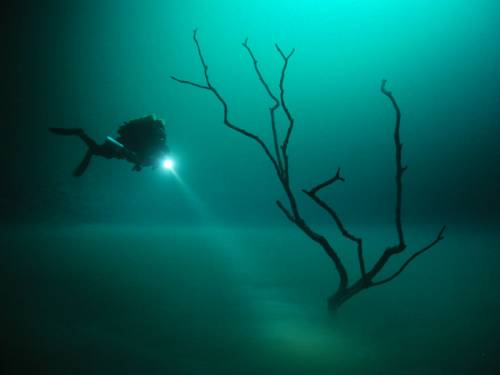
A cenote is a sinkhole with exposed rocky edges containing groundwater. It is typically found in the Yucatán Peninsula and some nearby Caribbean islands. The term is derived from a word used by the low-land Yucatec Maya to refer to any location where groundwater is accessible.
According to Anatoly Beloshchin, a professional photographer, the underwater scenery is amazing. He describes, “We are 30 meters deep, fresh water, then 60 meters deep – salty water and under me I see a river, island and fallen leaves… Actually, the river, which you can see, is a layer of hydrogen sulphide."
The river illusion is due to a phenomenon called halocline, a cline caused by a strong, vertical salinity gradient within a body of water. Because salinity (in concert with temperature) affects the density of seawater, it can play a role in its vertical stratification. Increasing salinity by one kg/m3 results in an increase of seawater density of around 0.7 kg/m.
The Yucatan Peninsula contains a vast coastal aquifer system which is typically density-stratified. The infiltrating meteoric water (i.e., rainwater) floats on top of higher density saline water intruding from the coastal margins. The whole aquifer is therefore an anchialine system (i.e., one that is land-locked, but connected to an ocean). Where a cenote, or the flooded cave it is an opening to, provides deep enough access into the aquifer then the interface between the fresh and saline water may be reached. The density interface between the fresh and saline waters is a halocline, which means a sharp change in salt concentration over a small change in depth. Mixing of the fresh and saline water results in a blurry swirling effect due to refraction between the different density fresh and saline waters. The depth of the halocline is a function of several factors: climate and specifically how much meteoric water recharges the aquifer, hydraulic conductivity of the host rock, distribution and connectivity of existing cave systems and how effective these are at draining water to the coast, and the distance from the coast. In general, the halocline is deeper the further from the coast and in the Yucatan Peninsula this depth is 10 to 20 meters below the water table at the coast, and 50 to 100 meters below the water table in the middle of the peninsula, with saline water underlying the whole of the peninsula.
In Cenote Angelita as you get deeper the water turns from pure to salty; 30 meters deep the water is pure, 60 meters deep it becomes saline. Some meters before you get to the bottom of the cave, you see a river underneath, with trees and leaves floating on some liquid level. However it may seem like a river, it’s not a real river. It’s just a layer of hydrogen sulphide.
Giant Sea Foam
Foam swallowed an entire beach and half the nearby buildings, including the local lifeguards' centre, in a freak display of nature at Yamba in New South Wales.
One minute a group of teenage surfers were waiting to catch a wave, the next they were swallowed up in a giant bubble bath. The foam was so light that they could puff it out of their hands and watch it float away.
It stretched for 30 miles out into the Pacific in a phenomenon not seen at the beach for more than three decades.
Scientists explain that the foam is created by impurities in the ocean, such as salts, chemicals, dead plants, decomposed fish and excretions from seaweed.
All are churned up together by powerful currents which cause the water to form bubbles.
These bubbles stick to each other as they are carried below the surface by the current towards the shore.
As a wave starts to form on the surface, the motion of the water causes the bubbles to swirl upwards and, massed together, they become foam.
The foam "surfs" towards shore until the wave "crashes", tossing the foam into the air.
Alligator Gar
The Alligator Gar ("Gator Gar"), Atractosteus spatula, is a primitive ray-finned fish. Unlike other Gars, the mature Alligator Gar possesses a dual row of large teeth in the upper jaw. Its name derives from the alligator-like appearance of these teeth along with the fish's elongated snout. The dorsal surface of the Alligator Gar is a brown or olive-color, while the ventral surface tends to be lighter. Their scales are diamond-shaped and interlocking (ganoid) and are sometimes used by Native Americans for jewelry.
Along with its status as the largest species of Gar, the Alligator Gar is the largest exclusively freshwater fish found in North America, measuring 8 to 10 feet (2.4 to 3.0 m) and weighing at least 200 lb (91 kg) at maturity. Kenny Williams, from Vicksburg, Miss., has broken the record for largest Alligator Gar ever caught using a net. He caught the fish on February 14, 2011. The world's largest alligator gar ever caught measures 8 ft 5 in (2.57 m) long, 327 lb (148 kg) in weight, and nearly 48 in (120 cm) around. The fish is believed to have been between 50 and 70 years old, wildlife officials said. Kenny Williams has donated the fish to the Mississippi Museum of Natural Science in Jackson where it will be on permanent display in the future.
The current world record for the largest Alligator Gar caught on rod and reel is 279 lb (127 kg). The largest taken by Bowfishing is 365 lb (166 kg). The fish is also known for its ability to survive outside the water, being able to last for up to two hours above the surface.
Alligator Gar are found in the Lower Mississippi River Valley and Gulf Coast states of the Southeastern United States and Mexico as far south as Veracruz, encompassing the following US states: Texas, Oklahoma, South Carolina, Louisiana, Mississippi, Alabama, Tennessee, Arkansas, Missouri, Florida, and Georgia. They have also been known historically to come as far north as central Kansas, Nebraska, Kentucky, Ohio, Iowa, and west-central Illinois, where the most northerly verified catch was at Meredosia, Illinois in 1922 and an 8.5 ft (2.6 m) specimen, now preserved, was caught at nearby Beardstown. Specimens at locations further south in Illinois have been verified as recently as 1976, with the Illinois Academy of Sciences verifiying a total of 122 captures to that date. They inhabit sluggish pools and backwaters or large rivers, bayous, and lakes. They are found in brackish or saltwater, and are more adaptable to the latter than are other gars. In Louisiana it is common to see these large gar striking the surface in brackish marshes.
Giant Freshwater Stingray
The giant freshwater stingray (Himantura chaophraya) is a species of stingray in the family Dasyatidae, native to large rivers and estuaries of Southeast Asia. It is one of the largest freshwater fishes in the world, with reports from the Chao Phraya and Mekong Rivers of individuals weighing 500–600 kg (1,100–1,300 lbs). Its numbers are dwindling due to overfishing and habitat loss, and some local populations are in danger of going extinct. The smaller freshwater whipray of New Guinea and northern Australia was once considered to be conspecific with the giant freshwater stingray but is now recognized as a separate species.
Originally described from Thailand (where it occurs in the Chao Phraya, Nan, Mekong, Bongpakong, Tachin and Tapi Rivers), the giant freshwater stingray is also found in Indonesia (the Mahakam River Basin in Kalimantan) and Malaysia (the Kinabatangan River in Sabah). The rays across these different regions are likely to be isolated from each other, and it is yet unclear whether they represent populations of the same species or a species complex. It prefers a sandy habitat.
The giant freshwater stingray has a relatively thin, more or less oval-shaped pectoral fin disk and minute eyes. The snout is very broad with a projecting triangular tip. The mouth is small, with 4–7 papillae (2–4 large central and 1–4 small lateral) on the floor. The whip-like tail measures 1.8–2.5 times the length of the disk and lacks fin folds. The serrated spine on the tail is the largest of any stingray, reaching 38 cm (15 in) long. It is covered with a sheath of toxic mucus and is capable of piercing bone.
The upper surface of the body and tail are covered with small, rough tubercles, becoming sharp on the tail beyond the spine. The back is uniform brown to gray in color, sometimes becoming lighter towards the margins. The underside is white, with a distinctive broad, black band edged with small spots around the margins of the pectoral and pelvic fins. The tail is black past the spine. This species reaches at least 4.6 meters (15 ft) long and 1.9 meters (6.2 ft) across.
Wels Catfish
The wels catfish (pronounced /ˈwɛls/ or /ˈvɛls/; Silurus glanis), also called sheatfish, is a large catfish found in wide areas of central, southern, and eastern Europe, and near the Baltic and Caspian Seas. It is a scaleless fresh and brackish water fish recognizable by its broad, flat head and wide mouth. Wels catfish can live for at least thirty years and have very good hearing.
The wels catfish lives on annelid worms, gastropods, insects, crustaceans, and fish; the larger ones also eat frogs, mice, rats and aquatic birds such as ducks.
The wels catfish lives in large, warm lakes and deep, slow-flowing rivers. It prefers to remain in sheltered locations such as holes in the riverbed, sunken trees, etc. It consumes its food in the open water or on the bottom, where it can be recognized by its large mouth. Wels catfish are kept in fish ponds as food fish.
Wels catfish's mouth contains lines of numerous small teeth, two long barbels on the upper jaw and four shorter barbels on the lower jaw. It has a long anal fin that extends to the caudal fin, and a small sharp dorsal fin positioned relatively far forward. It uses its sharp pectoral fins to capture prey. With these fins, it creates an eddy to disorient its victim, which it then simply engulfs in its enormous throat. It has very slippery green-brown skin. Its belly is pale yellow or white. Colour varies with environment. Clear water will give the fish a black coloration while muddy water will often tend to produce brownish specimens. Weight and length are not correlated linearly, and also depend on the season.
Algae Blooms
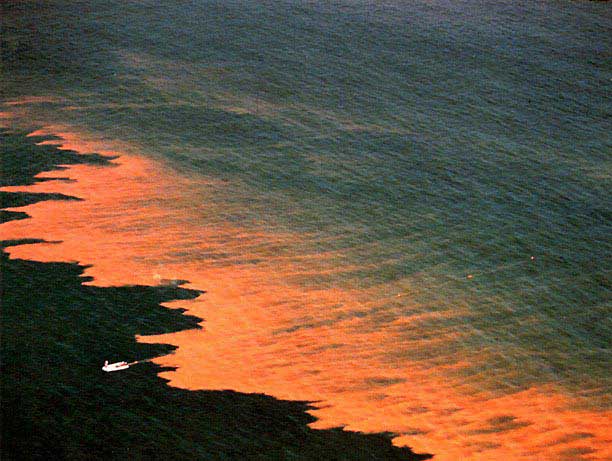
An algal bloom is a rapid increase or accumulation in the population of algae in an aquatic system. Algal blooms may occur in freshwater as well as marine environments. Typically, only one or a small number of phytoplankton species are involved, and some blooms may be recognized by discoloration of the water resulting from the high density of pigmented cells. Although there is no officially recognized threshold level, algae can be considered to be blooming at concentrations of hundreds to thousands of cells per milliliter, depending on the severity. Algal bloom concentrations may reach millions of cells per milliliter. Algal blooms are often green, but they can also be other colors such as yellow-brown or red, depending on the species of algae.
Bright green blooms are a result of blue-green algae, which are actually bacteria (cyanobacteria). Blooms may also consist of macroalgal, not phytoplankton, species. These blooms are recognizable by large blades of algae that may wash up onto the shoreline.
Of particular note are harmful algal blooms (HABs), which are algal bloom events involving toxic or otherwise harmful phytoplankton such as dinoflagellates of the genus Alexandrium and Karenia. Such blooms often take on a red or brown hue and are known colloquially as red tides.
In the marine environment, single-celled, microscopic, plant-like organisms naturally occur in the well-lit surface layer of any body of water. These organisms, referred to as phytoplankton or microalgae, form the base of the food web upon which nearly all other marine organisms depend. Of the 5000+ species of marine phytoplankton that exist worldwide, about 2% are known to be harmful or toxic. Blooms of harmful algae can have large and varied impacts on marine ecosystems, depending on the species involved, the environment where they are found, and the mechanism by which they exert negative effects.
Harmful algal blooms have been observed to cause adverse effects to varying species of marine mammals and sea turtles, with each presenting specific toxicity-induced reductions in developmental, immunological, neurological, and reproductive capacities. A mass mortality event of 107 bottlenose dolphins occurred along the Florida panhandle in the spring of 2004 due to ingestion of contaminated menhaden with high levels of brevetoxin. Manatee mortalities have also been attributed to brevetoxin but unlike dolphins, the main toxin vector was endemic seagrass species (Thalassia testudinum) in which high concentrations of brevetoxins were detected and subsequently found as a main component of the stomach contents of manatees.
Related Articles :
Dead Zones
Christmas Island Migration
At the beginning of the wet season (usually October / November), most adult red crabs suddenly begin a spectacular migration from the forest to the coast to breed. Breeding is usually synchronized island-wide. The rains provide moist overcast conditions for crabs to make their long and difficult journey to the sea.
During peak migration times, sections of roads where crabs cross in high numbers may be closed to vehicles for short periods of time. You can park your vehicle and carefully walk amongst the moving sea of crabs as they relentlessly make their way to and from the shore.
While the rains provide the moist preconditions for the march to begin, the timing of the migration breeding sequence is also linked to the phases of the moon. Eggs are released by the female red crabs into the sea precisely at the turn of the high tide during the last lunar quarter.
The sea level at the base of the cliffs and on the beaches, where the females release their eggs, at this time varies the least for a longer period, and it is therefore safer for the females approaching the water's edge to release their eggs. Sometimes there are earlier and later migrations of smaller numbers of crabs but all migrations retain this same lunar rhythm.
Related Articles :
Christmas Island Red Crab
Kaluga
The Kaluga (Huso dauricus) is a large predatory sturgeon found in the Amur River basin. Also known as the River Beluga, they are claimed to be the largest freshwater fish in the world, with a maximum size of at least 1,000 kg (2,205 lb) and 5.6 m (18.6 ft). Like the slightly larger Beluga, it spends part of its life in saltwater.The Kaluga is one of the biggest of the sturgeon family.
Kaluga caviar comes from the Kaluga "River Beluga" sturgeon.
Feeding Frenzy
In ecology, a feeding frenzy is a situation where oversaturation of a supply of food leads to rapid feeding by predatory animals. For example, a large school of fish can cause nearby sharks to enter a feeding frenzy. This can cause the sharks to go wild, biting anything that moves, including each other or anything else within biting range. This term is most often used when referring to sharks or piranhas, due to these being some of the most feared predators.
Nectocaris
Nectocaris is a genus containing one species (N. pteryx) of early cephalopod known from the Middle Cambrian Burgess Shale. Walcott, the discoverer of the shale, had photographed the one specimen he had collected in the 1910s, but never had time to investigate it further. It was not until 1976 that it was formally described, by Simon Conway Morris. The head had two stalked eyes, one pair of tentacles, and a flexible siphon underneath its body. Fleshy fins supported by internal spines ran along the sides of the flattened, kite-shaped body.
Because the genus was only known from a single specimen, Conway Morris was unable to deduce its affinity. It had some features which were reminiscent of the arthropods, but these could well have been convergently derived. Its fins were very unlike the arthropods. Working from photographs, the Italian palaeontologist Alberto Simonetta believed he could classify Nectocaris within the chordates. He focussed mainly on the tail and fin morphology, interpreting Conway Morris's 'gut' as a notochord - a distinctive chordate feature. However, his case was unconvincing, and its classification remained uncertain until 2010, when Martin Smith and Jean-Bernard Caron described 91 additional specimens, many better preserved than the type. These allowed them to reinterpret Nectocaris as a primitive cephalopod, with two tentacles instead of the 8 or 10 of modern cephalopods. The structure previous researchers had identified as an oval carapace or shield behind the eyes was shown to actually be a soft funnel, similar to the ones used for propulsion by modern cephalopods. The interpretation would push back the origin of cephalopods by at least 30 million years, much closer to the first appearance of complex animals, in the Cambrian explosion.
Nectocaris was a free-swimming, predatory or scavenging organism, possibly occupying a niche similar to the arrow worms. This lifestyle is honoured in its binomial name: Nectocaris means "swimming crab" (Latin pteryx means "fin").
Tigerfish
Tigerfish is the common name for a variety of species from several different families of fish, usually on account of their colouration or otherwise fearsome appearance.
Several species in the genus Hydrocynus of the family Alestiidae are called "tigerfish" and are particularly prized as gamefish. These African fish are found in many rivers and lakes on the continent and are fierce predators with distinctive protruding teeth.
The two most common species are probably most recognizable in Southern Africa. The first is the Goliath Tiger (Hydrocynus goliath), which is found in the Congo River system, the largest of the family. The second-largest, and the southernmost species, is the Tigerfish (Hydrocynus vittatus), commonly found in the Zambezi River and in the two biggest lakes along the Zambezi, Lake Kariba in Zambia, Zimbabwe, and Cabora Bassa in Mozambique and Jozini dam in South Africa.
The name "tigerfish" has occasionally been used for species of cichlid in the genus Rhamphochromis. These are large, silver-colored fishes that may have one or two black horizontal lines running the length of the body. These fish are native to Lake Malawi in Africa. They can measure up to 2 meters (6 ft. 7 in.) in length and weigh up to 50 kg (105 lbs.) They also have very sharp teeth that can rip through skin easily; however, they are not known to eat humans.
Tigerfish can be considered Africa's equivalent of the South American piranha, though they belong to a completely different family, as they are famous for their ferocity when hunting. They have razor-sharp teeth that are interlocking, along with streamlined, muscular bodies built for speed. Tigerfish are aggressive predators. A tigerfish has a gas-filled sac in its body that it uses as a sound receiver. This transmits vibrations from the water, enabling it to detect any animals nearby and respond accordingly. A school of juveniles can tackle animals of almost any size, including any land animals that stray too close to the water's edge. Adults tend to travel in smaller groups of four or five, but they are no less dangerous. Even an individual can take down prey as large as itself. When food is scarce or the competition for food is too great, tigerfish may resort to cannibalism. This is particularly common in the dry season. Tigerfish have also been known to attack humans, these attacks can be devastating owing to their sharp teeth and aggressive hunting tactics.
Basilosaurus
Basilosaurus ("King Lizard") is a genus of cetacean that lived from 40 to 34 million years ago Its fossilized remains were first discovered in the southern United States (Louisiana), and were initially believed to be some sort of reptilian sea monster, hence the suffix -"saurus", but later it was found that was not the case. Fossils from at least two other species of this taxon have been found in Egypt and Pakistan. in the Late Eocene.
Basilosaurus averaged about 18 meters (60 ft) in length, and is believed to have been the largest animal to have lived in its time. It displayed an unparalleled degree of elongation compared with modern whales. Their very small vestigial hind limbs have also been a matter of interest for paleontologists. The species is the state fossil of Mississippi and Alabama in the United States.
During the early 19th century in the American South, Basilosaurus cetoides fossils were so common (as well as large) that they were regularly used as furniture. Vertebrae were sent to the American Philosophical Society by a Judge Bly of Arkansas and Judge John Creagh of Clarke County, Alabama. Both fossils ended up in the hands of the anatomist Dr. Richard Harlan, who requested more examples from Creagh. With some reservation, Harlan speculated that the fossils belonged to a (50 m [166 ft] long) marine reptile, for which he suggested the name Basilosaurus, meaning “King reptile”.
When the British anatomist Sir Richard Owen studied the spine, mandibular fragments, arms, and ribs (more recently found) he proclaimed them to be mammalian. Owen proposed renaming the find to Zeuglodon cetoides (“whale-like yoke teeth”), which is now a junior synonym; though the latter is considered by many to be a more fitting name, the first-published name always takes precedence. The name Zeuglodon refers to the double rooted teeth typical of marine mammals.
In 1845, “Dr.” Albert Koch heard stories of giant bones in Alabama, and went down to cobble together a full skeleton. He eventually created a huge 114-foot (35 m) skeleton of a “sea serpent” he called "Hydrarchos", which he displayed in New York City, and later Europe. It was eventually shown to have come from 5 different individuals, some of which were not Basilosaurus. The remains were eventually destroyed in the Great Chicago Fire.
Fossil finds of another species, Basilosaurus isis, have been found in the aptly named Valley of the Whales in Egypt. The fossils were very well preserved, hind limbs included, and were rather numerous. Paleontologist Philip Gingerich, who organized several expeditions to the valley, speculated that Egyptian crocodile worship may have been inspired by the huge skeletons that lay there. Fossil remains of another species, Basilosaurus drazindai, have been found in Pakistan. Another fossilized species named Basiloterus husseini was its closest known relative, but was not as large or elongated.
Eastern Emerald Elysia
Elysia chlorotica, common name the eastern emerald elysia, is a small-to-medium-sized species of green sea slug, a marine opisthobranch gastropod mollusc. This sea slug superficially resembles a nudibranch, yet it does not belong to that suborder of gastropods. Instead it is a member of the closely-related suborder Sacoglossa. The suborder Sacoglossa are known as the 'sap-sucking Opisthobranchias'. Many members of this group use chloroplasts from the algae they eat; a phenomenon known as kleptoplasty. Elysia chlorotica is one of the "solar-powered sea slugs", utilizing solar energy via chloroplasts from its algal food. It lives in a subcellularendosymbiotic relationship with chloroplasts of the marine heterokont alga Vaucheria litorea.
Elysia chlorotica feeds on the intertidal algae Vaucheria litorea by puncturing the algal cell wall with its radula. The slug then holds the algal strand firmly in its mouth and, as though it were a straw, sucks out the contents. Instead of digesting the entire cell contents, or passing the contents through its gut unscathed, it retains only the algal chloroplasts, by storing them within its own cells throughout its extensive digestive system. The acquisition of chloroplasts begins immediately following metamorphosis from the veliger stagejuvenile sea slugs begin to feed on the when the Vaucheria litorea cells. Juvenile slugs are brown with red pigment spots until they feed upon the algae, at which point they become green. This is caused by the distribution of the chloroplasts throughout the extensively branched gut. Initially, the slug needs to continually feed upon algae to retain the chloroplasts, but over time the chloroplasts become more stably incorporated into the cells of the gut enabling the slug to remain green without further feeding.
The incorporation of chloroplasts within the cells of Elysia chlorotica allow the slug to capture energy directly from light, as most plants do, through the process known as photosynthesis. This is significantly beneficial for Elysia chlorotica because during time periods where algae is not readily available as a food supply, the Elysia chlorotica can survive for months on the sugars produced through photosynthesischloroplasts. Kept within the slug's own cells, it has been found that the chloroplasts can survive and function for up to nine or even 10 months. In one study performed by their own Elysia chlorotica were deprived of alga ingestion for a period of eight months. After the eight month period, despite the fact that the Elysia chlorotica were less green and more yellowish in colour, the majority of the chloroplasts within the slugs appeared to have remained intact while also maintaining their fine structure. Although Elysia chlorotica are unable to synthesize their own chloroplasts, the ability to maintain the chloroplasts acquired from Vaucheria litorea in a functional state indicates that Elysia chlorotica must possess photosynthesis-supporting genes within its own nuclear genome; most likely acquired through horizontal gene transfer. Since chloroplast DNAproteins required for proper photosynthesis, scientists investigated the alone encodes for just 10% of the Elysia chlorotica genome for potential genes that could support chloroplast survival and photosynthesis. The researchers found a vital algal gene, psbO (a nuclear gene encoding for a manganese-stabilizing protein within the photosystem II complex) in the sea slug's DNA, identical to the algal version. They concluded that the gene was likely to have been acquired through horizontal gene transfer, as it was already present in the eggs and sex cells of Elysia chlorotica.
Humboldt Squid
The Humboldt Squid (Dosidicus gigas), also known as Jumbo Squid, Jumbo Flying Squid, or Diablo Rojo (Spanish for Red Devil), is a large, predatory squid found in the waters of the Humboldt Current in the Eastern Pacific Ocean. They are most commonly found at depths of 200–700 metres (660–2,300 ft), from Tierra del Fuego to California. Recent findings suggest the range of this species is spreading north into the waters of Oregon, Washington, British Columbia, and Alaska. Though they usually prefer deep water, between 1,000 and 1,500 squid washed up on the Long Beach Peninsula in southwest Washington in the fall of 2004. They have also ventured into Puget Sound.
Generally, the tube (or body) constitutes about 40% of the animal's mass, the fin (or wing) about 12%, the tentacles about 14%, the outer skin about 3%, the head (including eyes and beak) about 5%, with the balance (26%) made up of the inner organs.
They often approach prey quickly with all ten appendages extended forward in a cone-like shape. Upon reaching striking distance, they will open their eight swimming and grasping arms, and extend two long tentacles covered in sharp 'teeth,' grabbing their prey and pulling it back towards a parrot-like beak, which can easily cause dramatic lacerations to human flesh. The whole process takes place in seconds.
Recent footage of shoals of these animals demonstrates a tendency to meet unfamiliar objects aggressively. Having risen to depths of 130–200 metres (430–660 ft) below the surface to feed (up from their typical 700 metre (2,300 ft) diving depth, beyond the range of human diving), they have attacked deep-sea cameras and rendered them inoperable. Reports of recreational scuba divers being attacked by Humboldt Squid have been confirmed. One particular diver, Scott Cassell, who has spent much of his career videotaping this species, has developed body armor to protect against attacks. Each of the squid's suckers is ringed with sharp teeth, and the beak itself can tear flesh, although it's believed they lack the jaw strength to crack heavy bone.
Deep Sea Dragonfish
The deep sea dragonfish, sometimes known as the scaleless dragonfish, is a ferocious predator that inhabits the deep oceans of the world. Known scientifically as Grammatostomias flagellibarba, it has extremely large teeth compared to its body size. In spite of its gruesome appearance, its is a small fish, measuring only about 6 inches (about 15 centimeters) in length. There are several different species of dragonfish. All are very similar in appearance.
The deep sea dragonfish is one of the many species of deep sea fish that can produce its own light through a chemical process known as bioluminescence. The light is produced by a special organ known as a photophore. It is believed that the fish can use these flashing lights in the dark waters to attract prey and even to signal potential mates. The dragonfish has a large head and mouth equipped with many sharp, fang-like teeth. It also has a long protrusion known as a barbel attached to its chin. This barbel is tipped with a light-producing photophore. The dragonfish also has photophores along the sides of its body. These light organs may be used to signal other dragonfish during mating. They may also serve to attract and disorient prey fishes from deep below.
The deep sea dragonfish lives in deep ocean waters at depths of up to 5,000 feet (1,500 meters). Although dragonfish species are found in most oceans the world, the deep sea dragonfish is limited mainly to the North and Western Atlantic Ocean and the Gulf of Mexico.
Related Articles :
Stareater
Skeleton Coast
The Skeleton Coast (German: Skelettküste) is the northern part of the Atlantic Ocean coast of Namibia and south of Angola from the Kunene River south to the Swakop River, although the name is sometimes used to describe the entire Namib Desert coast. The Bushmen of the Namibian interior called the region "The Land God Made in Anger", while Portuguese sailors once referred to it as "The Gates of the bad place".
On the coast the upwelling of the cold Benguela current gives rise to dense ocean fogs (called "cassimbo" by the Angolans) for much of the year. The winds blow from land to sea, rain fall rarely exceeds 10 millimetres (0.39 in) annually and the climate is inhospitable. There is a constant, heavy surf on the beaches. In the days of human-powered boats it was possible to get ashore through the surf but impossible to launch from the shore. The only way out was by going through a marsh hundreds of miles long and only accessible through a hot and arid desert.
The coast is named for the bleached whale and seal bones which covered the shore when the whaling industry was still active, as well as the skeletal shipwrecks caused by rocks offshore in the fog. More than a thousand vessels of various sizes and areas litter the coast. Notable wrecks in the region include the Eduard Bohlen, the Otavi, the Dunedin Star, and Tong Taw.
Box Jellyfish
Chironex fleckeri, commonly known as sea wasp, is an infamous lethally venomous species of Box jellyfish living in coastal waters from northern Australia and New Guinea north to the Philippines and Vietnam. It is considered the most lethal jellyfish in the world because of the numerous incidents resulting in injury or death to humans.
The amount of venom in one animal is enough to kill 60 adult humans.
First aid consists of washing the sting area with vinegar, and in no circumstance should alcohol, alcohol-based lotions, or methylated spirits be applied. Cardiopulmonary resuscitation (CPR) may be required. Medical help should be sought as soon as possible after considering these needs.
Notorious for its dangerous sting, C. fleckeri has tentacles up to 3 metres (9.8 ft) long which are covered in thousands upon thousands of cnidocytes which, on contact, release microscopic darts, each delivering an extremely powerful venom. Being stung commonly results in excruciating pain, and if the sting area is significant, an untreated victim may die in as little as 3 minutes.
Coconut Crab
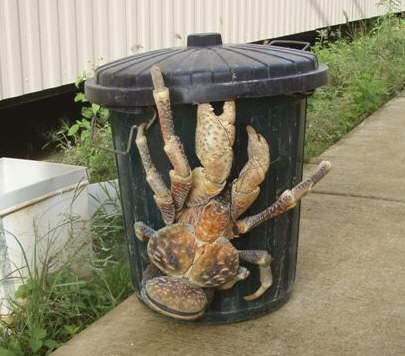
The coconut crab, Birgus latro, is the largest land-living arthropod in the world, and is probably at the upper limit of how big terrestrial animals with exoskeletons can become in today's atmosphere. The species inhabits the coastal forest regions of many Indo-Pacific islands, although localized extinction has occurred where the crab is sympatric with man. Generally nocturnal, they remain hidden during the day and emerge only on some nights to forage. Their body is divided into four regions; the cephalic lobe, forepart, trunk, and opisthosoma. It is a highly apomorphic hermit crab and is known for its ability to crack coconuts with its strong pincers to eat the contents. It is the only species of the genus Birgus.