Showing posts with label Freaky. Show all posts

Tuesday, March 8, 2011

March 8, 2011 : Stareater


Stareater

Astronesthes sp. (2008) is a stareate from the depths of the Antarctic Ocean south of New Zealand. It attracts small prey using the glowing red
tip of a long black barbel on its chin as a lure.

The fish grows to a length of 21 centimetres (8.3 in). The mouth of the fish is filled with sharp, needlelike, curved teeth. The skin is delicate, and when trapped in a net, scientists abrased a specimen's skin retrieving it. Lining the belly of the stareater are tiny black dots, which serve as a type of light organ.


Related Articles
: Deep Sea Dragonfish

Friday, February 11, 2011

February 11, 2011 : Human Face Fish


Human Face Fish

The Human Face Fish is a cyprinid fish found in 2003 purported to have markings on its head reminiscent of the facial features of a human. It has been reported by Reuters as being a cross between two varieties of the carp Cyprinus carpio, specifically the common carp and the leather carp, but by other news outlets as a true hybrid between the common carp and the ayu sweetfish Plecoglossus altivelis. The latter is almost certainly incorrect though, as carps and ayu belong to quite different superorders of Teleostei.

The fish resides in a pond in Chongju near Seoul, South Korea. They are also found in Slovenia, in the caves under and around Lake Bohinj.

Sunday, January 30, 2011

January 30, 2011 : Snakeheads


Snakeheads

Snakeheads (
Channidae) are a family of freshwater fish native to Africa and Asia. These predatory fish are distinguished by a long dorsal fin, large mouth and shiny teeth. They have a physiological need to breathe atmospheric air, which they do with a suprabranchial organ: a primitive form of a labyrinth organ. There are two extant genera, Channa in Asia, and Parachanna in Africa, consisting of 30-35 species.

They are considered valuable food fish. Called Ca Loc, ca Qua, or Ca Chuoi in Vietnamese, it is prized in clay pot dishes and pickled preparations. Larger species like
Channa striata, Channa maculata, and Parachanna obscura are farmed in aquaculture. Snakeheads feed on plankton, aquatic insects, and molluskscarp, or frogs. In rare cases, small mammals such as rats are taken. The size of the snakehead species differs greatly. "Dwarf snakeheads" like when small. When adult, they mostly feed on other fish like Channa gachua grow to 10 inches (25 cm). Most snakeheads grow up to 2 or 3 feet (60–90 cm). Only two species (Channa marulius and Channa micropeltes) can reach a length of more than 1 meter and a weight of more than 6 kg.

It is illegal to keep snakeheads as pets in all states of the U.S. and other countries as they have become an invasive species due to individuals releasing them into the wild. In the U.S., National Geographic referred to snakeheads as "Fishzilla."

When the Snakehead eats it is a thrust predator. It will eat its prey all at once, striking and ingesting it whole.


The giant snakehead (
Channa micropeltes) is native throughout Asia, and is the most aggressive Snakehead. They can grow to around 1 meter in length. Adult Snakeheads force their young to breathe air by pushing them to the surface.

From 2002 to 2003, one Los Angeles supermarket was found to have sold approximately 25,000 dollars worth of illegal live Snakeheads which caused breakouts in local ecosystems.

Monday, January 24, 2011

January 24, 2011 : Dead Zones


Dead Zones

Dead zones are hypoxic (low-oxygen) areas in the world's oceans, the observed incidences of which have been increasing since oceanographers began noting them in the 1970s. These occur near inhabited coastlines, where aquatic life is most concentrated. (The vast middle portions of the oceans which naturally have little life are not considered "dead zones".) The term can also be applied to the identical phenomenon in large lakes.

In March 2004, when the recently established UN Environment Programme published its first Global Environment Outlook Year Book (GEO Year Book 2003) it reported 146 dead zones in the world's oceans where marine life could not be supported due to depleted oxygen levels. Some of these were as small as a square kilometre (0.4 mi²), but the largest dead zone covered 70,000 square kilometres (27,000 mi²). A 2008 study counted 405 dead zones worldwide.

Aquatic and marine dead zones can be caused by an increase in chemical nutrients (particularly nitrogen and phosphorus) in the water, known as eutrophication. These chemicals are the fundamental building blocks of single-celled, plant-like organisms that live in the water column, and whose growth is limited in part by the availability of these materials. Eutrophication can lead to rapid increases in the density of certain types of these phytoplankton, a phenomenon known as an algal bloom. Although these algae produce oxygen in the daytime via photosynthesis, during the night hours they continue to undergo cellular respiration and can therefore deplete the water column of available oxygen. In addition, when algal blooms die off, oxygen is used up further during bacterial decomposition of the dead algal cells. Both of these processes can result in a significant depletion of dissolved oxygen in the water, creating hypoxic conditions. Dead zones can be caused by natural and by anthropogenic factors. Use of chemical fertilizers is considered the major human-related cause of dead zones around the world. Natural causes include coastal upwelling and changes in wind and water circulation patterns. Runoff from sewage, urban land use, and fertilizers can also contribute to eutrophication.

Notable dead zones in the United States include the northern Gulf of Mexico region, surrounding the outfall of the Mississippi River, and the coastal regions of the Pacific Northwest, and the Elizabeth River in Virginia Beach, all of which have been shown to be recurring events over the last several years.

Related Articles
: Fish Kill and Algae Blooms

Tuesday, January 18, 2011

January 18, 2011 : Tetrodotoxin


Tetrodotoxin

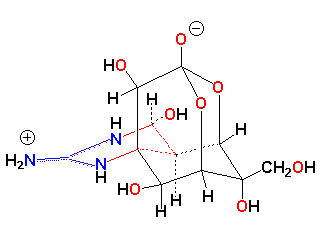
Tetrodotoxin (also known as "tetrodox" and frequently abbreviated as TTX, sometimes colloquially referred to as "zombie powder" by those who practice Vodou or are of Haitian descent) is a potent neurotoxin with no known antidote. There have been successful tests of a possible antidote in mice, but further tests must be carried out to determine efficacy in humans. Tetrodotoxin blocks action potentials in nerves by binding to the voltage-gated, fast sodium channels in nerve cell membranes, essentially preventing any affected nerve cells from firing by blocking the channels used in the process. The binding site of this toxin is located at the pore opening of the voltage-gated Na+ channel. Its name derives from Tetraodontiformes, the name of the order that includes the pufferfish, porcupinefish, ocean sunfish or mola, and triggerfish, several species of which carry the toxin. Although tetrodotoxin was discovered in these fish and found in several other animals (e.g., blue-ringed octopus, rough-skinned newt, and Naticidae) it is actually produced by certain symbiotic bacteria, such as Pseudoalteromonas tetraodonis, certain species of Pseudomonas and Vibrio, as well as some others that reside within these animals.

Tetrodotoxin has been isolated from widely differing animal species, including western newts of the genus Taricha (where it was termed "tarichatoxin"), pufferfish, toads of the genus Atelopus, several species of blue-ringed octopodes of the genus Hapalochlaena (where it was called "maculotoxin"), several sea stars, certain angelfish, a polyclad flatworm, several species of Chaetognatha (arrow worms), several nemerteans (ribbonworms) and several species of xanthid crabs. The toxin is variously used as a defensive biotoxin to ward off predation, or as both a defensive and predatory venom (the octopodes, chaetognaths and ribbonworms). Tarichatoxin and maculotoxin were shown to be identical to tetrodotoxin in 1964 and 1978, respectively. Recent evidence has shown the toxin to be produced by bacteria within blue-ringed octopuses. The most common source of bacteria associated with TTX production is Vibrio bacteria, with Vibrio alginolyticus being the most common species. Pufferfish, chaetognaths, and nemerteans have been shown to contain Vibrio alginolyticus and TTX.

Tetrodotoxin is roughly 100 times more poisonous than potassium cyanide. Fish poisoning by consumption of members of the order Tetraodontiformes is extremely serious. The organs (e.g. liver) of the pufferfish can contain levels of tetrodotoxin sufficient to produce paralysis of the diaphragm and death due to respiratory failure. Toxicity varies between species and at different seasons and geographic localities, and the flesh of many pufferfish may not usually be dangerously toxic. It is not always entirely fatal; however, at near-lethal doses, it can leave a person in a state of near-death for several days, while the person continues to be conscious.

Sunday, December 12, 2010

December 12, 2010 : Stoplight Loosejaw


Stoplight Loosejaw

The stoplight loosejaws are small, deep-sea dragonfishes of the genus Malacosteus, classified either within the subfamily Malacosteinae of the family Stomiidae, or in the separate family Malacosteidae. They are found worldwide, outside of the Arctic and Subantarctic, in the mesopelagic zone below a depth of 500 meters (1,640 ft). This genus once contained three nominal species: M. niger (the type), M. choristodactylus, and M. danae, with the validity of the latter two species being challenged by different authors at various times. In 2007, Kenaley examined over 450 stoplight loosejaw specimens and revised the genus to contain two species, M. niger and the new M. australis.

Malacosteus and the related genera
Aristostomias and Pachystomias are the only fishes that produce red bioluminescence. As most of their prey organisms are not capable of perceiving light at those wavelengths, this allows Malacosteus to hunt with an essentially invisible beam of light. Furthermore, Malacosteus is unique amongst animals in using a chlorophyll derivative to perceive red light. The name Malacosteus is derived from the Greek malakos meaning "soft" and osteon meaning "bone". Another common name for these fishes is "rat-trap fish", from the unusual open structure of their jaws.

As long wavelengths of light (i.e. red) do not reach the deep sea, many deep-sea organisms are red-colored (effectively appearing black) and are insensitive to red wavelengths. The red photophore of Malacosteus thus allows it to illuminate prey without being detected. These fishes exhibit a number of adaptations for feeding on large prey. The "open" structure of its jaws reduces water resistance, allowing them to be snapped shut more quickly, while large recurved teeth and powerful jaw closing muscles assure a secure hold on prey items. The connection between the head and the body is reduced, with unossified vertebrae, allowing the cranium to be tilted back and the jaws thrust forward for a wider gape. Finally, the gills are exposed to the outside, allowing the fish to continue respiring while slowly swallowing large prey.

Tuesday, November 2, 2010

November 2, 2010 : Osedax


Osedax 

Osedax is a genus of deep-sea siboglinid polychaetes, commonly called boneworms, zombie worms or bone-
eating worms. Osedax is Latin for "bone-eating", the name alluding to how the worms bore into the bones of whale carcasses to reach enclosed lipids, on which they rely for sustenance.

Scientists from the Monterey Bay Aquarium Research Institute (MBARI) using the submarine ROV Tiburon first discovered the genus in Monterey Bay, California, in February 2002. The worms were found living on the bones of a decaying gray whale in the Monterey Canyon, at a depth of 2,893 m (9,491 ft).

Lacking stomach and mouth, Osedax rely on symbiotic species of bacteria to digest whale fat and oils and release nutrients that they can absorb. Osedax have colorful feathery plumes that act as gills, and unusual root-like structures that absorb nutrients. Between 50 and 100 microscopic dwarf males live inside a single female, and never develop past the larval stage.

Following its discovery in 2002, the genus was announced in Science in 2004. 

In late 2005, an experiment by Swedish marine biologists resulted in the discovery of a species of the worm in the North Sea off the west coast of Sweden. In the experiment, a minke whale carcass that had been washed ashore had been sunk to a depth of 120 m (390 ft) and monitored for several months. Biologists were surprised to find that unlike the previous discoveries, the new species, colloquially known as "bone eating snot flower" after its scientific name (Osedax mucofloris; a more accurate translation would be "slimeflower bone-eater"), lived in very shallow waters compared to the previous discoveries.

In November 2009, researchers reported finding as many as 15 species of boneworms living in Monterey Bay on the California coast.

Monday, October 25, 2010

October 25, 2010 : Delphyodontos dacriformes (Extinct)


Delphyodontos dacriformes

Delphyodontos dacriformes was a prehistoric holocephalid fish from the early Carboniferous, from the Bear Gulch Limestone Lagerstätte, in Montana. Its fossils consist mainly of aborted fetuses or newly hatched young. Sharp teeth and fecal matter in the fossils suggests that
Delphyodontos practiced intrauterine cannibalism, like some modern sharks, such as gray reef sharks.

According to the fossils, the recently born would have resembled tadpoles with small, but sharp beaks. Because of the evidence suggesting intrauterine cannibalism, D. dacriformes is assumed to have been carnivorous, though, besides siblings, it is unknown what other organisms they would have eaten.

The generic name, Delphyodontos, means "womb tooth," in reference to the sharp, beak-like teeth and their possible habits of intrauterine cannibalism. The specific name, dacriformes, refers to the teardrop-shaped body.

Friday, September 3, 2010

September 2, 2010 : Pyrosomes


Pyrosomes

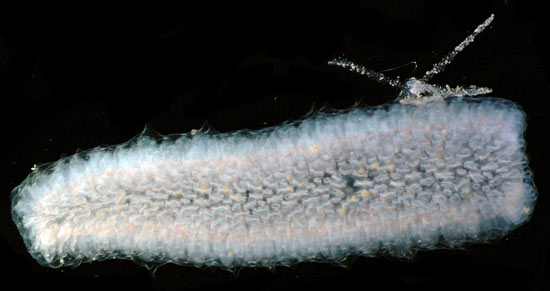
Pyrosomes, or pyrosoma, are free-floating colonial tunicates that live usually in the upper layers of the open ocean in warm seas, although some may be found to great depth. Pyrosomes are cylindrical or conical shaped colonies made up of hundreds to thousands of individuals, known as zooids. Colonies range in size from less than one centimeter to several meters in length.

Each zooid is only a few millimeters in size, but is embedded in a common gelatinous tunic that joins all of the individuals. Each zooid opens both to the inside and outside of the "tube", drawing in ocean water from the outside to its internal filtering mesh called the branchial basket, extracting the microscopic plant cells on which it feeds, and then expelling the filtered water to the inside of the cylinder of the colony. The colony is bumpy on the outside, each bump representing a single zooid, but nearly smooth, though perforated with holes for each zooid, on the inside.

Pyrosomes are planktonic, which means that their movements are largely controlled by currents, tides and waves in the oceans. On a smaller scale, however, each colony can move itself slowly by the process of jet propulsion, created by the coordinated beating of cilia in the branchial baskets of all the zooids, which also create feeding currents.

Pyrosomes are brightly bioluminescent, flashing a pale blue-green light that can be seen for many tens of meters. The name Pyrosoma comes from the Greek (pyro = "fire", soma = "body"). Pyrosomes are closely related to salps, and are sometimes called "fire salps." Sailors on the ocean are occasionally treated to calms seas containing many pyrosomes, all bioluminescencing on a dark night.

Friday, August 27, 2010

August 27, 2010 : Basking Shark


Basking Shark

The basking shark (Cetorhinus maximus) is the second largest living shark, after the whale shark. It is a cosmopolitan species, found in all the world's temperate oceans. It is a slow moving and generally harmless filter feeder.

This shark is called the basking shark because it is most often observed when feeding at the surface and appears to be basking in the warmer water there. It is the only member of the family Cetorhinidae. Gunnerus was the first to describe and name the species Cetorhinus maximus from a specimen found in Norway. The genus name Cetorhinus comes from the Greek, ketos which means marine monster or whale and rhinos meaning nose, the species name maximus is from Latin and means "greatest". The following centuries featured more attempts at naming: Squalus isodus, in 1819 by Macri; Squalus elephas, by Lesueur in 1822; Squalus rashleighanus, by Couch in 1838; Squalus cetaceus, by Gronow in 1854; Cetorhinus blainvillei by Capello in 1869; Selachus pennantii, by Cornish in 1885; Cetorhinus maximus infanuncula, by Deinse & Adriani 1953; and finally Cetorhinus maximus normani, by Siccardi 1961.

The largest accurately-measured specimen was trapped in a herring net in the Bay of Fundy, Canada in 1851. Its total length was 12.27 metres (40.3 ft), and it weighed an estimated 19 short tons (17 t). There are dubious reports from Norway of three basking sharks over 12 metres (39 ft), the largest at 13.7 metres (45 ft), dubious because few anywhere near that size have been caught in the area since. Normally the basking shark reaches a length of between 6 metres (20 ft) and a little over 8 metres (26 ft). Some specimens surpass 9–10 metres (30–33 ft), but after years of large-scale fishing, specimens of this size have become rare.

Tuesday, August 24, 2010

August 24, 2010 : Lancetfish


Lancetfish

Lancetfishes are large oceanic predatory fishes in the genus Alepisaurus ("Scaleless lizard"), the only living genus in the family Alepisauridae.

Lancetfishes grow up to 2 metres (6.6 ft) in length. Very little is known about their biology, even though they are widely distributed in all oceans, except the polar seas. Specimens have been recorded as far north as Greenland. They are often caught as by-catch for vessels long-lining for tuna.

The generic name is from Greek a- meaning "without", lepis meaning "scale", and sauros meaning "lizard".

Lancetfishes possess a long and very high dorsal fin, soft-rayed from end to end, with an adipose fin behind it. The dorsal fin has 41 to 44 rays and occupies the greater length of the back. This fin is rounded in outline, about twice as high as the fish is deep, and can be depressed into a groove along the back. The body is slender, flattened from side to side, deepest at the gill covers, and tapers back to a slender caudal peduncle.

The mouth is wide, gaping to the back of the eye, and each jaw has two or three large fang-like teeth, in addition to numerous smaller teeth. The caudal fin is very deeply forked; its upper lobe is prolonged as a long filament, although most lancetfishes seem to lose this when captured. The anal fin originates under the last dorsal ray, and is deeply concave in outline. The ventral fins are about halfway between the anal and the tip of the snout, while the pectoral fins are considerably longer than the body is deep and are situated very low down on the sides. There are no scales, and the fins are exceedingly fragile.

Tuesday, August 17, 2010

August 17, 2010 : Deep Sea Gigantism


Deep Sea Gigantism


In zoology, deep-sea gigantism, also known as abyssal gigantism, is the tendency for species of crustaceans, invertebrates and other deep-sea-dwelling animals to display a larger size than their shallow-water counterparts. Examples of this phenomenon include the giant isopod, the Japanese spider crab, the king of herrings (an oarfishSeven-arm Octopus, and a number of squid species: the Colossal Squid (up to 14 m in length), the giant squid (up to 13 m), the Robust Clubhook Squid, the Dana Octopus Squid, of up to 12 m), the Galiteuthis phyllura, Kondakovia longimana, and the bigfin squids.

It is not known whether this effect comes about as a result of adaptation for scarcer food resources (therefore delaying sexual maturity and resulting in greater size), greater pressure, or for other reasons. The Blue Planet series posited that larger specimens do well in the abyssal environment due to the advantages in body temperature regulation and a diminished need for constant activity, both inherent in organisms with a lower surface area to mass ratio (see the square-cube law).

One example for which scientists do have an explanation is the giant tube worm. These creatures live off hydrothermal vents, which supply them with enormous amounts of energy.

Saturday, August 14, 2010

August 14, 2010 : Mimic Octopus


Mimic Octopus

The mimic octopus, Thaumoctopus mimicus, is a species of octopus that has a strong ability to mimic other creatures. It grows up to 60 cm (2 feet) in length. Its normal colouring consists of brown and white stripes or spots.

Living in the tropical seas of South East Asia, it was not discovered officially until 1998, off the coast of Sulawesi. The octopus mimics the physical likeness and movements of more than fifteen different species, including sea snakes, lionfish, flatfish, brittle stars, giant crabs, sea shells, stingrays, flounders, jellyfish, sea anemones, and mantis shrimp. It accomplishes this by contorting its body and arms, and changing colour.

Many octopus species are extremely flexible. For example, one octopus the size of a volleyball can actually squeeze its entire body into a soft drink can. If the mimic octopus has that flexibility, it would explain in part how it mimics other creatures.

Although all octopuses can change colour and texture, and many can blend with the sea floor, appearing as rocks, the mimic octopus is the first octopus species ever observed to impersonate other animals.

Based on observation, the mimic octopus may decide which animal to impersonate depending on local predators. For example, when the octopus was being attacked by damselfish, it was observed that the octopus appeared as a banded sea snake, a damselfish predator. The octopus impersonates the snake by turning black and yellow, burying six of its arms, and waving its other two arms in opposite directions.

The mimic octopus is often confused with Wunderpus photogenicus, another recently discovered species. The Wunderpus can be distinguished by the pattern of strong, fixed white markings on its body.

Thursday, August 5, 2010

August 5, 2010 : Acorn Worm

Acorn Worm

The Acorn worms or Enteropneusta are a hemichordate class of invertebrates, closely related to the chordates. There are about 70 species of acorn worm in the world, the main species for research being Saccoglossus kowaleski.

All species are infaunal benthos that either may be deposit feeders or suspension feeders. Some of these worms may grow to be very long; one particular species may reach a length of 2.5 meters (almost eight feet), although most acorn worms are much, much smaller.

One genus,
Balanoglossus, is also known as the tongue worm.

Friday, July 16, 2010

July 16, 2010 : Deep Sea Dragonfish


Deep Sea Dragonfish

The deep sea dragonfish, sometimes known as the scaleless dragonfish, is a ferocious predator that inhabits the deep oceans of the world. Known scientifically as Grammatostomias flagellibarba, it has extremely large teeth compared to its body size. In spite of its gruesome appearance, its is a small fish, measuring only about 6 inches (about 15 centimeters) in length. There are several different species of dragonfish. All are very similar in appearance.
 

The deep sea dragonfish is one of the many species of deep sea fish that can produce its own light through a chemical process known as bioluminescence. The light is produced by a special organ known as a photophore. It is believed that the fish can use these flashing lights in the dark waters to attract prey and even to signal potential mates. The dragonfish has a large head and mouth equipped with many sharp, fang-like teeth. It also has a long protrusion known as a barbel attached to its chin. This barbel is tipped with a light-producing photophore. The dragonfish also has photophores along the sides of its body. These light organs may be used to signal other dragonfish during mating. They may also serve to attract and disorient prey fishes from deep below.

The deep sea dragonfish lives in deep ocean waters at depths of up to 5,000 feet (1,500 meters). Although dragonfish species are found in most oceans the world, the deep sea dragonfish is limited mainly to the North and Western Atlantic Ocean and the Gulf of Mexico.

Related Articles
: Stareater

Thursday, July 1, 2010

July 1, 2010 : Gulper Eel


Gulper Eel

The pelican eel, or Eurypharynx pelecanoides, is a deep-sea fish rarely seen by humans, though the creatures are occasionally snagged in fishermen's nets. It is an eel-like fish, the only member of the genus Eurypharynx and the family Eurypharyngidae. It belongs to the order Saccopharyngiformes which is closely related to the true eels in Anguilliformes. It is also sometimes referred to as the umbrella mouth gulper.

The pelican eel's most notable feature is its enormous mouth, much larger than its body. The mouth is loosely-hinged, and can be opened wide enough to swallow a fish much larger than itself. The pouch-like lower jaw resembles that of a
pelican, hence its name. The stomach can stretch and expand to accommodate large meals, although analysis of stomach contents suggests that the eels primarily eat small crustaceans. Despite the great size of the jaws, which occupy about a quarter of the animal's total length, it has only tiny teeth, which also would not be consistent with a regular diet of large fish.

Wednesday, June 23, 2010

June 23, 2010 : Sheepshead


Sheepshead

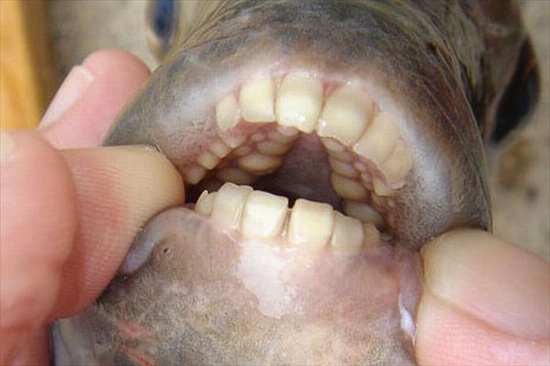
The sheepshead, Archosargus probatocephalus, is a marine fish that grows to 30 in (760 mm), but commonly reaches 5 to 8 in. It is deep and compressed in body shape, with 5 to 6 dark bars on the side of the body over a gray background. It has sharp dorsal spines. Its diet consists of oysters, clams, and other bivalves, and barnacles, fiddler crabs, and other crustaceans. It has a hard mouth, with several rows of stubby teeth, which help crush prey.

Monday, June 7, 2010

June 7, 2010 : Red-Lipped Batfish


Red-Lipped Batfish

The red-lipped batfish (Ogcocephalus darwini) is an unusual looking fish found on the Galapagos Islands. Red-lipped batfish are closely related to rosy-lipped batfish (Ogcocephalus porrectus), which are found near Cocos Island off the coast of Costa Rica. Both fish species look and behave very similarly to one another.

Batfish are not good swimmers; they use their pectoral fins to "walk" on the ocean floor. When the batfish reaches adulthood, its dorsal fin becomes a single spine-like projection that lures prey.

Tuesday, May 11, 2010

May 11, 2010 : Stargazer


Stargazer

In addition to the top-mounted eyes, stargazers also have a large upward-facing mouth in a large head. Their usual habit is to bury themselves in sand, and leap upwards to ambush prey (benthic fish and invertebrates) that pass overhead. Some species have a worm-shaped lure growing out of the floor of the mouth, which they can wiggle to attract prey's attention. Both the dorsal and anal fins are relatively long; some lack dorsal spines. Lengths range from 18 cm up to 90 cm, for the giant stargazer Kathetostoma giganteum.

Stargazers are venomous; they have two large poison spines situated behind the opercle and above the pectoral fins. They can also cause electric shocks.

Friday, April 30, 2010

April 30, 2010 : Hatchetfish


Hatchetfish

Found in tropical and subtropical waters of the Atlantic, Pacific and Indian Oceans, marine hatchetfishes range in size from Polyipnus danae at 2.8 cm (1.1 in) to the c.12 cm (4.7 in)-long Giant Hatchetfish (Argyropelecus gigas). They are small deep-sea fishes which have evolved a peculiar body shape and like their relatives have bioluminescent photophores. The latter allow them to use counterillumination to escape predators that lurk in the depths: by matching the light intensity with the light penetrating the water from above, the fish does not appear darker if seen from below. They typically occur at a few hundred meters below the surface, but their entire depth range spans from 50 to 1,500 meters deep.