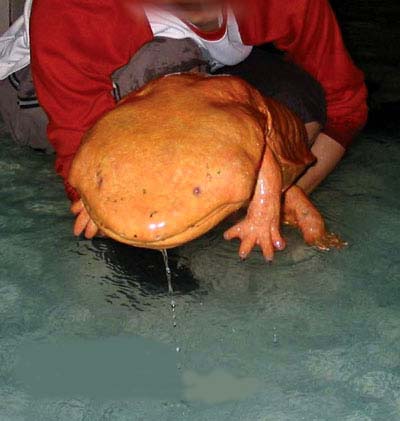
Chinese Giant Salamander
The Chinese giant salamander (Andrias davidianus) is the largest salamander in the world, reaching a length of 180 cm (6 ft), although it rarely - if ever - reaches that size today. Endemic to rocky mountain streams and lakes in China, it is considered critically endangered due to habitat loss, pollution, and over-collecting, as it is considered a delicacy and used in traditional Chinese medicine. Records from Taiwan may be the results of introductions. It has been listed as one of the top-10 "focal species" in 2008 by the Evolutionarily Distinct and Globally Endangered (EDGE) project.
It has a large head, small eyes and dark and wrinkly skin. It is one of only two extant species in the genus Andrias, the other being the slightly smaller, but otherwise very similar Japanese giant salamander (Andrias japonicus). The Chinese giant salamander feeds on insects, frogs, and fish. It has very poor eyesight, and therefore depends on special sensory nodes that run in a line on the creature's body, from head to tail. They are capable of sensing the slightest vibrations around them with the help of these nodes. The female lays 500 eggs in an underwater breeding cavity, which is guarded by the male until the eggs hatch after 50–60 days. The average adult salamander is 25–30 kg (55-66 lb) and 1.15 m (3.8 ft).
A medium-sized specimen, approximately 3 ft (0.91 m) long, was kept for several years at the Steinhardt Aquarium in San Francisco, California, and now is on display again in the "Water Planet" section of the new California Academy of Sciences building. Per early 2008, ISIS records only show five individuals held in US zoos (Zoo Atlanta, Cincinnati Zoo, and Saint Louis Zoological Park), and an additional four in European zoos (Zoo Dresden and Rotterdam Zoo). It is likely additional individuals are kept in non-ISIS zoos and animals parks in its native China. There are several of them in the aquarium of Shanghai. It has been bred in captivity, but it is doubtful if this can be achieved to an extent where the pressure on the wild populations is reduced.
It has been argued that the correct scientific name of this species is Andrias scheuchzeri (in which case Andrias davidianus would be a junior synonym) – a name otherwise restricted to an extinct species described from Swiss fossils.
Electric Catfish
Electric catfish is the common name for the catfish (order Siluriformes) family Malapteruridae. This family includes two genera, Malapterurus and Paradoxoglanis with 19 species. Several species of this family have the ability to produce an electric shock of up to 350 volts using electroplaques of an electric organ. Electric catfish are found in tropical Africa and the Nile River. Electric catfish are usually nocturnal and feed primarily on other fish, incapacitating their prey with electric discharges.
Malapteruridae is the only group of catfish with a well-developed electrogenic organ; however, electroreceptive systems are widespread in catfishes. The electrogenic organ is derived from anterior body musculature and lines the body cavity. Electric catfish do not have dorsal fins or fin spines. They have three pairs of barbels (the nasal pair is absent). The swim bladder with elongate posterior chambers, two chambers in Malapterrus and three in Paradoxoglanis.
The Nile fish was well known to the ancient Egyptians. The Egyptians have depicted the fish in their mural paintings and elsewhere; the first extant depiction of an electric catfish is that on the slate palette of the pre-dynastic Egyptian ruler Narmer, about 3100 BC. An account of its electric properties was given by an Arab physician of the 12th century; then as now the fish was known by the suggestive name of Raad or Raash, which means thunder (literally trembler, shaker).
Though the shock an electric catfish can generate is not known to be fatal to humans, the catfish does use its electricity as a weapon to ward off predators.
Pram Bug
Phronima is a small, deep sea hyperiid amphipod of the family Phronimidae. It is found throughout the world's oceans, except in polar regions. The body of Phronima is transparent. Females attack salps, using their mouth and claws to eat the animal and hollow out its gelatinous shell. She then enters the barrel and lays her eggs inside. She then propels the barrel through the water as the larvae develop, providing them with fresh food and water.
Related Articles :
Amphipods and
Sandhopper
Brontoscorpio
Brontoscorpio anglicus ("English thunder scorpion") was a 1-metre long aquatic scorpion that lived during the Silurian period. When alive, B. anglicus would have resembled an oversized scorpion, albeit with relatively large (for a scorpion) compound eyes; it was an important predator of its time, given that the arthropods were among the largest animals on Earth during the Silurian.
All post-Paleozoic scorpions are terrestrial, while during the Silurian many of the known taxa made the transition from aquatic to terrestrial environments. It has been inferred that Brontoscorpio was capable of leaving the water and entering land, whether to evade other predators, such as large nautiloids, eurypterids, or even other aquatic scorpions; or pursue prey, such as other, smaller terrestrial scorpions. However, given its great size, B. anglicus had to return to the water when it tired of supporting its own weight, or at the very least whenever it moulted its exoskeleton (on land, it would risk being crushed by its own mass). Marine scorpions such as B. anglicus captured, stung, and ate small sea animals such as fish like acanthodians, heterostracans, smaller scorpions and trilobites.
As with other arachnids, such as modern scorpions, Brontoscorpio respired through gas exchange via pores in its exoskeleton and the inner linings of its book lungs. Its tail was tipped with a large, venomous stinger that was, according to Walking with Monsters, the size of a light bulb.
Freshwater Mussels
Generally unable to move of their own accord, the parasite larva or glochidium can do little more than clamp down on the first thing that brushes by its cute little jaws, sometimes equipped with vicious fangs and an adhesive tongue. Once attached, the host's skin will grow to encase the tiny hitchhiker, which remains for days or weeks until ready to drop off and settle down as a young mussel. Other species even allow themselves to be swallowed, and settle in the digestive tract where they may absorb nutrients until they are excreted. Usually only compatible with a single fish species, they rely on their parents to infect the right host with all manner of devilry.
Read the full article
Pigbutt Worm
The pigbutt worm or flying buttocks (Chaetopterus pugaporcinus) is a newly discovered species of worm found by scientists at the Monterey Bay Aquarium Research Institute. The worm is round in shape, approximately the size of a hazelnut, and bears a strong resemblance to a disembodied pair of buttocks. Because of this, it was given a Latin species name that roughly translates to "resembling a pig's rear."
The worm has been recently observed residing just below the oxygen minimum zone between 900 and 1,200 metres (3,000 to 4,000 feet) deep — even when the sea floor is significantly deeper. The worms have also been observed floating with their mouths surrounded by a cloud of mucus. Current theories suggest that they reside in this area of the ocean because of its cornucopia of detritus and marine snow, and that the worms use these mucus clouds to capture particles of food and "snow."
The worm has a segmented body, but the middle segments are highly inflated, giving the animal a round shape. These morphological characteristics are unique among chaetopterids. It is unknown whether the specimens found to date were adult or larval forms. Their unusual size (five to ten times larger than any known chaetopterid larvae) might indicate they were adults, but all known species of chaetopterid adults live in parchment-like tubes on the sea floor. Comparison to larval morphology has indicated that the specimens have a close relationship to either genus Chaetopterus or genus Mesochaetopterus, and a phylogenetic tree constructed from mitochondrial and ribosomal DNA sequences from twelve different Chaetopteridae worms found them to be most closely related to other worms of the Chaetopterus genus.