Showing posts with label Myth. Show all posts
Thursday, December 9, 2010
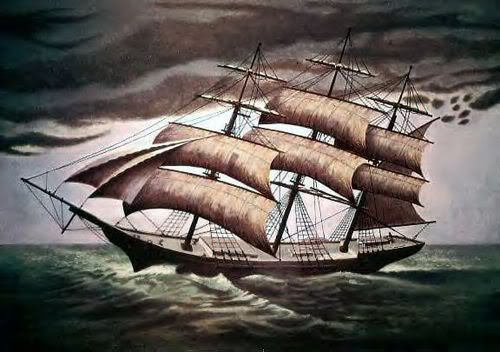
December 9, 2010 : Flying Dutchman (Myth)
Flying Dutchman
The legend of the Flying Dutchman concerns a ghost ship that can never make port, doomed to sail the oceans forever. It probably originates from 17th century nautical folklore. The oldest extant version dates to the late 18th century.
Sightings in the 19th and 20th centuries report the ship to be glowing with ghostly light. It is said that if hailed by another ship, its crew will try to send messages to land or to people long dead. In ocean lore, the sight of this phantom ship is a portent of doom.
Versions of the story are numerous in nautical folklore and related to medieval legends such as Captain Falkenburg, who was cursed to ply the North Sea until Judgment Day, playing dice with the Devil for his own soul.
According to some sources, the 17th-century Dutch captain Bernard Fokke is the model for the captain of the ghost ship. Fokke was renowned for the speed of his trips from Holland to Java and was suspected of being in league with the Devil. The first version of the legend as a story was printed, in Blackwood's Edinburgh Magazine for May 1821, which puts the scene as the Cape of Good Hope. This story introduces the name Vanderdecken for the captain and the motifs (elaborated by later writers) of letters addressed to people long dead being offered to other ships for delivery, but if accepted will bring misfortune; and the captain having sworn to round the Cape of Good Hope though it should take until the day of judgment.
Sunday, October 31, 2010
October 31, 2010 : Hydra (Myth)
Hydra
In Greek mythology, the Lernaean Hydra (Greek: Λερναία Ὕδρα) was an ancient nameless serpent-like chthonic water beast (as its name evinces) that possessed nine heads — and for each head cut off it grew two more — and poisonous breath so virulent even her tracks were deadly. The Hydra of Lerna was killed by Heracles as one of his Twelve Labours. Its lair was the lake of Lerna in the Argolid, though archaeology has borne out the myth that the sacred site was older even than the Mycenaean city of Argos since Lerna was the site of the myth of the Danaids. Beneath the waters was an entrance to the Underworld, and the Hydra was its guardian.
After slaying the Nemean lion, Eurystheus sent Heracles to slay the Hydra, which Hera had raised just to slay Heracles. Upon reaching the swamp near Lake Lerna, where the Hydra dwelt, Heracles covered his mouth and nose with a cloth to protect himself from the poisonous fumes. He fired flaming arrows into its lair, the spring of Amymone, a deep cave that it only came out of to terrorize neighboring villages. He then confronted it, wielding a harvesting sickle (according to some early vase-paintings), a sword or his famed club. Ruck and Staples (1994: 170) have pointed out that the chthonic creature's reaction was botanical: upon cutting off each of its heads he found that two grew back, an expression of the hopelessness of such a struggle for any but the hero, Hercules. The weakness of the Hydra was that only one of its heads was immortal.
Monday, October 11, 2010
October 11, 2010 : Jormungand (Myth)
Jormungand
In Norse mythology, Jörmungandr (pronounced [ˈjœrmuŋɡandr]), mostly known as Jormungand, or Jörmungand(Old Norse: Jǫrmungandr), or Midgard Serpent (Old Norse: Midgarðsormr), or World Serpent, is a sea serpent, and the middle child of the giantess Angrboða and the god Loki. According to the Prose Edda, Odin took Loki's three children, Fenrisúlfr, Hel and Jörmungandr, and tossed Jörmungandr into the great ocean that encircles Midgard. The serpent grew so large that he was able to surround the Earth and grasp his own tail. When he lets go the world will end. As a result he earned the alternate name of the Midgard Serpent or World Serpent. Jörmungandr's arch enemy is the god Thor.
The major sources for myths about Jörmungandr are the Prose Edda, Húsdrápa, Hymiskviða, and Völuspá. Less important sources include kennings in skaldic poetry. For example in Þórsdrápa, faðir lögseims, "father of the sea-thread", is used as a kenning for Loki. There are also image stones from ancient times depicting the fishing encounter.
Thursday, October 7, 2010
October 7, 2010 : Kraken (Myth)
Kraken
Kraken (pronounced /ˈkreɪkən/ or /ˈkrɑːkən/) are mythical sea monsters of gargantuan size, said to have dwelt off the coasts of Norway and Iceland. The sheer size and fearsome appearance attributed to the beasts have made them common ocean-dwelling monsters in various fictional works (see Kraken in popular culture). The legend may actually have originated from sightings of real giant squid that are variously estimated to grow to 13–15 m (40–50 ft) in length, including the tentacles. These creatures normally live at great depths, but have been sighted at the surface and have reportedly attacked ships.
Kraken may be derived from the Old Norse noun kraka "to drag under the water". In modern German, Krake (plural and declined singular: Kraken) means octopus, but can also refer to the legendary Kraken.
Even though the name kraken never appears in the Norse sagas, there are similar sea monsters, the hafgufa and lyngbakr, both described in Örvar-Odds saga as a giant spider-creature. The Norwegian text from c. 1250, Konungs skuggsjá. Carolus Linnaeus included kraken as cephalopods with the scientific name Microcosmus in the first edition of his Systema Naturae (1735), a taxonomic classification of living organisms, but excluded the animal in later editions. Kraken were also extensively described by Erik Pontoppidan, bishop of Bergen, in his "Natural History of Norway" (Copenhagen, 1752–3). Early accounts, including Pontoppidan's, describe the kraken as an animal "the size of a floating island" whose real danger for sailors was not the creature itself, but the whirlpool it created after quickly descending back into the ocean. However, Pontoppidan also described the destructive potential of the giant beast: "It is said that if it grabbed the largest warship, it could manage to pull it down to the bottom of the ocean" (Sjögren, 1980). Kraken were always distinct from sea serpents, also common in Scandinavian lore (Jörmungandr for instance).
Monday, October 4, 2010
October 4, 2010 : Aspidochelone (Myth)
Aspidochelone
According to the tradition of the Physiologus and medieval bestiaries, the aspidochelone is a fabled sea creature, variously described as a large whale or sea turtle, that is as large as an island. The name aspidochelone appears to be a compound word combining Greek aspis (which means either "asp" or "shield"), and chelone, the turtle. It rises to the surface from the depths of the sea, and entices unwitting sailors to make landfall on its huge shell. In Old English literature, in the poem The Whale, the creature appears under the name Fastitocalon, apparently a variant of aspidochelone. In the moralistic allegory of the Physiologus and bestiary tradition, the aspidochelone represents Satan, who deceives those whom he seeks to devour.
One version of the Latin text of the Physiologus reads:
"There is a monster in the sea which in Greek is called aspidochelone, in Latin "asp-turtle"; it is a great whale, that has what appear to be beaches on its hide, like those from the sea-shore. This creature raises its back above the waves of the sea, so that sailors believe that it is just an island, so that when they see it, it appears to them to be a sandy beach such as is common along the sea-shore. Believing it to be an island, they beach their ship alongside it, and disembarking, they plant stakes and tie up the ships. Then, in order to cook a meal after this work, they make fires on the sand as if on land. But when the monster feels the heat of these fires, it immediately submerges into the water, and pulls the ship into the depths of the sea."
"Such is the fate of all who pay no heed to the Devil and his wiles, and place their hopes in him: tied to him by their works, they are submerged into the burning fire of Gehenna: for such is his guile."
Posts during October will be of real-life sea monsters, long extinct, as well as those of myth and folklore.
Sunday, October 3, 2010
October 3, 2010 : Scylla (Myth)
Scylla
In Greek mythology, Scylla (pronounced /ˈsɪlə/, sil-uh; Greek: Σκύλλα, Skulla) was a monster that lived on one side of a narrow channel of water, opposite its counterpart Charybdis. The two sides of the strait were within an arrow's range of each other—so close that sailors attempting to avoid Charybdis would pass too close to Scylla and vice versa.
Scylla was a horrible sea monster with six long necks equipped with grisly heads, each of which contained three rows of sharp teeth. Her body consisted of twelve tentacle-like legs and a cat's tail and with four to six dog-heads ringing her waist. She was one of the children of Phorcys and either Hecate, Crataeis, Lamia or Ceto (all of whom may be various names for the same goddess. Some sources, including Stesichorus, cite her parents as Triton and Lamia.
Traditionally the strait has been associated with the Strait of Messina between Italy and Sicily, but more recently this theory has been challenged, and the alternative location of Cape Scilla in northwest Greece has been suggested by Tim Severin.
The phrase "between Scylla and Charybdis" (popularly reworded "between a rock and a hard place") has come to mean being in a state where one is between two dangers and moving away from one will cause you to be in danger from the other.
Posts during October will be of real-life sea monsters, long extinct, as well as those of myth and folklore.
Saturday, October 2, 2010
October 2, 2010 : Charybdis (Myth)
Charybdis
In Greek mythology, Charybdis or Kharybdis (pronounced /kəˈrɪbdɨs/; in Greek, Χάρυβδις) was a sea monster, once a beautiful naiad and the daughter of Poseidon and Gaia. She takes form as a huge bladder of a creature whose face was all mouth and whose arms and legs were flippers and who swallows huge amounts of water three times a day before belching them back out again, creating whirlpools. In some variations of the tale, Charybdis is just a large whirlpool rather than a sea monster. Charybdis was very loyal to her father in his endless feud with Zeus; it was she who rode the hungry tides after Poseidon had stirred up a storm, and led them onto the beaches, gobbling up whole villages, submerging fields, drowning forests, claiming them for the sea. She won so much land for her father's kingdom that Zeus became enraged and changed her into a monster.
The myth has Charybdis lying on one side of a blue, narrow channel of water. On the other side of the strait was Scylla, another sea-monster. The two sides of the strait are within an arrow's range of each other, so close that sailors attempting to avoid Charybdis will pass too close to Scylla and vice versa. The phrase "between Scylla and Charybdis" has come to mean being in a state where one is between two dangers and moving away from one will cause you to come closer to the other. "Between Scylla and Charybdis" is the origin of the phrase "between the rock and the whirlpool" (the rock upon which Scylla dwelt and the whirlpool of Charybdis) and may also be the genesis of the phrase "between a rock and a hard place".
According to Thomas Bulfinch, based on writings of Homer, Charybdis stole the oxen of Geryon from Hermes, in whose possession they had been at the time, and was transformed into a sea monster as a punishment.
The phrase "between Scylla and Charybdis" (popularly reworded "between a rock and a hard place") has come to mean being in a state where one is between two dangers and moving away from one will cause you to be in danger from the other.
Posts during October will be of real-life sea monsters, long extinct, as well as those of myth and folklore.
Monday, August 23, 2010
August 23, 2010 : Sea Serpents (Myth)
Sea Serpents
Sightings of sea serpents have been reported for hundreds of years, and continue to be claimed today. Cryptozoologist Bruce Champagne identified more than 1,200 purported sea serpent sightings. Despite these numerous sightings, no credible physical evidence has been recorded and it is currently believed that the sightings can be best explained as misidentification of known animals such as oarfish and whales. Some cryptozoologists have suggested that the sea serpents are relict plesiosaurs, mosasaurs or other Mesozoic marine reptiles, an idea often associated with lake monsters such as the Loch Ness Monster.
Skeptics and debunkers have questioned the interpretation of sea serpent sightings, suggesting that reports of serpents are misidentifications of things such as cetaceans (whales and dolphins), sea snakes, eels, basking sharks, baleen whales, oarfish, large pinnipeds, seaweed, driftwood, flocks of birds, and giant squid.
While most cryptozoologists recognize that at least some reports are simple misidentifications, they claim that many of the creatures described by those who have seen them look nothing like the known species put forward by skeptics and claim that certain reports stick out. For their part, the skeptics remain unconvinced, pointing out that even in the absence of out-right hoaxes, imagination has a way of twisting and inflating the slightly out-of-the-ordinary until it becomes extraordinary.
Subscribe to:
Posts (Atom)