Swimming Sea Cucumber
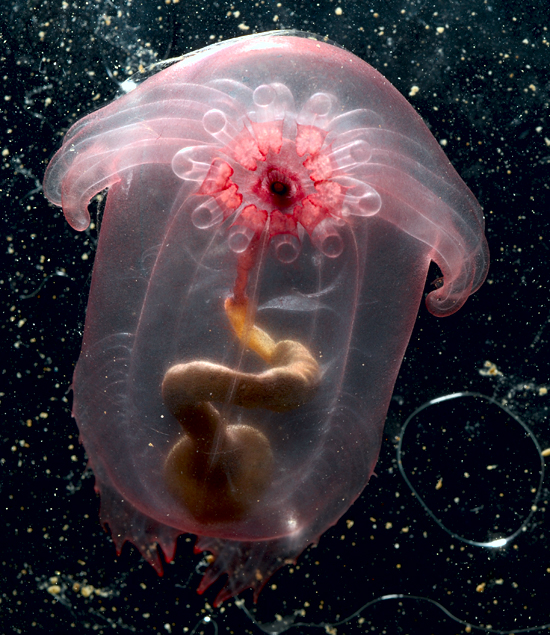
Sea cucumbers resemble large, leathery slugs that typically amble across the seabed. Unusually, Enypniastes has developed webbed swimming structures at the front and back of the body, and can swim long distances of up to 1,000m (3,280 ft) up into the water column.
They are brilliant red in colour, with a soft, delicate, transparent body, through which their intestine and other internal organs are visible.
Their mouths are surrounded by tentacles which are used to gather sediment from the sea floor.
Sea cucumbers are capable of swimming up from the bottom by undulating the cape-like structure around the top of the animal. They are graceful, slow swimmers.
When attacked by predators, they produce bioluminescence across their entire body surface, before shedding the sticky glowing skin as a distraction ploy.
Humphead Parrotfish
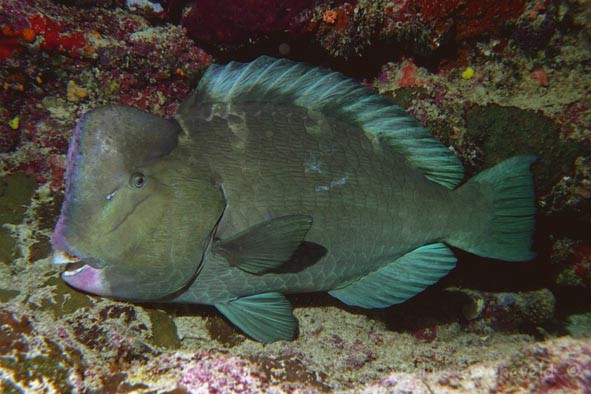
The green humphead parrotfish, Bolbometopon muricatum, is the largest species of parrotfish growing to lengths of 1.3 metres (4.3 ft) and weighing up to 46 kilograms (100 lb). It is found on reefs in the Indian and Pacific Oceans, from the Red Sea in the west to Samoa in the east, and from the Yaeyama Islands in the north to the Great Barrier Reef, Australia in the south.
Other common names include bumphead parrotfish, humphead parrotfish, double-headed parrotfish, buffalo parrotfish and giant parrotfish.
Unlike wrasses, it has a vertical head profile, and unlike other parrotfishes, it is uniformly covered with scales except for the leading edge of the head which is often light green to pink. Primary phase colouration is a dull gray with scattered white spots, gradually becoming uniformly dark green. This species does not display sex-associated patterns of color change. Adults develop a bulbous forehead and their teeth plates are exposed (only partly covered by lips). The species is slow growing and long-lived (up to 40 years), with delayed reproduction and low replenishment rates. This species is gregarious and usually occurs in small aggregations, but group size can be quite large (> 75) on seaward and clear outer lagoon reefs.
Ranchu Goldfish
The ranchu is a hooded variety of fancy goldfish developed in Japan. It is referred to as the "king of goldfish" by the Japanese.
The modern-day ranchu is a Japanese development of the lionhead. They are the direct outcome of crossbreeding experiments of different Chinese lionhead specimens.
A ranchu has an egg-shaped body with a deep belly that is between 5/8 to 3/4 the length of the fish. This goldfish does not have a dorsal fin and breeding standards require that the back should not have any vestiges of the dorsal fin on it. The back should be rounded and not flat, as in the case of lionheads. The area of the caudal peduncle should curve sharply downwards to meet the tail. The caudal peduncle itself should be broad and neither lengthy or too short (a properly formed caudal peduncle avoids swimming motion impairments to this type of goldfish). The ranchu's tail meets the caudal peduncle at a forty-five degree angle, giving the fish a unique swimming motion. Furthermore, the tail lobes are rounded, and all other finnage are paired.
The most prominent feature of the ranchu is its head. There must be sufficient space between the eyes, and also from the eyes to the front of the head. The gill cover should figuratively extend quite far towards the tail. The headgrowth should seem to begin from the bottom of the gill cover and move upward. The headgrowths of young ranchu fry may take at least a year to develop. Young ranchus possessing broad foreheads and square noses generally produce better headgrowths. Mature ranchus can reach between 6 to 8 inches (15 to 20 centimeters) in length.
Great Blue Hole
The Great Blue Hole is a large underwater sinkhole off the coast of Belize. It lies near the center of Lighthouse Reef, a small atoll 70 kilometres (43 mi) from the mainland and Belize City. The hole is circular in shape, over 300 metres (984 ft) across and 124 metres (407 ft) deep. It was formed during several episodes of Quaternary glaciation when sea levels were much lower - the analysis of stalactites found in Great Blue Hole shows that formation has taken place 153,000; 66,000; 60,000; and 15,000 years ago. As the ocean began to rise again, the caves were flooded. The Great Blue Hole is a part of the larger Belize Barrier Reef Reserve System, a World Heritage Site of the United Nations Educational, Scientific and Cultural Organization (UNESCO).
This site was made famous by Jacques-Yves Cousteau, who declared it one of the top ten scuba diving sites in the world. In 1971, he brought his ship, the Calypso, to the hole to chart its depths. Investigations by this expedition confirmed the hole's origin as typical karst limestone formations, formed before rises in sea level in at least four stages, leaving ledges at depths of 21, 49 and 91 meters (69, 161 and 299 ft). Stalactites were retrieved from submerged caves, confirming their previous formation above sea level. Some of these stalactites were also off-vertical by 5° in a consistent orientation, thus indicating that there had also been some past geological shift and tilting of the underlying plateau, followed by a long period in the current plane.
Initial measured depth of Great Blue Hole was 125m which is the most often cited depth up to this day. An expedition by the Cambrian Foundation in 1997 measured the hole's depth as 124m at its deepest point. This difference in measurement can be explained by ongoing sedimentation or by imprecision in earlier measurements. The purpose of this expedition was the collection of core samples from the floor of the Blue Hole and documentation of the cave system. To accomplish these tasks, all of the divers had to be certified in cave diving and mixed gases.
Christmas Island Migration
At the beginning of the wet season (usually October / November), most adult red crabs suddenly begin a spectacular migration from the forest to the coast to breed. Breeding is usually synchronized island-wide. The rains provide moist overcast conditions for crabs to make their long and difficult journey to the sea.
During peak migration times, sections of roads where crabs cross in high numbers may be closed to vehicles for short periods of time. You can park your vehicle and carefully walk amongst the moving sea of crabs as they relentlessly make their way to and from the shore.
While the rains provide the moist preconditions for the march to begin, the timing of the migration breeding sequence is also linked to the phases of the moon. Eggs are released by the female red crabs into the sea precisely at the turn of the high tide during the last lunar quarter.
The sea level at the base of the cliffs and on the beaches, where the females release their eggs, at this time varies the least for a longer period, and it is therefore safer for the females approaching the water's edge to release their eggs. Sometimes there are earlier and later migrations of smaller numbers of crabs but all migrations retain this same lunar rhythm.
Related Articles :
Christmas Island Red Crab
Christmas Island Red Crab
The Christmas Island red crab, Gecarcoidea natalis, is a species of terrestrial crab endemic to Christmas Island in the Indian Ocean. Although restricted to a relatively small area, it is estimated that up to 120 million red crabs may live there, making it the most abundant of the 14 terrestrial crab species on Christmas Island. Christmas Island red crabs eat mostly fallen leaves and flowers, but will occasionally eat other animals, including other red crabs (see cannibalism) if the opportunity arises.
Christmas red crabs live in burrows for shelter from the sun. Since they breathe through gills, the possibility of drying out is dangerous. They are famous for their annual migration to the sea to lay their eggs in the ocean. During the migration, the crabs cover highways so densely that they are visible from the air. Volunteers shovel the crabs off the roads and, although no harm is intended, some of the countless millions inevitably get injured.
Early inhabitants of Christmas Island rarely mentioned these crabs. It is possible that their large population size was caused by the extinction of the endemic Maclear's Rat, Rattus macleari in 1903, which may have controlled the crab's population.
An exploding population of the yellow crazy ant, an invasive species accidentally introduced to Christmas Island and Australia from Africa, is believed to have killed 15–20 million red crabs in recent years.
Related Articles :
Christmas Island Migration
Barramundi
The Barramundi (Lates calcarifer), also known as Asian Seabass, is a species of catadromous fish in familyLatidae of order Perciformes. The native species is widely distributed in the Indo-West Pacific region from the Persian Gulf, through Southeast Asia to Papua New Guinea and Northern Australia. Known in Thai language as Pla Krapong (Thai: ปลากระพง), it is very popular in Thai cuisine. It is known as pandugappa in the Telugu language in India.
Barramundi is a loanword from an Australian Aboriginal language of the Rockhampton area in Queensland Originally, the name barramundi referred to saratoga and Gulf saratoga. meaning "large-scaled river fish". However, the name was appropriated for marketing reasons during the 1980s, a decision which has aided in raising the profile of this fish significantly.L. calcarifer is broadly referred to as Asian seabass by the international scientific community, but is also known as giant perch, giant seaperch, Australian seabass, and by a variety of names in other local languages, such as Ikan Siakap or Ikan Kakap Putih in Indonesian and also known as selunsung in local sabahan. 'Barra Mundi' when pronounced as two words, is clearly of Indian origin meaning 'big head'.