Bowhead Whale
The bowhead whale (Balaena mysticetus) is a baleen whale of the right whale family Balaenidae in suborderMysticeti. A stocky dark-colored whale without a dorsal fin, it can grow to 20 meters (66 ft) in length. Estimated maximum weight of this thick-bodied species is 136 tonnes (134 LT; 150 ST), second only to the blue whale, although the bowhead's maximum length is less than several other whales. It lives entirely in fertile Arctic and sub-Arctic waters, unlike other whales that migrate to feed or reproduce. It is also known as Greenland right whale or Arctic whale. The bowhead is perhaps the longest-living mammal, and has the largest mouth of any animal.
The bowhead was an early whaling target. Its population was severely reduced before a 1966 moratorium. The population is estimated to be over 24,900 worldwide, down from an estimated 50,000 before whaling.
The bowhead whale has a robust, dark-colored body, no dorsal fin and a strongly bowed lower jaw and narrow upper jaw. Its baleen, the longest of any whale at 3 meters (10 ft), strains tiny prey from the water. The whale has a massive bony skull which it uses to break through the Arctic ice to breathe. Inuit hunters have reported them surfacing through 60 cm (24 in) of ice. The bowhead may reach up to 20 m (66 ft). The largest yet reported was 21.2 m (70 ft) m for an unweighed giant caught off Spitsbergen, Norway. Females are larger than males. Its blubber is the thickest of any animal, averaging 43–50 cm (17–20 in).
Signal Crayfish
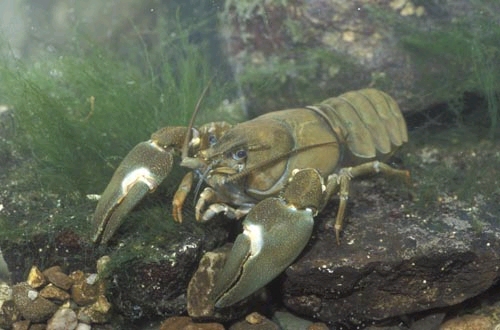
The signal crayfish, Pacifastacus leniusculus, is a North American species of crayfish. It was introduced to Europe in the 1960s to supplement the Scandinavian Astacus astacus fisheries, which were being damaged by crayfish plague, but the imports turned out to be a carrier of that disease. The signal crayfish is now an invasive species, ousting native species across Europe and Japan.
From 1907, crayfish plague, an infectious disease caused by the water mould Aphanomyces astaci, damaged stocks of the native European crayfish Astacus astacus. Since the signal crayfish occupied a similar ecological niche in its native range, it was imported in the 1960s to Sweden and Finland to allow recreational and commercial crayfish capture. It was not realised at the time that the signal crayfish was a carrier of the crayfish plague. All American species carry the infection, but it is only lethal to individuals that are already stressed; to European species, the infection is rapidly fatal.
The signal crayfish is now the most widespread alien crayfish in Europe, occurring in 25 countries, from Finland to Great Britain and from Spain to Greece. It was first introduced to Great Britain in 1976, and is now widespread across the island as far north as the Moray Firth. It has also been observed on the Isle of Man, but has not yet been introduced to Ireland.
Velvet Crab
The velvet crab (alternatively velvet swimming crab or devil crab), Necora puber, is a species of crab. It is the largest swimming crab (family Portunidae) found in British coastal waters, with a carapace width of up to 100 millimetres (3.9 in), and the only species in the genus Necora. The body is coated with short hairs, giving the animal a velvety texture, hence the common name. It is one of the major crab species for United Kingdom fisheries.
The velvet crab lives from southern Norway to Western Sahara in the North Sea and north Atlantic as well as western parts of the Mediterranean Sea, on rocky bottoms from the shoreline to a depth of about 65 metres (213 ft). The last pair of pereiopods are flattened to facilitate swimming.
Mary Celeste
The Mary Celeste (often incorrectly referred to as Marie Celeste following an intervention by Conan Doyle - see below) was a brigantine merchant ship famous for having been discovered on 4 December 1872 in the Atlantic Ocean unmanned and apparently abandoned, despite the fact that the weather was fine and her crew had been experienced and able seamen. The Mary Celeste was in seaworthy condition and still under sail heading towards the Strait of Gibraltar. She had been at sea for a month and had over six months' worth of food and water on board. Her cargo was virtually untouched and the personal belongings of passengers and crew were still in place, including valuables. The crew was never seen or heard from again. Their disappearance is often cited as the greatest maritime mystery of all time.
The fate of her crew has been the subject of much speculation. Theories range from alcoholic fumes, to underwater earthquakes, to waterspouts, to paranormal explanations involving extraterrestrial life, unidentified flying objects (UFOs), sea monsters, and the phenomena of the Bermuda Triangle, although the Mary Celeste is not known to have sailed through the Bermuda Triangle area. The Mary Celeste is often described as the archetypal ghost ship, since she was discovered derelict without any apparent explanation, and her name has become a synonym for similar occurrences.
Oliver Deveau, chief mate of the Dei Gratia, boarded the Mary Celeste. He reported he did not find anyone on board, and said that "the whole ship was a thoroughly wet mess". There was only one operational pump, two apparently having been disassembled, with a lot of water between decks and three and a half feet (1.1 m) of water in the hold. However, the ship was not sinking and was still seaworthy.
All of the ship's papers were missing, except for the captain's logbook. The forehatch and the lazarette were both open, although the main hatch was sealed. The ship's clock was not functioning, and the compass was destroyed; the sextant and marine chronometer were missing. The only lifeboat on the Mary Celeste, a yawl located above the main hatch, was also missing. The peak halyard, used to hoist the main sail, had disappeared. A rope, perhaps the peak halyard, was found tied to the ship very strongly and the other end, very frayed, was trailing in the water behind the ship.
Popular stories of untouched breakfasts with still-warm cups of tea on the cabin table are untrue and most likely originated with fictionalized accounts of the incident, especially one by Sir Arthur Conan Doyle. At the inquiry, Oliver Deveau stated that he saw no preparations for eating and there was nothing to eat or drink in the cabin.
Deveau returned to his ship and reported to the captain. Two men, Charles Augustus Anderson and Charles Lund, then boarded the Mary Celeste.
The cargo of 1,701 barrels of alcohol Devreau reported was in good order. However, when it was eventually unloaded in Genoa, nine barrels were found to be empty.
A six-month supply of uncontaminated food and fresh water was still aboard, and the crew's personal possessions and artifacts were left untouched, making a piracy raid seem extremely unlikely. It appeared the vessel had been abandoned in a hurry. There was no sign of a struggle, or any sort of violence.
Upside-Down Catfish
Upside-down catfish, Synodontis nigriventris, is a species of catfish. It is particularly noteworthy because of its habit of swimming upside down most of the time. Upside-down catfish originate from the Central Congo basin of Africa.
Upside-down catfish are small, reaching a maximum of 9.6 centimetres (4 in). Like other members of the mochikidae family, they have large eyes, a large dorsal fin and three pair of barbels. Upside-down catfish are adapted to spend most of their time upside-down. This is reflected in the fish's pigmentation—their bellies are darker than their backs, a form of countershading.
These fish are mostly nocturnal, and feed on insects, crustaceans, and plant matter. These fish lay eggs. The young fish do not swim upside-down until they are about two months old.
Fish Kill
The term fish kill is applied to a localized die-off of fish populations which may also be associated with more generalized mortality of aquatic life. It may result from a variety of causes, most frequently ecological hypoxia (oxygen depletion). The hypoxic event may be brought on by factors including high and temperatures, weather, drought, thermal pollution and algae blooms. Fish kills may also occur due to the presence of disease, agricultural sewage runoff, oil or chemical spill, hazardous waste spills, sea-quakes, inappropriate re-stocking of fish, underwater explosions, and other catastrophic events that upset a normally stable aquatic population.
Fish kills are often the first visible signs of ecological hypoxia and are usually investigated as a matter of urgency by environmental agencies to determine the cause of the hypoxic event and whether or not the cause was man made, due to pollution, or naturally occurring.
Related Articles :
Dead Zones
Puffer Fish
Tetraodontidae is a family of primarily marine and estuarine fish of the Tetraodontiformes order. The family includes many familiar species which are variously called pufferfish, balloonfish, blowfish, bubblefish, globefish, swellfish, toadfish, toadies, honey toads, and sea squab. They are morphologically similar to the closely related porcupinefish, which have large external spines (unlike the thinner, hidden spines of Tetraodontidae, which are only visible when the fish has puffed up). The scientific name refers to the four large teeth, fused into an upper and lower plate, which are used for crushing the shells of crustaceans and mollusks, their natural prey.
Puffer fish are generally believed to be the second–most poisonous vertebrate in the world, after the Golden Poison Frog. Certain internal organs, such as liver, and sometimes their skin are highly toxic to most animals when eaten, but nevertheless the meat of some species is considered a delicacy in Japan (as 河豚, pronounced as fugu), Korea (as bok), and China (as 河豚 he2 tun2) when prepared by chefs who know which part is safe to eat and in what quantity.
The tetraodontidae contains at least 121 species of puffers in 20 genera. They are most diverse in the tropics and relatively uncommon in the temperate zone and completely absent from cold waters. They are typically small to medium in size, although a few species can reach lengths of greater than 100 centimetres (39 in).
The puffer's unique and distinctive natural defenses help compensate for their slow locomotion. Puffers move by combining pectoral, dorsal, anal, and caudal fins. This makes them highly maneuverable but very slow, and therefore comparatively easy predation targets. Their tail fin is mainly used as a rudder, but it can be used for a sudden evasive burst of speed that shows none of the care and precision of their usual movements. The puffers excellent eyesight combined with this speed burst is the first and most important defense against predators. Their back up defense mechanism, used if they are successfully pursued, is to fill their extremely elastic stomachs with water (or air when outside the water) until they are much larger and almost spherical in shape. Even if they are not visible when the puffer is not inflated, all puffers have pointed spines, so a hungry predator may suddenly find itself facing an unpalatable pointy ball rather than a slow, tasty fish. Predators which don't heed this warning (or who are "lucky" enough to catch the puffer suddenly, before or during inflation) may die from choking, and predators that do manage to swallow the puffer may find their stomaches full of tetrodotoxin, making puffers an unpleasant, possibly lethal, choice of prey. This neurotoxin is found primarily in the ovaries and liver, although smaller amounts exist in the intestines and skin, as well as trace amounts in muscle. It does not always have a lethal effect on large predators, such as sharks, but it can kill humans.