Friday, May 7, 2010
May 7, 2010 : Sea Salp
Sea Salp
A salp (plural salps; also salpa, plural salpae or salpas) is a barrel-shaped, free-floating tunicate. It moves by contracting, thus pumping water through its gelatinous body. The salp strains the pumped water through its internal feeding filters, feeding on phytoplankton that it sieves out of the water.
Salps are common in equatorial, temperate, and cold seas, where they can be seen at the surface, singly or in long, stringy colonies. The most abundant concentrations of salps are in the Southern Ocean (near Antarctica). Here they sometimes form enormous swarms, often in deep water, and are sometimes even more abundant than krill. Over the last century, while krill populations in the Southern Ocean have declined, salp populations appear to be increasing.
Thursday, May 6, 2010
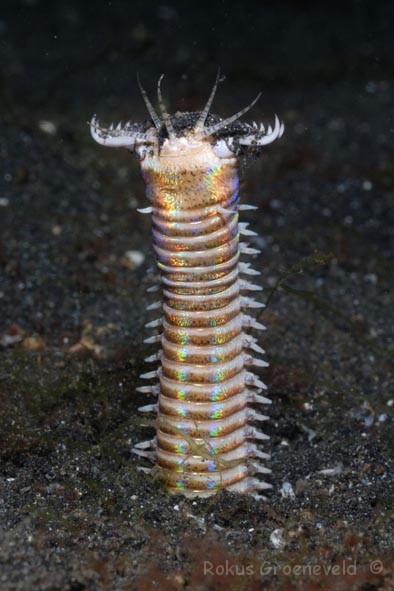
May 6, 2010 : Bobbit Worm
Bobbit Worm
Eunice aphroditois, the Bobbit worm, is an aquatic predatory polychaete worm dwelling at the ocean floor at depths of approximately 10 metres (33 ft) to 40 metres (130 ft).
This organism buries its long body into an ocean bed composed of gravel, mud or corals, where it waits patiently for outside stimulus to reach one of its five antennae.
Armed with sharp teeth, it is known to attack with such speeds that its prey is sometimes sliced in half. Although the worm hunts for food, it is omnivorous.
Wednesday, May 5, 2010
May 5, 2010 : Cookiecutter Shark
Cookiecutter Shark
The name "cookiecutter shark" refers to its feeding habit of gouging round plugs, like a cookie cutter, out of larger animals. Marks made by cookiecutter sharks have been found on a wide variety of marine mammals and fishes, as well as on submarines, undersea cables, and even human bodies. It also consumes whole relatively smaller prey such as squid. Cookiecutter sharks have adaptations for hovering in the water column and likely rely on stealth and subterfuge to capture more active prey. Its dark collar seems to mimic the silhouette of a small fish, while the rest of its body blends into the downwelling light via its ventral photophores. When a would-be predator approaches the lure, the shark attaches itself using its suctorial lips and specialized pharynx and neatly excises a chunk of flesh using its bandsaw-like set of lower teeth. This species has been known to travel in schools.
Tuesday, May 4, 2010
May 4, 2010 : Slingjaw Wrasse
Slingjaw Wrasse
The slingjaw wrasse gets its name from its highly protrusible jaws, which can extend out to over half the fish's total body length. Unlike most other bony fishes, the lower jaw is not firmly attached to the skull. As a result, the slingjaw wrasse can project the upper and lower jaws simultaneously. This anatomical anomaly is employed to snatch shrimps, crabs and small fish out of narrow crevices and from between coral branches.
Monday, May 3, 2010
May 3, 2010 : Lion's Mane Jellyfish
Lion's Mane Jellyfish
The lion's mane jellyfish (Cyanea capillata) is the largest known species of jellyfish. Its range is confined to cold, boreal waters of the Arctic, northern Atlantic and northern Pacific Oceans, seldom found farther south than 42°N latitude. Similar jellyfish (which may be the same species) are known from the seas off Australia and New Zealand. The Arctic Lion's mane jellyfish is one of the longest known animals; the largest recorded specimen had a bell (body) with a diameter of 2.3 m (7 feet 6 inches) and tentacles 36.5 m (120 feet) long. It was found washed up on the shore of Massachusetts Bay in 1870. This specimen was longer than a blue whale, generally regarded as the largest animal on earth.
Sunday, May 2, 2010
May 2, 2010 : Japanese Spider Crab
Japanese Spider Crab
The Japanese spider crab has the greatest leg span of any arthropod, reaching 3.8 metres (12 ft 6 in) from claw to claw. The body may grow to a size of 40 centimetres or 16 in (carapace width) and the whole crab can weigh up to 41 pounds (19 kg). It is the males which have the longest chelipeds; females have much shorter chelipeds, which are shorter than the following pair of legs. Apart from its outstanding size, the Japanese spider crab differs from other crabs in a number of ways. The first pleopods of males are unusually twisted, and its larvae appear primitive. The crab is orange, with white spots along the legs. It is reported to have a gentle disposition "in spite of its ferocious appearance".
Saturday, May 1, 2010
May 1, 2010 : Symbion pandora
In the eastern Atlantic Ocean – on the mouthparts of Norway lobsters (also known as Dublin Bay prawns or langoustines)
There's no question that discovering a new species is very cool. But how about discovering a new phylum?
A phylum is a broad division in taxonomy: all vertebrates, for example, from fish to humans, are in the chordate phylum. In 1995, Peter Funch and Reinhardt Møbjerg Kristensen, both then at the University of Copenhagen, Denmark, discovered an animal so unlike any other that a new phylum – Cycliophora – had to be created just for it.
Symbion pandora, as they called the new creature, is a tiny animal with a complex body and a bizarre life cycle. It still baffles biologists 15 years after it was formally described, and the latest work on its nervous system isn't helping matters.
Subscribe to:
Posts (Atom)