So you've certainly noticed by now that I haven't posted anything in nearly a year. That's probably because I've completely forgotten about these blogs.
I should have posted a note like this earlier, but I kept putting it off. I'm no longer updating the blogs. I won't be even in the foreseeable future.
I will however leave the blogs as they are. The links all still work and the navigation bar on the right side still links between the blogs. It'll be open for however long Blogger keeps it up, and available for you all to read.
I may come back to it. I may not. I did enjoy doing it for a while, but then it started to feel like a second job and drained the fun out of it.
Enjoy yourselves and thanks for reading.

Sunday, June 10, 2012


Sunday, August 28, 2011
August 28, 2011 : Ambergris

Ambergris occurs as a biliary secretion of the intestines of the sperm whale and can be found floating upon the sea, or in the sand near the coast. It is also sometimes found in the abdomens of whales. Because the beaks of giant squids have been found embedded within lumps of ambergris, scientists have theorized that the substance is produced by the whale's gastrointestinal tract to ease the passage of hard, sharp objects that the whale might have eaten.
Ambergris is found in lumps of various shapes and sizes, weighing from 15 g (½ oz) to 50 kg (100 pounds) or more. When initially expelled by or removed from the whale, the fatty precursor of ambergris is pale white in color (sometimes streaked with black), soft, with a strong fecal smell. Following months to years of photo-degradation and oxidation in the ocean, this precursor gradually hardens, developing a dark gray or black color, a crusty and waxy texture, and a peculiar odor that is at once sweet, earthy, marine, and animalic. Its smell has been generally described as a vastly richer and smoother version of isopropanol without its stinging harshness.
Ambergris has been mostly known for its use in creating perfume and fragrance much like musk. While perfumes can still be found with ambergris around the world, American perfumers usually avoid it because of legal ambiguities. It was banned from use in many countries in the 1970s, including the United States, because its precursor originates from the sperm whale, which is an endangered species. However, it has been legal since 2005 because of strict monitoring of distributors who ensure that only ambergris that has been naturally washed to shore is sold. Ancient Egyptians burned ambergris as incense, while in modern Egypt ambergris is used for scenting cigarettes. The ancient Chinese called the substance "dragon's spittle fragrance". During the Black Death in Europe, people believed that carrying a ball of ambergris could help prevent them from getting the plague. This was because the fragrance covered the smell of the air which was believed to be the cause of plague.
This substance has also been used historically as a flavouring for food, and some people consider it an aphrodisiac. During the Middle Ages, Europeans used ambergris as a medication for headaches, colds, epilepsy, and other ailments.
Source
Sunday, August 21, 2011
August 21, 2011 : Jellyfish Lake

Jellyfish Lake is a marine lake located on Eil Malk island in Palau. Eil Malk is part of the Rock Islands, a group of small, rocky, mostly uninhabited islands in Palau's Southern Lagoon, between Koror and Peleliu. There are about 70 other marine lakes located throughout the Rock Islands. Jellyfish Lake is one of Palau's most famous dive (snorkeling only) sites. It is notable for the millions of golden jellyfish which migrate horizontally across the lake daily.
Jellyfish Lake is connected to the ocean through fissures and tunnels in the limestone of ancient Miocene reef. However the lake is sufficiently isolated and the conditions are different enough that the diversity of species in the lake is greatly reduced from the nearby lagoon. The golden jellyfish, Mastigias cf. papua etpisoni, and possibly other species in the lake have evolved to be substantially different from their close relatives living in the nearby lagoons.
Snorkeling in Jellyfish Lake is a popular activity for tourists to Palau. Several tour operators in Koror offer trips to the lake. Eil Malk island is approximately a 45 minute boat ride from Koror. The lake is accessed by a short trail from the beach on Eil Malk to the lake.
Although both species of jellyfish living in the lake have stinging cells (nematocytes), they are not in general powerful enough to cause harm to humans. It has been reported that it is possible to notice the stings on sensitive areas like the area around the mouth. The Fish n' Fins tour guide recommended that people with allergies to jellyfish consider wearing protective clothing.
Source
Sunday, August 14, 2011
August 14, 2011 : Bobtail Squid

Bobtail squid (order Sepiolida) are a group of cephalopods closely related to cuttlefish. Bobtail squid tend to have a rounder mantle than cuttlefish and have no cuttlebone. They have eight suckered arms and two tentacles and are generally quite small (typical male mantle length being between 1 and 8 cm). Sepiolids live in shallow coastal waters of the Pacific Ocean and some parts of the Indian Ocean as well as in shallow waters on the west coast of the Cape Peninsula off South Africa. Like cuttlefish, they can swim by either using the fins on their mantle or by jet propulsion. They are also known as dumpling squid (owing to their rounded mantle) or stubby squid.
Bobtail squid have a symbiotic relationship with bioluminescent bacteria (Vibrio fischeri), which inhabit a special light organ in the squid's mantle. The bacteria are fed a sugar and amino acid solution by the squid and in return hide the squid's silhouette when viewed from below by matching the amount of light hitting the top of the mantle. The organ contains filters which may alter the wavelength of luminescence closer to that of downwelling moonlight and starlight; a lens with biochemical similarities to the squid's eye to diffuse the bacterial luminescence; and a reflector which directs the light ventrally.
Source
Sunday, August 7, 2011
August 7, 2011 : Halomonas titanicae

Halomonas titanicae
Scientists at Dalhousie University in Halifax, Canada, collected samples of the R.M.S. Titanic's icicle-like rust formations, called rusticles, in 1991.
Although the formations were teaming with life, nobody had identified the specific microbes on the ship, instead grouping them into broad categories such as bacteria or fungi.
So Henrietta Mann and then graduate student Bhavleen Kaur, now of the Ontario Science Centre, decided to isolate and identify one species of bacteria from the mess of microscopic life-forms.
The one they chose turned out to be a new species, which the pair dubbed Halomonas titanicae. The bacteria is part of a family that had never been seen before in waters as deep as those in which the Titanic sits, about 2.4 miles (3.8 kilometers) below the surface, Kaur said.
Sunday, July 10, 2011
Spoke Too Soon

I'll be on hiatus for a few weeks, with good reason. I feel I've earned a break from the blog and most importantly, there's something big coming down the line.
It's obviously been longer than a few weeks, hasn't it?
I apologize for having gone MIA. I've been meaning to return to blogging now for a while, but my heart hasn't been in it. However, I'm looking to return to posting soon.
There's going to be a few changes to the format. I will begin to operate the blog with weekly posts. I will no longer continue Strange Waters as a post-a-day blog. That required too much effort to pull off by myself. There's an even better reason for this, but it would spoil the surprise if I told it here.
Strange Waters will receive new updates soon, and I hope you all continue reading.
Saturday, April 16, 2011
The Story of Strange Waters

In early April of 2010, I was laid off from work having finished a large project I was specifically brought on to do. There wasn't enough work to keep me around once the project wrapped up, and so the company and I split amicably.
Finding myself unemployed, I took a week off for myself to prepare of another exhausting job search. This time however I knew I needed a side project to keep me occupied during the day, and so I tried my hand at blogging. My first attempt lasted a week, and within the first few days of it my husband questioned the point of that first blog, and I had agreed with him it was pointless. However through our conversations online (long-distance at the moment due to finances) I would start to develop the idea behind a new blog, and so this site was born.
I quickly shuttered that initial blog and started fresh, registering the new blog under the name I Hate The Ocean (hence the URL). The name itself was an outlandish statement that came from these conversations in which we would link each other bizarre images and articles, mostly about animal life.
And so the blog started up and I planned for it to run until I found another job. And so in late August of 2010, I was brought back into the same company as before, but offered full-time employment and new responsibilities, heading up a new service we would be offering to our clients. This left me with the question of what to do with the blog. Should I abandon it, or continue it?
And so a new goal was established – to make a blog post everyday for an entire calendar year. And so the blog would get a facelift with that new goal, and would come to be known as Strange Waters.
And here we are, a little over a year since the first post. I do hope to continue posting on the blog, just not everyday. I hope to settle into a more regular schedule, posting one day a week around the same time every week. I do not plan on doing any more post-a-day blogs in the near future, just because they are so much work to maintain by one person.
And that's the story of Strange Waters. One year done and I've only run into one spammer. Not bad at all.
Monday, April 11, 2011
Thank You Everyone

One year. That's how long I've been doing this blog. One post, everyday, for an entire year. And I've completed it. I feel truly good about myself for having worked on something of this level.
I have been surprised by the number of people that have read this blog. Strange Waters has been viewed over 65,000 times, and all that without advertising the blog itself! Most of all I'm surprised at myself, for having stuck with this until the 365th post.
However, Strange Waters isn't done yet. I'll be on hiatus for a few weeks, with good reason. I feel I've earned a break from the blog and most importantly, there's something big coming down the line.
To those new to the blog, now is a good chance to catch up on the past year. You'll be surprised at what's been posted up here, and even further surprised at what exists out there in the world.
Again, thank you everyone for reading, and I hope you'll stick with me.
Sincerely, Bowser.
Sunday, April 10, 2011
April 10, 2011 : Great White Shark

Great White Shark
The great white shark, Carcharodon carcharias, also known as great white, white pointer, white shark, or white death, is a large lamniform shark found in coastal surface waters in all major oceans. The great white shark is very well known for its size, with the largest individuals known to have approached or exceeded 6 metres (20 ft) in length and 2,268 kilograms (5,000 lb) in weight. It reaches maturity at around 15 years of age and can have a life span of over 30 years. The great white shark is arguably the world's largest known extant macropredatory fish and is one of the primary predators of marine mammals. It is also known to prey upon a variety of other marine animals including fish, pinnipeds, and seabirds. It is the only known surviving species of its genus, Carcharodon.
The best selling novel Jaws and the subsequent blockbuster film by Steven Spielberg depicted the great white shark as a "ferocious man eater". In reality, humans are not the preferred prey of the great white shark. The IUCN treats the great white shark as vulnerable, while it is included in Appendix II of CITES.
Carolus Linnaeus gave the great white shark its first scientific name, Squalus carcharias in 1758. Sir Andrew Smith gave it the generic name Carcharodon in 1833, and in 1873 the generic name was identified with Linnaeus' specific name and the current scientific name Carcharodon carcharias was finalised.
Carcharodon comes from the Greek words karcharos, which means sharp or jagged, and odous, which means tooth.
Great white sharks live in almost all coastal and offshore waters which have water temperature between 12 and 24 °C (54 and 75 °F), with greater concentrations in the United States (Atlantic Northeast and California), South Africa, Japan, Australia (especially New South Wales and South Australia), New Zealand, Chile, and the Mediterranean. One of the densest known populations is found around Dyer Island, South Africa where much shark research is conducted.
It is an epipelagic fish, observed mostly in inland tributaries in the presence of rich game like fur seals, sea lions, cetaceans, other sharks, and large bony fish species. It is an open-ocean dweller and has been recorded at depths of around 1,220 m (4,000 ft). These findings challenge the traditional notion about the great white as being a coastal species.
Saturday, April 9, 2011
April 9, 2011 : Scaly-foot Gastropod

Scaly-foot Gastropod
Crysomallon squamiferum, common name the scaly-foot gastropod, is a species of deep sea hydrothermal vent snail, a marine gastropod mollusk in the family Peltospiridae.
This species was discovered in 2001 on the bases of black smokers at the Kairei hydrothermal vent field, on the Central Indian Ridge, just north of the Rodrigues Triple Point and about 2,420 metres (7,940 ft) below the surface.
The snail's foot is armored with iron-mineral scales. It is protected by scale-shaped sclerites composed of the iron sulfides greigite and pyrite. No other animal is known to use iron sulfides in this way.
The snail's shell is unusual in that its structure is composed of three layers. The outer layer is made of the aforementioned iron sulfides, containing greigite Fe3S4 about 30 μm thick. This makes this gastropod the only metazoan, known so far, to employ this material in its skeleton. The middle layer is organic, and is also the thickest of the three (about 150 μm). It is comparable to the periostracum, a thin protein coating found on other snail shells. The innermost layer is made of aragonite, a calcium mineral that is found in the shells of mollusks and various corals.
Each layer contributes to the effectiveness of the snail's shell in different ways. The middle organic layer appears to absorb the mechanical strain and energy generated by a squeezing attack (as by the claws of a crab), making the shell much tougher. The organic layer also acts to dissipate heat.
The United States military is currently funding research on the armor of the snail in hopes of developing insights into new military armor designs.
Friday, April 8, 2011
April 8, 2011 : Shark Dart

Shark Dart
The Farallon Shark Dart, a U.S. Navy weapon from the 1970s. The most common version resembles a slim dagger, with a CO2 cartridge in the handle and a long hollow needle for a blade. The idea was to stab the shark, causing the CO2 to be released into its body. The idea was that this would not kill it but would affect its buoyancy, forcing it to break off the attack without leaving much blood in the water. The reality may have been more gruesome.
"I saw some footage on it, it was horrible," says a diver describing the effects here. "Their bellies would inflate and they said it would force the shark’s stomach out of their mouths."
As well as the dagger, there was also a lance-like shark dart on a pole, and even a projectile version – a spear gun which fired a Shark Dart projectile. This seems to have been the inspiration for the shark gun firing ‘compressed air bullets’ used by 007 in Live And Let Die.
According to Tom LaPuzza of the Space and Naval Warfare Systems Center in San Diego, California, the Shark Dart was carried by SEAL divers who protected NASA astronauts after spashdown – but it was never popular, a view I found confirmed by others.
“We never had a history of any of our divers encountering hostile sharks during operational or training missions,” Tom Hawkins of the Naval Special Warfare Foundation told me. “It [the Shark Dart] was just more equipment to carry, when the threat didn’t warrant the extra weight or bulk.”
Farallon gave up making their Shark Dart long ago, though they still supply Special Forces with hi-tech gadgets such as Diver Propulsion Vehicles (DPVs).
Thursday, April 7, 2011
April 7, 2011 : Mako Shark

Mako Shark
The shortfin mako shark, Isurus oxyrinchus ("sharp nose"), is a large mackerel shark. Along with the closely related longfin mako (Isurus paucus) it is commonly referred to as a "mako shark".
In 1809, Constantine Rafinesque first described shortfin mako and coined the name Isurus oxyrinchus (IsurusMāori language, meaning either the shark or a shark tooth. It may have originated in a dialectal variation as it is similar to the common words for shark in a number of Polynesian languages— means "the same tail", oxyrinchus means "pointy snout"). "Mako" comes from the makō in the Kāi Tahu Māori dialect, mangō in other Māori dialects, "mago" in Samoan, ma'o in Tahitian, and mano in Hawaiian. The first written usage is in LeeKendall's & Grammar and vocabulary of the language of New Zealand (1820), which simply states "Máko; A certain fish". Richard Taylor's A leaf from the natural history of New Zealand (1848) is more elaborate: "Mako, the shark which has the tooth so highly prized by the Maoris".
The shortfin mako inhabits offshore temperate and tropical seas worldwide. The closely related longfin mako shark, Isurus paucus, is found in the Gulf Stream or warmer offshore waters.
It is a pelagic species that can be found from the surface down to depths of 150 meters (492 ft), normally far from land though occasionally closer to shore, around islands or inlets. One of only four known endothermic sharks, it is seldom found in waters colder than 16 °C (60.8 °F).
In the western Atlantic it can be found from Argentina and the Gulf of Mexico to Browns Bank off of Nova Scotia. In Canadian waters these sharks are neither abundant nor rare. Swordfish are a good indication of shortfin makos as the former is a source of food and prefers similar environmental conditions.
Shortfin makos travel long distances to seek prey or mates. In December 1998, a female tagged off California was captured in the central Pacific by a Japanese research vessel, meaning this fish traveled over 1,725 miles (2,776 km). Another swam 1,322 miles (2,128 km) in 37 days, averaging 36 miles (58 km) a day.
The shortfin mako's speed has been recorded at 50 kilometers per hour (31 mph) with bursts of up to 74 kilometers per hour (46 mph). They can leap approximate 9 meters (30 ft) high or higher in the air. Some scientists suggest that the biochemistry of shortfin mako can swim up to 100 kilometers per hour (62 mph). Scientists are in debate exactly how fast the shortfin mako shark can swim, as well as which particular species are actually the champion ocean swimmers. This high-leaping fish is sought as game worldwide. There are cases when an angry mako jumped into a boat after having been hooked.
Wednesday, April 6, 2011
April 6, 2011 : Opalescent Squid
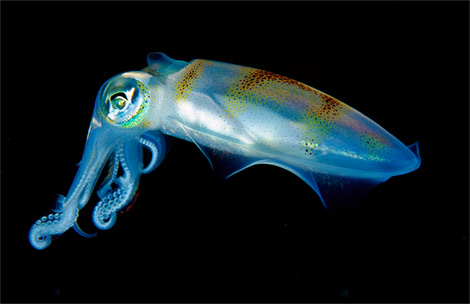
Opalescent Squid
The Opalescent Inshore Squid (Loligo opalescens) is a small squid (mantle length (ML) up to 190 mm) in the family Loliginidae. It is a myopsid squid, which is the near shore group and that means that they have corneas over their eyes. The species lives in the Eastern Pacific Ocean from Mexico's Baja California peninsula to Alaska, USA, within 200 miles (320 kilometers) off shore.
Adult Loligo opalescens can reach a total size of 28 cm. Males are typically larger with a mantle length of 13-19 cm, while females are 12-18 cm in mantle length. The mantle of L. opalescens is not fused to the head and its body is 4 to 5 times longer than it is wide, with fins equal in both length and width. This squid has 8 arms with 2 longer tentacles ending in tentacular clubs equipped with suckers at their ends. The tentacular clubs are narrow with 4 rows of suckers and 2 large rows in the center of the tentacular club bordered by outer rows of smaller suckers. The 8 arms have only 2 rows of alternating suckers running down their length. In male L. opalescens, the left ventral arm is specialized or “hectocotylized” for spermatophore transfer during mating. The eyes of L. opalescens are covered with a non-perforated membrane known as a cornea which is a signature of myopsid squid. The color of L. opalescens can range from white to brown, with the animals able to change their color shades using chromatophores depending on mood and for camouflage. They are normally a bluish-white to mottled brown and gold, and they change to dark red or brown when excited, frightened or feeding.
L. opalescens is a cannibalistic predator that feeds on smaller prey species such as fish, crabs and shrimp, mollusks, and other juvenile squid. It uses its two longer tentacles with tentacular clubs on the end to snare and catch its prey. L. opalescens itself is an important food source for many predators like larger fish, sharks, marine mammals, sea birds, and also humans. Its predators include the Common Seal, California Sea Lion, Blue shark, Chinook salmon, Black-throated Diver, and Brandt's Cormorant.
Tuesday, April 5, 2011
April 5, 2011 : Breaching

Breaching
A breach or a lunge is a leap out of the water also known as cresting. The distinction between the two is fairly arbitrary: cetacean researcher Hal Whitehead chooses to define a breach as any leap in which at least 40% of the animal's body clears the water, and a lunge as a leap with less than 40% clearance. Qualitatively, a breach is a genuine jump with an intent to clear the water, whereas a lunge is the result of a fast upward sloping swim, perhaps as a result of feeding, that has caused the whale to clear the surface of the water unintentionally.
Whales such as Sperm Whales perform a breach by travelling vertically upwards from depth, and heading straight out of the water. Others, such as the Humpback Whale, travel close to the surface and parallel to it, and then jerk upwards at full speed to perform a breach. In a typical breach, as performed by a Humpback or Right Whale, the whale clears the water at an angle of about 30° to the horizontal. Around 90% of the body clears the water before the whale turns to land on its back or side. "Belly flops" also occur but are less common. In order to achieve 90% clearance, a Humpback needs to leave the water at a speed of eight metres per second or 29 km/h. For a 36 ton animal this results in a momentum of 288 thousand newton-seconds.
Breaches are often carried out in series. The longest recorded sustained series was by a Humpback near the West Indies - totaling 130 leaps in less than 90 minutes. Repeated breaches tire the animal, so that less of the body clears the water each time.
The Right, Humpback and Sperm whales are the most prodigious jumpers. However the other baleen whales such as Fin, Blue, Minke and Sei whales also breach. Oceanic dolphins, including the Orca, are very common breachers and are in fact capable of lifting themselves completely out of the water very easily.
Many reasons have been suggested for breaching. Whales are more likely to breach when they are in groups, suggesting social reasons, such as an assertion of dominance, courting or warning of danger. Scientists have called this theory "honest signalling". The immense cloud of bubbles and underwater disturbance following a breach cannot be faked; neighbours then know a breach has taken place. A single breach costs a whale only about 0.075% of its total daily energy intake, but a long series of breaches may add up to a significant energy expenditure.
It is also possible that the loud "smack" upon re-entering is useful for stunning or scaring prey. Noisemaking is believed to be the reason for lobtailing. Others suggest that a breach allows the whale to breathe in air that is not close to the surface, which may aid breathing in rough seas. Another widely accepted possible reason is to dislodge parasites from the skin. While other whale experts think some of the behavior might simply be playful in nature.
Breaching has also been observed in the following sharks and rays: the great white shark, thresher shark, shortfin mako, longfin mako, spinner shark, blacktip reef shark, salmon shark, porbeagle shark, copper shark and basking shark as well as the manta ray.
Monday, April 4, 2011
April 4, 2011 : Swinhoe's Softshell Turtle
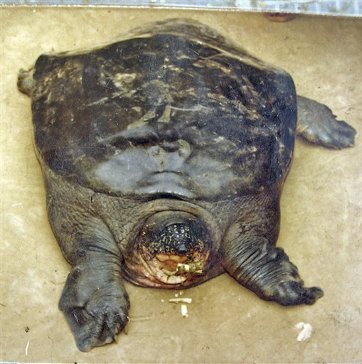
Swinhoe's Softshell Turtle
Rafetus swinhoei, commonly known as the Red river giant softshell turtle, Shanghai softshell turtle, Yangtze giant softshell turtle (Chinese: 斑鱉; Pinyin: Bān Bīe; literally "specked softshell turtle"), or Swinhoe's softshell turtle, is a species of softshell turtle. Rafetus leloii is considered a junior synonym of Rafetus swinhoei, a related and much bigger softshell turtle which lives more than 2000 km further south in Vietnam. It is listed as critically endangered in the IUCN Red List 2006, and is one of the rarest turtles in the world. There are only four known to survive in Vietnam and China: one each at Hoan Kiem Lake, Hanoi and Dong Anh, Hanoi, Vietnam, an 80-year-old female in Changsha Zoo and a 100-year-old male in Suzhou Zoo.
Rafetus swinhoei have been known to inhabit the Yangtze River and Lake Taihu, situated on the border of Jiangsu and Zhejiang provinces, in eastern China; Gejiu, Yuanyang, Jianshui and Honghe in Yunnan province in southern China; . The last known specimen caught in the wild in China was in 1998 in the Red River between Yuanyang and Jianshui ; that turtle was then released. There are only four known living specimens in Vietnam and China, one each at Hoan Kiem Lake, Hanoi, Dong Anh Hanoi, Vietnam and Suzhou, Changsha Zoos, China.
A specimen at the Beijing Zoo died in 2005, and another one at the Shanghai Zoo died in 2006; both of them were caught at Gejiu in the 1970s.
Coordinated by the Wildlife Conservation Society and the Turtle Survival Alliance, the still reproductive, more than 80-year-old female living in the Changsha Zoo was introduced to the only known male in China, a more than 100-year-old individual living more than 600 miles away at the Suzhou Zoo, on May 5, 2008. The female has arrived safely and settled in well into her new habitat at the Suzhou Zoo, and biologists were optimistic for breeding success.
Rafetus swinhoei is on the brink of extinction due to habitat loss, hunting for subsistence and local consumption, and the use of the carapace and bones in medicine. Skulls are often kept as trophies. A recent plan to build hydropower cascade of 12 dams on the Red River in China may flood all of its habitat and change the ecosystem of lower Vietnam.
In 1999, 2000, and 2005 turtles have reemerged from Hoan Kiem Lake on special occasions, when it was seen by a large audience and caught on film. It is believed that there is only a single turtle left in the lake. In April 2011, it was captured because it had open sores that needed to be treated.
Sunday, April 3, 2011
April 3, 2011 : Bearded Fireworm

Bearded Fireworm
The bearded fireworm, Hermodice carunculata, is a type of marine bristleworm.
Bearded fireworms are usually between 5–10 centimetres (1.9–3.9 in) in length, but can reach up to 35 centimetres (13.8 in). They are endowed with a group of poisonous white bristles on each side, which are flared out when the worm is disturbed. It is considered by marine biologists as a particularly beautiful and colourful species, though swimmers wisely tend to avoid them due to their appearance.
The bearded fireworm is usually found on reefs, under stones in rocky areas of the sea, and on some mud bottoms. Sometimes, they can be found to be hidden on moss-covered rocks.
It is encountered throughout the tropical western Atlantic and at Ascension Island in mid-Atlantic. It can be found near ocean reefs and at depths of up to 150m. These worms are also common in the mediterranean sea, in the coastal waters surrounding Cyprus and the Maltese archipelago.
The bearded fireworm is a slow creature, and is not considered a threat to humans unless touched by a careless swimmer. The bristles, when flared, can penetrate human skin, injecting a powerful neurotoxin and producing intense irritation and a painful burning sensation around the area of contact. The sting can also lead to nausea and dizziness. This sensation lasts up to a few hours, but a painful tingling can continue to be felt around the area of contact. In a case of accidental contact, application and removal of adhesive tape will help remove the spines; applying alcohol to the area will also help alleviate the pain.
Saturday, April 2, 2011
April 2, 2011 : Humpback Whale

Humpback Whale
The humpback whale (Megaptera novaeangliae) is a species of baleen whale. One of the larger rorqual species, adults range in length from 12–16 metres (39–52 ft) and weigh approximately 36,000 kilograms (79,000 lb). The humpback has a distinctive body shape, with unusually long pectoral fins and a knobbly head. It is an acrobatic animal, often breaching and slapping the water. Males produce a complex whale song, which lasts for 10 to 20 minutes and is repeated for hours at a time. The purpose of the song is not yet clear, although it appears to have a role in mating.
Found in oceans and seas around the world, humpback whales typically migrate up to 25,000 kilometres (16,000 mi) each year. Humpbacks feed only in summer, in polar waters, and migrate to tropical or sub-tropical waters to breed and give birth in the winter. During the winter, humpbacks fast and live off their fat reserves. The species' diet consists mostly of krill and small fish. Humpbacks have a diverse repertoire of feeding methods, including the bubble net feeding technique.
Like other large whales, the humpback was and is a target for the whaling industry. Due to over-hunting, its population fell by an estimated 90% before a whaling moratorium was introduced in 1966. Stocks have since partially recovered; however, entanglement in fishing gear, collisions with ships, and noise pollution also remain concerns. There are at least 80,000 humpback whales worldwide. Once hunted to the brink of extinction, humpbacks are now sought by whale-watchers, particularly off parts of Australia, New Zealand, South America, Canada, and the United States.
Humpback whales are rorquals (family Balaenopteridae), a family that includes the blue whale, the fin whale, the Bryde's whale, the sei whale and the minke whale. The rorquals are believed to have diverged from the other families of the suborder Mysticeti as long ago as the middle Miocene. However, it is not known when the members of these families diverged from each other.
Though clearly related to the giant whales of the genus Balaenoptera, the humpback has been the sole member of its genus since Gray's work in 1846. More recently though, DNA sequencing analysis has indicated the Humpback is more closely related to the gray whale (Eschrichtius robustus) and to certain rorquals, such as the fin whale (Balaenoptera physalus) than it is to other rorquals such as the minke whales. If further research confirms these relationships, it will be necessary to reclassify the rorquals.
Friday, April 1, 2011
April 1, 2011 : Fata Morgana

Fata Morgana
A Fata Morgana is an unusual and very complex form of mirage, a form of superior mirage, which, like many other kinds of superior mirages, is seen in a narrow band right above the horizon. It is an Italian phrase derived from the vulgar Latin for "fairy" and the Arthurian sorcerer Morgan le Fay, from a belief that the mirage, often seen in the Strait of Messina, were fairy castles in the air or false land designed to lure sailors to their death created by her witchcraft. Although the term Fata Morgana is sometimes incorrectly applied to other, more common kinds of mirages, the true Fata Morgana is not the same as an ordinary superior mirage, and is certainly not the same as an inferior mirage.
Fata Morgana mirages tremendously distort the object or objects which they are based on, such that the object often appears to be very unusual, and may even be transformed in such a way that it is completely unrecognizable. A Fata Morgana can be seen on land or at sea, in polar regions or in deserts. This kind of mirage can involve almost any kind of distant object, including such things as boats, islands, and coastline, as shown in the photographs which accompany this article.
A Fata Morgana is not only complex, but also rapidly changing. The mirage comprises several inverted (upside down) and erect (right side up) images that are stacked on top of one another. Fata Morgana mirages also show alternating compressed and stretched zones.
This optical phenomenon occurs because rays of light are strongly bent when they pass through air layers of different temperatures in a steep thermal inversion where an atmospheric duct has formed. (A thermal inversion is an atmospheric condition where warmer air exists in a well-defined layer above a layer of significantly cooler air. This temperature inversion is the opposite of what is normally the case; air is usually warmer close to the surface, and cooler higher up.)
In calm weather, a layer of significantly warmer air can rest over colder dense air, forming an atmospheric duct which acts like a refracting lens, producing a series of both inverted and erect images. A Fata Morgana requires a duct to be present; thermal inversion alone is not enough to produce this kind of mirage. While a thermal inversion often takes place without there being an atmospheric duct, an atmospheric duct cannot exist without there first being a thermal inversion.
Thursday, March 31, 2011
March 31, 2011 : Arctic Circle
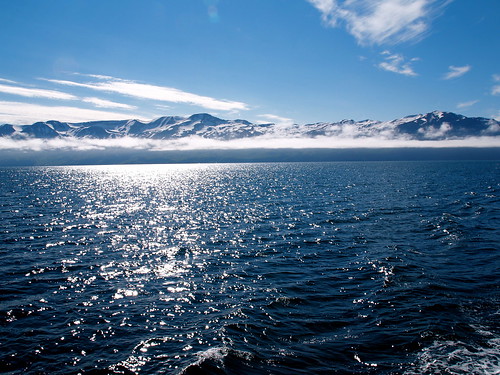
Arctic Circle
The Arctic Circle is one of the five major circles of latitude that mark maps of the Earth. For Epoch 2011, it is the parallel of latitude that runs 66° 33′ 44″ (or 66.5622°) north of the Equator.
The region north of this circle is known as the Arctic, and the zone just to the south is called the Northern Temperate Zone. The equivalent polar circle in the Southern Hemisphere is called the Antarctic Circle.
The Arctic Circle marks the southern extremity of the polar day (24-hour sunlit day, often referred to as the "midnight sun") and polar night (24-hour sunless night). North of the Arctic Circle, the sun is above the horizon for 24 continuous hours at least once per year and below the horizon for 24 continuous hours at least once per year. On the Arctic Circle those events occur, in principle, exactly once per year, at the June and December solstices, respectively.
In fact, because of atmospheric refraction and because the sun appears as a disk and not a point, part of the midnight sun may be seen on the night of the northern summer solstice up to about 50′ (90 km (56 mi)) south of the Arctic Circle; similarly, on the day of the northern winter solstice, part of the sun may be seen up to about 50′ north of the Arctic Circle. That is true at sea level; those limits increase with elevation above sea level although in mountainous regions, there is often no direct view of the horizon.
The position of the Arctic Circle is not fixed, but directly depends on the Earth's axial tilt, which fluctuates within a margin of 2° over a 40,000 year period, notably due to tidal forces resulting from the orbit of the Moon. The Arctic Circle is currently drifting northwards at a speed of about 15 m (49 ft) per year.
Relatively few people live north of the Arctic Circle due to the Arctic climate. The three largest communities above the Arctic Circle are situated in Russia: Murmansk (population 325,100), Norilsk (135,000), and Vorkuta (85,000). Tromsø (in Norway) has about 62,000 inhabitants. In contrast, the largest North American community north of the circle, Barrow, Alaska, has approximately 4,000 inhabitants. Rovaniemi (in Finland), which lies slightly south of the line, has a population of approximately 58,000, and is the largest settlement in the immediate vicinity of the Arctic Circle.
Wednesday, March 30, 2011
March 30, 2011 : False Catshark

False Catshark
The false catshark (Pseudotriakis microdon) is a species of ground shark in the family Pseudotriakidae, and the sole member of its genus. It has been reported from a number of locations worldwide, usually at depths of 200-1,500 meters (660-4,900 ft) on the continental slopes. A large, slow-moving shark, it feeds mostly on bony fishes but also takes elasmobranchs and cephalopods, and scavenges off the sea floor. It is one of the few non-lamnoid sharks known to exhibit intrauterine oophagy, in which the developing embryos feed on eggs ovulated by the mother. This species is of minimal interest to fisheries.
The Pacific populations of the false catshark were formerly regarded as a separate species, Pseudotriakis acrales; Leonard Compagno synonymized the two species in 1984 based on a lack of distinguishing characteristics. The closest living relative of the false catshark is the slender smooth-hound (Gollum attenuatus), and some authors place that species in the Pseudotriakidae.
The false catshark is known from scattered locations worldwide, including New York, New Jersey, Cuba, Brazil, Iceland, France, Portugal, Madeira, the Azores, Senegal, Cape Verde, the Aldabra Islands, Japan, Taiwan, Australia, New Zealand, and Hawaii. It is found near the bottom on continental and insular slopes from 173 to 1,890 meters (570-6,100 ft), but occasionally wanders over the continental shelf into shallower water.
Subscribe to:
Posts (Atom)